
1. Indications and Usage
Non-Small Cell Lung Cancer (NSCLC): Treatment of locally advanced or metastatic NSCLC in patients who have failed at least one prior chemotherapy regimen (primarily platinum-based combination chemotherapy).
2. Dosage and Administration
Route of Administration: Oral administration ONLY.
Recommended Dosage: 125 mg three times daily.
Administration Schedule: Administered on an empty stomach or with food; however, high-fat meals may significantly increase drug absorption.
Critical Administration Instructions:
Swallowing: Tablets must be swallowed whole; do not crush or chew.
Missed Dose: If a dose is missed, take it as soon as remembered unless it is close to the time of the next scheduled dose. Do not double the dose.
Dose Modifications: For mild transaminase elevation (ALT/AST <100 IU/L), continue monitoring; for significant elevation (ALT/AST ≥100 IU/L), withhold administration until recovery.
3. Mechanism of Action
EGFR Inhibition: Icotinib is a selective inhibitor of the epidermal growth factor receptor (EGFR) tyrosine kinase.
Signal Transduction Blockade: It competitively binds to the ATP-binding site of the EGFR tyrosine kinase domain, inhibiting autophosphorylation and downstream signaling pathways.
Antitumor Effect: This blockade prevents tumor cell proliferation and promotes tumor cell apoptosis.
4. Safety and Warnings
Interstitial Lung Disease (ILD): ILD has been reported. Patients must be monitored for new or progressive respiratory symptoms; if confirmed, the drug should be permanently discontinued.
Hepatotoxicity: Elevations in ALT and AST may occur. Liver function tests should be monitored regularly.
Dermatologic Toxicity: Rash and diarrhea are common; they are usually reversible but require clinical management.
Fetal Risk: May cause fetal harm; effective contraception is required during treatment.
5. Adverse Reactions and Clinical Research
Most Common Adverse Reactions: Skin and subcutaneous tissue disorders (rash, pruritus), gastrointestinal disorders (diarrhea, nausea), and liver function abnormalities (elevated ALT/AST).
Common Laboratory Abnormalities: Increased ALT, increased AST, increased bilirubin, leukopenia, and neutropenia.
Clinical Research Highlights: The Phase III ICOGEN trial demonstrated that icotinib was non-inferior to gefitinib in terms of efficacy, with a generally manageable safety profile in patients with EGFR-mutant NSCLC.
6. Drug Interactions
CYP2C19 and CYP3A4 Inhibitors: Icotinib is primarily metabolized by CYP2C19 and CYP3A4. Strong inhibitors of these enzymes may increase icotinib plasma concentrations.
CYP2C19 and CYP3A4 Inducers: Strong inducers of these enzymes may decrease icotinib plasma concentrations.
Drugs Metabolized by CYP2C9 and CYP3A4: Icotinib has inhibitory effects on these enzymes and may increase the plasma concentrations of co-administered drugs metabolized by them.
7. Pharmaceutical Information
Chemical Composition: Active Ingredient: Icotinib Hydrochloride.
Appearance: Reddish-brown film-coated tablets, which appear off-white after stripping the coating.
Packaging: Available in 125 mg strengths.
Storage: Store in a well-closed container, protected from light and moisture.
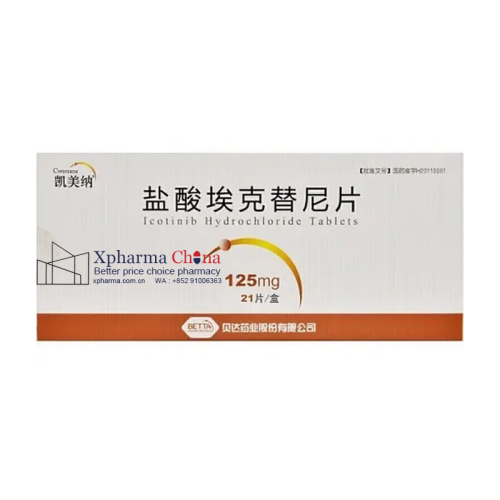
Kaimeina Icotinib Hydrochloride Tablets
Brand Name: 凯美纳 ®(Kaimeina®)
Generic Name: Icotinib Hydrochloride
Strength: 125 mg per tablet, 21 tablets per box
Manufacturer: Betta Pharmaceuticals Co., Ltd.
Marketing Authorization Holder: Betta Pharmaceuticals Co., Ltd.
Approval Date in China: August 12, 2011
Registration Number: 国药准字H20110061
Storage: Store tightly sealed at a temperature not exceeding 30°C, protected from light and moisture. Refer to the full package insert for detailed storage specifications.
Price&Cost:Contact Us now for the best price of Icotinib Hydrochloride(Kaimeina)
Only logged in customers who have purchased this product may leave a review.

Reviews
There are no reviews yet.