- Indications and Usage Hypertension: Indicated for the treatment of hypertension in adults. It can be used as monotherapy or in combination with other antihypertensive agents.
- Dosage and Administration Recommended Dosage: 80 mg taken orally once daily. Alternative Dosage: For patients who require a lower starting dose, 40 mg once daily may be considered. Administration Details: The tablet can be taken with or without food. Renal/Hepatic Impairment: No dosage adjustment is generally required for mild to moderate hepatic impairment. In severe hepatic impairment, caution is advised due to limited clinical data.
- Mechanism of Action AT1 Receptor Antagonism: Azilsartan medoxomil is a prodrug that is rapidly converted to its active metabolite, azilsartan. Azilsartan selectively and reversibly blocks the binding of angiotensin II to the AT1 receptor. Physiological Effect: By inhibiting angiotensin II, it prevents vasoconstriction, aldosterone secretion, and sodium retention, thereby effectively reducing blood pressure.
- Safety and Warnings Fetal Toxicity: Drugs that act on the renin-angiotensin system can cause fetal harm when administered to pregnant women. Use is contraindicated during pregnancy, especially in the second and third trimesters. Hypotension and Renal Impairment: Severe hypotension and acute renal failure (including acute renal failure in patients with bilateral renal artery stenosis) may occur. Hyperkalemia: Serum potassium levels should be monitored, particularly in patients with renal impairment or those taking potassium supplements. Diabetic Patients: Concomitant use with aliskiren is contraindicated in patients with diabetes.
- Adverse Reactions and Clinical Research Most Common Adverse Reactions: The most frequent adverse reactions are generally related to the drug class, including hypotension, dizziness, and fatigue. Clinical Research: Clinical trials have demonstrated that azilsartan medoxomil provides significant and sustained blood pressure reductions compared to other ARBs (e.g., valsartan, olmesartan) and placebo.
- Drug Interactions Aliskiren: Concomitant use with aliskiren is contraindicated in patients with diabetes due to the increased risk of renal impairment, hypotension, and hyperkalemia. NSAIDs: Non-steroidal anti-inflammatory drugs (NSAIDs) may attenuate the antihypertensive effect and increase the risk of renal impairment. Potassium-Sparing Diuretics/Salts: Concurrent use may increase the risk of hyperkalemia. Lithium: Concomitant use may increase serum lithium levels and toxicity; monitoring is required.
- Pharmaceutical Information Chemical Composition: Active ingredient: Azilsartan medoxomil potassium. Appearance: Typically supplied as film-coated tablets (e.g., 40 mg, 80 mg), often pink or beige in color. Packaging: Supplied in blister packs or bottles. Storage: Store at controlled room temperature (20°C to 25°C). Protect from moisture.
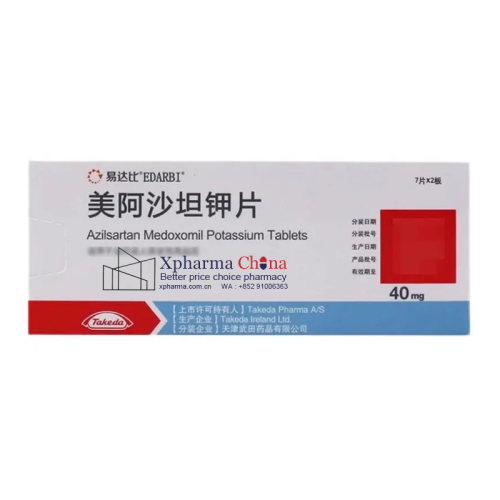
Yidabi Azilsartan Medoxomil Potassium Tablets
Brand Name: EDARBI® (Yidabi® / 易达比 ®)
Generic Name: Azilsartan Medoxomil Potassium Tablets
Strength: 40 mg per tablet, 7 tablets per blister, 2 blisters per box
Manufacturer: Takeda Ireland Ltd. (Production); Tianjin Takeda Pharmaceuticals Co., Ltd. (Packager)
Marketing Authorization Holder: Takeda Pharma A/S
Approval Date in China: January 11, 2021
Registration Number: HJ20210003
Storage: Seal tightly, protect from light, store below 25°C; short-term storage at 15–30°C is permitted. Refer to the full package insert for detailed storage specifications.
Only logged in customers who have purchased this product may leave a review.
Reviews
There are no reviews yet.