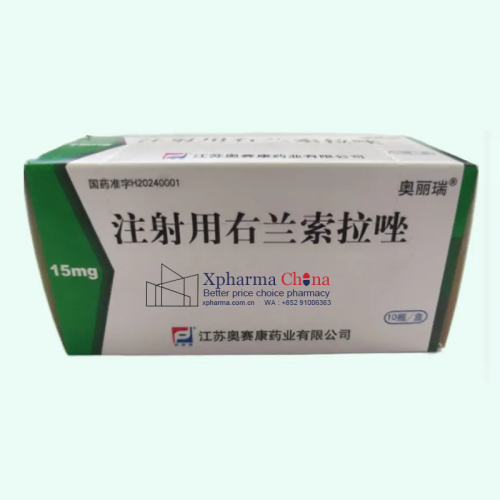
Aolirui Ravilansoprazole for Injection
Brand Name:奥丽瑞 ®(Aolirui®)
Generic Name: Ravilansoprazole
Strength: 15 mg per vial, 10 vials per box
Manufacturer: Jiangsu Aosaikang Pharmaceutical Co., Ltd.
Marketing Authorization Holder: Jiangsu Aosaikang Pharmaceutical Co., Ltd.
Approval Date in China: 2024
Registration Number: 国药准字H20240001
Storage: Seal and store below 25°C, protected from light and moisture. Refer to the full package insert for detailed storage specifications.
Price&Cost:Contact Us now for the best price of Ravilansoprazole(Aolirui)
1. Indications and Usage
Duodenal Ulcer with Bleeding:
Treatment of patients with bleeding duodenal ulcers for those for whom oral therapy is not appropriate .
Gastric Ulcer with Bleeding:
Treatment of patients with bleeding gastric ulcers for those for whom oral therapy is not appropriate .
Other Indications:
May also be used for the treatment of gastroesophageal reflux disease (GERD) and pathological hypersecretory conditions (e.g., Zollinger-Ellison syndrome) when oral administration is not feasible .
2. Dosage and Administration
Route of Administration:
For Intravenous (IV) Infusion ONLY.
Recommended Dosage:
Standard Dose: Typically 30 mg once or twice daily.
Duration: Usually recommended for a limited period (e.g., up to 7 days) until oral therapy can be resumed .
Critical Administration Instructions:
Reconstitution: Dissolve the contents of the vial with 5 mL of Sterile Water for Injection.
Dilution: Further dilute with 100 mL of 0.9% Sodium Chloride Injection (Normal Saline).
Infusion Time: Administer over at least 30 minutes.
Filtration: It is recommended to use a 1.2 µm filter during administration to remove potential precipitates.
3. Mechanism of Action
Proton Pump Inhibition:
Lansoprazole is a proton pump inhibitor (PPI). It is a weak base that accumulates in the acidic environment of the parietal cells of the stomach.
Irreversible Suppression:
It is converted to its active form (sulfenamide) in the acidic canaliculi, where it binds covalently to the H+/K+-ATPase enzyme (proton pump) on the basolateral membrane.
Therapeutic Result: This irreversibly inhibits the final step of gastric acid production, suppressing both basal and stimulated acid secretion .
4. Safety and Warnings
Cutaneous and Systemic Lupus Erythematosus:
PPI therapy may increase the risk of developing lupus erythematosus.
Acute Interstitial Nephritis:
Observed in patients taking PPIs. Discontinue if this occurs.
Hypomagnesemia:
Hypomagnesemia, hypocalcemia, and hypokalemia have been reported rarely in patients treated for at least three months.
Vitamin B12 Deficiency:
Long-term use (more than 3 years) may lead to malabsorption of Vitamin B12.
Contraindications:
Hypersensitivity to lansoprazole or any component of the formulation .
Co-administration with rilpivirine-containing products .
5.Adverse Reactions and Clinical Research
Most Common Adverse Reactions:
Headache, dizziness, diarrhea, nausea, abdominal pain, and injection site reactions (pain, inflammation) .
Serious Adverse Events:
Severe skin reactions (e.g., Stevens-Johnson syndrome), anaphylaxis, and hepatic dysfunction.
6.Drug Interactions
CYP2C19 Substrates/Inhibitors:
Lansoprazole is metabolized by CYP2C19 and CYP3A4. Caution is advised when co-administering with drugs that inhibit or are metabolized by these enzymes (e.g., diazepam, phenytoin).
Antiretrovirals:
May interact with atazanavir and rilpivirine due to pH-dependent solubility.
7.Pharmaceutical Information
Chemical Composition:
Active Ingredient: Lansoprazole.
Appearance: White to off-white lyophilized powder.
Packaging: Single-use vial (30 mg).
Storage: Store at controlled room temperature.
Only logged in customers who have purchased this product may leave a review.
Reviews
There are no reviews yet.