
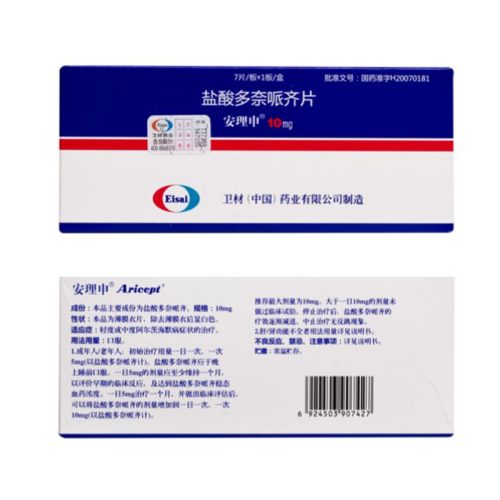
Aricept Donepezil Hydrochloride Tablets
Brand Name: 安理申® (Aricept®)
Generic Name: Donepezil Hydrochloride
Strength: 10 mg per tablet, 7 tablets per box
Manufacturer: Eisai (China) Pharmaceutical Co., Ltd.
Marketing Authorization Holder: Eisai Inc.
Approval Date in China: 2007
Registration Number: 国药准字 H20070181
Storage: Store at room temperature, sealed away from light and moisture, keep out of reach of children
Price&Cost:Contact Us now for the best price of Donepezil Hydrochloride(Aricept)
1. Indications and Usage
Alzheimer’s Disease:
Indicated for the treatment of dementia of the Alzheimer’s type.
Usage Context:
Efficacy has been demonstrated in patients with mild, moderate, and severe dementia of the Alzheimer’s type.
2. Dosage and Administration
Recommended Dosage:
Initial Dosage: 5 mg orally once daily.
Maintenance Dosage: The recommended maintenance dose is 5 mg or 10 mg once daily. Doses higher than 10 mg/day have not been studied in clinical trials.
Note: Dosage increases should generally be made only after a minimum of 4 weeks on the previous dose to allow for steady-state concentration.
Administration Instructions:
Administer orally at bedtime.
Administer with or without food.
3. Mechanism of Action
Acetylcholinesterase Inhibitor:
Donepezil is a reversible inhibitor of the enzyme acetylcholinesterase.
Physiological Effect:
It prevents the degradation of acetylcholine (ACh), thereby increasing the concentration of ACh in the cerebral cortex and hippocampus. This enhancement of cholinergic neurotransmission is believed to improve cognitive function in patients with Alzheimer’s disease.
4. Safety and Warnings
Gastrointestinal Bleeding:
Cholinesterase inhibitors can increase gastric acid secretion. Patients with a history of ulcer disease or those taking NSAIDs should be monitored for signs of GI bleeding.
Cardiac Effects (Bradycardia and Heart Block):
Due to their cholinomimetic action, cholinesterase inhibitors may have vagotonic effects on heart rate (e.g., sinus bradycardia) and can cause heart blocks. Use with caution in patients with “sick sinus syndrome” or other supraventricular cardiac conduction conditions.
Pulmonary Disease:
Use with caution in patients with a history of asthma or obstructive pulmonary disease.
Genitourinary Obstruction:
Although not observed in clinical trials, cholinomimetics are assumed to have some potential to cause bladder outflow obstruction.
Neuromuscular Disorders:
Cholinesterase inhibitors are assumed to significantly exaggerate the muscle relaxation caused by succinylcholine-type muscle relaxants during anesthesia.
5. Adverse Reactions
Most Common:
Diarrhea, nausea, vomiting, fatigue, insomnia, muscle cramps, anorexia, and headache.
6. Drug Interactions
CYP450 Inhibitors:
CYP2D6 and CYP3A4 Inhibitors: Ketoconazole and quinidine inhibit the metabolism of donepezil, increasing its plasma concentration.
CYP450 Inducers:
Rifampicin, Phenytoin, Carbamazepine: These agents induce CYP enzymes and may decrease the plasma concentration of donepezil.
Anticholinergics:
Cholinesterase inhibitors and anticholinergic medications may have antagonistic effects.
Succinylcholine:
Cholinesterase inhibitors may prolong muscle relaxation during anesthesia.
7. Pharmaceutical Information
Chemical Name:
(±)-2,3-Dihydro-5,6-dimethoxy-2-{[(1-methyl-4-pyridinyl)methyl]formyl}-1H-inden-1-one hydrochloride.
Storage:
Store at 25°C (77°F); excursions permitted to 15-30°C (59-86°F).
Only logged in customers who have purchased this product may leave a review.



Reviews
There are no reviews yet.