Ayvakit Avapritinib Tablets
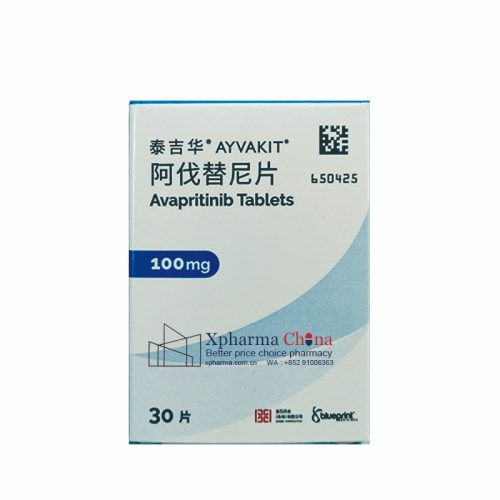
Brand Name: 泰吉华 ®(Ayvakit ®)
Generic Name: Avapritinib
Strength: 100mg per tablet, 30 tablets per box
Manufacturer: Blueprint Medicines Corporation (Original Manufacturer) / CStone Pharmaceuticals (Suzhou) Co., Ltd.(Domestic Manufacturer)
Marketing Authorization Holder: CStone Pharmaceuticals (Suzhou) Co., Ltd.
Approval Date in China: March 30, 2021
Registration Number: 国药准字 HJ20210019
Storage: Store in a tightly closed container at a temperature not exceeding 25℃, protect from light and moisture, keep out of reach of children
Price&Cost:Contact Us now for the best price of Avapritinib (Ayvakit)
1. Indications and Usage
Gastrointestinal Stromal Tumor (GIST):
Indicated for the treatment of adult patients with unresectable or metastatic GIST harboring a PDGFRA exon 18 mutation, including PDGFRA D842V mutation .
Systemic Mastocytosis (SM):
Indicated for the treatment of adult patients with advanced systemic mastocytosis (AdvSM) (including aggressive SM, SM with associated hematologic neoplasm, and mast cell leukemia) .
2. Dosage and Administration
Route of Administration:
For Oral Use ONLY.
Recommended Dosage:
GIST: 300 mg once daily.
AdvSM: Starting dose is typically 27.5 mg once weekly or 100 mg once weekly, depending on baseline platelet count and specific protocol .
Administration Instructions:
Administer orally with or without food.
Do not crush or chew the tablets; swallow whole .
Missed Dose:
If a dose is missed, it should be taken as soon as possible unless it is less than 48 hours before the next scheduled dose (for weekly dosing) or 12 hours (for daily dosing). In that case, skip the missed dose .
3. Mechanism of Action
Type I Kinase Inhibitor:
Avapritinib is a potent and selective Type I inhibitor of KIT and PDGFRA. It binds to the kinases in their active conformation .
Target Specificity:
It specifically targets mutant forms such as PDGFRA D842V (which is resistant to imatinib) and KIT D816V, inhibiting tumor cell growth and proliferation .
4. Safety and Warnings
Intracranial Hemorrhage:
Can cause intracranial hemorrhage (e.g., subdural hematoma). Risk factors include thrombocytopenia or use of anticoagulants. Discontinue permanently if intracranial hemorrhage occurs .
Cognitive Impairment:
Neuropsychiatric effects, including memory impairment and confusion, can occur. Monitor patients regularly .
Fluid Retention (Edema):
Peripheral and facial edema are common. Monitor for signs of fluid overload .
Embryo-Fetal Toxicity:
Can cause fetal harm. Effective contraception is required during treatment .
5. Adverse Reactions
Most Common:
Hematologic: Anemia (39%).
Dermatologic: Periorbital edema (33%), facial edema (27%), peripheral edema (23%).
Gastrointestinal: Nausea (45%), diarrhea (26%), vomiting (24%), decreased appetite (21%).
CNS: Fatigue (40%), memory impairment (20%) .
6. Drug Interactions
Metabolic Pathway:
Avapritinib is primarily metabolized by CYP3A4.
Strong/Moderate CYP3A4 Inhibitors (e.g., Itraconazole, Clarithromycin): Avoid co-administration. If unavoidable, reduce the avapritinib dose .
Strong CYP3A4 Inducers (e.g., Rifampin): Avoid co-administration as they significantly decrease avapritinib exposure .
7. Pharmaceutical Information
Chemical Composition:
Active Ingredient: Avapritinib.
Appearance: Film-coated tablets available in strengths of 25 mg, 50 mg, 100 mg, 200 mg, and 300 mg .
Storage: Store at 20°C–25°C (68°F–77°F) .
Only logged in customers who have purchased this product may leave a review.
Reviews
There are no reviews yet.