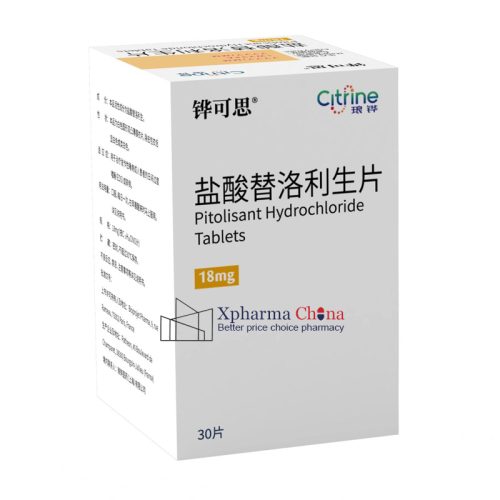
Citrine Pitolisant Hydrochloride Tablets
Brand Name:铧可思 ®(Citrine®)
Generic Name: Pitolisant Hydrochloride
Strength: 18 mg per tablet, 30 tablets per box
Manufacturer: Bioprojet Pharma, France
Marketing Authorization Holder: Bioprojet Pharma SARL
Domestic Import & Promotion Entity: RareStone (Citrine) Pharmaceutical (Shanghai) Co., Ltd. (琅铧医药)
Approval Date in China: June 30, 2023
Registration Number: 国药准字HJ20230088
Storage: Store at temperature not exceeding 30°C, tightly sealed, protect from light and moisture. Refer to the package insert for detailed storage and handling instructions.
Price&Cost:Contact Us now for the best price of Pitolisant Hydrochloride(Citrine)
1. Indications and Usage
Narcolepsy:
Treatment of narcolepsy in adults, adolescents, and children aged 6 years and older.
Specifically indicated for excessive daytime sleepiness (EDS) and/or cataplexy.
2. Dosage and Administration
Route of Administration:
For Oral Use ONLY.
Recommended Dosage:
Starting Dose: 8.9 mg once daily.
Titration:
Week 2: Increase to 17.8 mg once daily.
Week 3: Increase to maximum recommended dose of 35.6 mg once daily (based on response and tolerability).
Maximum Dose: 35.6 mg once daily.
Critical Administration Instructions:
Timing: Take immediately upon waking in the morning.
Food: Can be taken with or without food.
Missed Dose: If a dose is missed, take the next dose the following morning at the usual time.
3. Mechanism of Action
H3 Receptor Antagonist/Inverse Agonist:
Pitolisant is a selective antagonist/inverse agonist of the histamine H3 receptor.
Enhancement of Histaminergic Signaling:
Blocking Autoinhibition: H3 receptors act as autoreceptors that inhibit histamine release. By blocking them, Pitolisant increases the synthesis and release of endogenous histamine in the brain.
Wakefulness Promotion: Increased histamine activity in the prefrontal cortex and arousal circuits promotes wakefulness.
Neurotransmitter Modulation:
Through H3 heteroreceptor activity, it also increases the release of other wakefulness-promoting neurotransmitters, such as norepinephrine, dopamine, and acetylcholine.
4. Safety and Warnings
QTc Prolongation:
Pitolisant can cause a moderate prolongation of the QT interval.
Contraindications: Avoid in patients with known QT prolongation, cardiac arrhythmias, or those taking other QT-prolonging drugs.
Psychiatric Disorders:
May worsen depression or anxiety. Monitor patients with psychiatric history for suicidal ideation.
Contraception:
Pitolisant may reduce the effectiveness of hormonal contraceptives. Alternative non-hormonal contraception is recommended during treatment and for 21 days after discontinuation.
Hepatic and Renal Impairment:
Dose adjustments are required for moderate hepatic or renal impairment. Contraindicated in severe hepatic impairment.
5.Adverse Reactions
Most Common:
Insomnia, nausea, headache, anxiety, irritability, and dizziness.
6.Drug Interactions
CYP2D6 Inhibitors:
Concomitant use with strong CYP2D6 inhibitors (e.g., paroxetine, fluoxetine) may increase pitolisant exposure by up to 2.2-fold. Dose reduction is required.
CYP3A4 Inducers:
Strong inducers (e.g., carbamazepine, rifampin) may decrease pitolisant exposure by 50%. Dose adjustment may be necessary.
Hormonal Contraceptives:
Pitolisant is a weak inducer of CYP3A4, which can lower hormone levels in contraceptives.
H1 Antagonists:
Avoid concomitant use with central H1 antagonists (e.g., diphenhydramine) as they may counteract the therapeutic effect.
7.Pharmaceutical Information
Chemical Composition:
Active Ingredient: Pitolisant Hydrochloride.
Available Strength: 4.45 mg, 8.9 mg, 17.8 mg tablets.
Appearance: Yellow to brownish-yellow, capsule-shaped tablets.
Storage: Store at 25°C (77°F); excursions permitted to 15–30°C (59–86°F).
Only logged in customers who have purchased this product may leave a review.

Reviews
There are no reviews yet.