Firmagon Degarelix Acetate for Injection
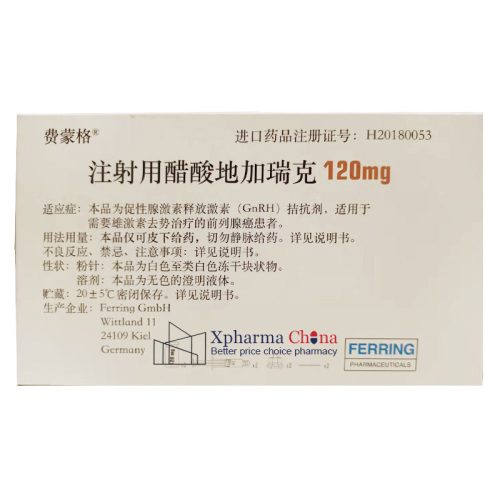
Brand Name:费蒙格 ®(Firmagon®)
Generic Name: Degarelix Acetate
Strength: 120 mg per vial
Manufacturer: Ferring GmbH
Marketing Authorization Holder: Ferring Pharmaceuticals A/S (Denmark); domestic filing entity: Ferring (Shanghai) Trading Co., Ltd.
Approval Date in China: September 11, 2018
Registration Number: H20180053
Storage: Store in a sealed container at 20±5°C (68±9°F).
Price&Cost:Contact Us now for the best price of Degarelix Acetate(Firmagon)
1. Indications and Usage
Prostate Cancer:
Indicated for the treatment of advanced prostate cancer in men.
It provides androgen deprivation therapy (ADT) to reduce testosterone levels to castrate levels.
2. Dosage and Administration
Route of Administration:
For Subcutaneous Injection (SC) ONLY. Do not administer intravenously or intramuscularly.
Recommended Dosage:
Starting Dose: 240 mg administered as two 3 mL injections (120 mg each) on Day 1.
Maintenance Dose: 80 mg administered as a single 4 mL injection once every 28 days thereafter.
Administration Instructions:
Inject into the abdomen (avoiding the waistline or areas near the ribs where pressure may be applied).
Reconstitution: The powder must be reconstituted with the provided sterile water for injection. Do not shake the vial vigorously to avoid foaming. Use within 1 hour after reconstitution.
Missed Dose:
Administer as soon as possible and resume the every-28-day schedule.
3. Mechanism of Action
GnRH Receptor Antagonist:
Degarelix is a synthetic decapeptide that binds competitively to pituitary GnRH receptors.
Immediate Suppression:
Unlike GnRH agonists (e.g., leuprolide), degarelix does not cause an initial “testosterone flare” (transient increase in testosterone). It immediately suppresses the secretion of luteinizing hormone (LH) and follicle-stimulating hormone (FSH), leading to a rapid and sustained reduction in serum testosterone to castrate levels (<0.5 ng/ml).
4. Safety and Warnings
QTc Prolongation:
Degarelix may prolong the QTc interval. Use with caution in patients with congenital long QT syndrome, congestive heart failure, or those taking Class Ia or III antiarrhythmics. Monitor ECG and electrolytes as appropriate.
Injection Site Reactions:
Very common (up to 91% in some studies), including pain, erythema, swelling, and induration. Most are mild to moderate and transient.
Liver Enzyme Elevations:
Increases in ALT and AST have been observed. Monitor liver function tests periodically.
Hypersensitivity:
Serious allergic reactions, including anaphylaxis and angioedema, have been reported.
5. Adverse Reactions
Most Common:
Hot flashes, injection site reactions (pain, redness, swelling), weight gain, fatigue, chills, back pain, and increased transaminases.
6. Drug Interactions
CYP450 System:
Degarelix is not a substrate, inhibitor, or inducer of CYP450 enzymes. No significant drug-drug interactions mediated by CYP enzymes are expected.
Concomitant Medications:
Caution is advised when using drugs known to prolong the QTc interval.
7. Pharmaceutical Information
Chemical Composition:
Active Ingredient: Degarelix Acetate.
Appearance: White to off-white freeze-dried cake; Solvent is a clear, colorless liquid.
Storage: Store at 25°C (77°F); excursions permitted to 15°C–30°C (59°F–86°F). Keep in the original package to protect from moisture.
Only logged in customers who have purchased this product may leave a review.
Reviews
There are no reviews yet.