
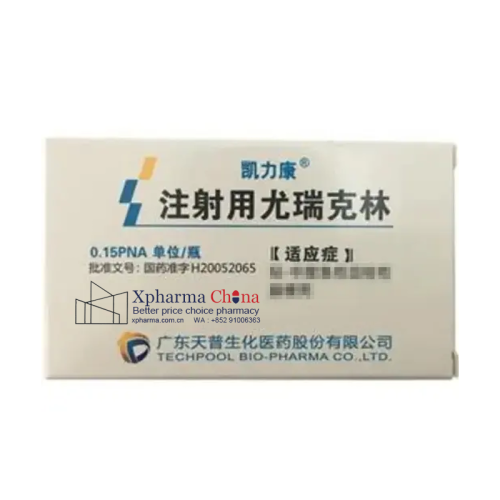
Kailikang Urinary Kallidinogenase for Injection
Brand Name:凯力康®(Kailikang®)
Generic Name: Urinary Kallidinogenase
Strength: 0.15 PNA unit per vial
Manufacturer: Techpool Bio-Pharma Co., Ltd.
Marketing Authorization Holder: Techpool Bio-Pharma Co., Ltd.
Approval Date in China: 2005
Registration Number: 国药准字H20052065
Storage: Store in a sealed container, keep in cool, dry place protected from moisture. Refer to the full package insert for detailed storage specifications.
Price&Cost:Contact Us now for the best price of Urinary Kallidinogenase (Kailikang)
1. Indications and Usage
Acute Ischemic Stroke:
Treatment of mild to moderate acute thrombotic cerebral infarction .
Note: It is specifically indicated for ischemic stroke and is contraindicated in hemorrhagic stroke.
2. Dosage and Administration
Route of Administration:
For Intravenous (IV) Infusion ONLY.
Recommended Dosage:
Standard Dose: 0.15 PNA Units per time.
Frequency: Once daily.
Duration: A typical course of treatment is 3 weeks .
Critical Administration Instructions:
Timing: Therapy should be initiated within 48 hours of symptom onset .
Reconstitution: Dissolve one vial (0.15 PNA Units) in 50 mL or 100 mL of 0.9% Sodium Chloride Injection .
Infusion Time: Administer over 30 minutes.
Speed Control: Infusion speed must not be too fast. The first 15 minutes should be administered slowly to monitor for hypotension .
3. Mechanism of Action
Kallikrein-Kinin System Activation:
Urinary kallidinogenase is a proteolytic enzyme that converts endogenous high-molecular-weight kininogen into kinin and kallidin .
Microvascular Dilatation:
These kinins act on vascular smooth muscle to cause vasodilation, particularly in the microvasculature.
Cerebral Protection:
It increases cerebral blood flow, improves microcirculation, inhibits platelet aggregation, and enhances oxygen delivery to ischemic brain tissue .
4. Safety and Warnings
Hypotension:
The most significant risk is a sudden and severe drop in blood pressure.
Action: Monitor blood pressure closely. If significant hypotension occurs, discontinue immediately and administer pressor agents .
Contraindications:
Hemorrhagic Stroke: Contraindicated in the acute phase of cerebral hemorrhage or other hemorrhagic diseases .
Allergy: Patients with a history of drug allergy or allergic constitution should use with caution .
Drug Interactions (Critical):
ACE Inhibitors: Concomitant use with Angiotensin-Converting Enzyme (ACEI) inhibitors (e.g., Captopril, Lisinopril) is contraindicated as they have a synergistic hypotensive effect, potentially leading to dangerous hypotension .
5.Adverse Reactions and Clinical Research
Most Common Adverse Reactions:
Vomiting, facial flushing and heat sensation, headache, diarrhea, conjunctival congestion, palpitations, and injection site redness/itching .
Clinical Research Highlights:
Clinical trials indicate it improves neurological function and quality of life in acute ischemic stroke patients when used within 48 hours .
6.Drug Interactions
Antihypertensives:
May enhance the hypotensive effect of antihypertensive agents.
Specific Warning: Strictly avoid combining with ACEI class drugs due to the risk of syncope or shock .
7.Pharmaceutical Information
Chemical Composition:
Active Ingredient: Urinary Kallidinogenase (a glycoprotein of 238 amino acids) .
Appearance: White lyophilized solid or powder.
Packaging: Single-use vial (0.15 PNA Units).
Storage: Sealed and stored at controlled room temperature.
Only logged in customers who have purchased this product may leave a review.
Reviews
There are no reviews yet.