
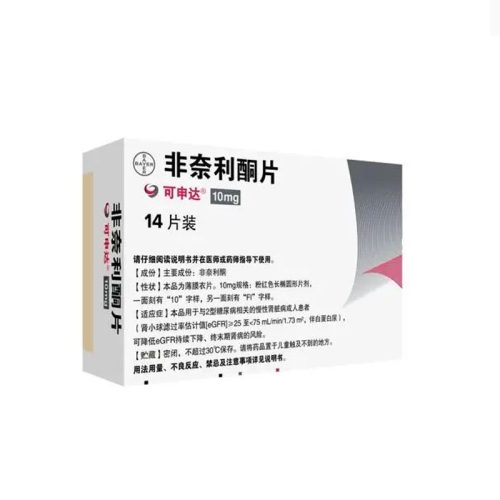
Kerendia Finerenone Film-coated Tablets
Brand Name: 可申达 ®(Kerendia®)
Generic Name: Finerenone
Strength: 10 mg per film-coated tablet, 14 tablets per box
Manufacturer: Bayer AG (Germany)
Marketing Authorization Holder: Bayer AG;Domestic Responsible Party: 拜耳医药保健有限公司
Approval Date in China: June 30, 2022
Registration Number:国药准字 HJ20220057
Storage: Seal tightly, store at temperature not exceeding 30℃; keep out of sight and reach of children
Price&Cost:Contact Us now for the best price of Finerenone(Kerendia)
1. Indications and Usage
Chronic Kidney Disease (CKD) Associated with Type 2 Diabetes (T2D): Indicated to reduce the risk of sustained eGFR decline, end-stage kidney disease, cardiovascular death, non-fatal myocardial infarction, and hospitalization for heart failure in adults.
2. Dosage and Administration
Administration: Oral administration, once daily. Can be taken with or without food.
Starting Dose:
eGFR ≥60 mL/min/1.73 m²: 20 mg once daily.
eGFR ≥25 to <60 mL/min/1.73 m²: 10 mg once daily.
Monitoring: Measure serum potassium (K+) prior to initiation. If K+ >5.0 mEq/L, do not start treatment. Monitor K+ 4 weeks after initiation and periodically thereafter.
Dose Adjustment:
If K+ >5.0 mEq/L: Withhold dose; resume when K+ ≤5.0 mEq/L.
If K+ ≤4.8 mEq/L after 4 weeks: Increase dose from 10 mg to 20 mg (if eGFR fall >30%, maintain at 10 mg).
3. Mechanism of Action
Nonsteroidal MRA: Finerenone is a potent and selective antagonist of the mineralocorticoid receptor (MR).
Pathway: It blocks MR-mediated sodium reabsorption and overactivation in epithelial (e.g., kidney) and non-epithelial (e.g., heart, vasculature) tissues. This inhibition reduces inflammation and fibrosis, thereby protecting the heart and kidney from damage.
4. Safety and Warnings
Hyperkalemia: The most significant risk. Contraindicated in patients with adrenal insufficiency. Avoid initiating if serum K+ >5.0 mEq/L.
Hypotension: May occur; monitor blood pressure.
CYP3A4 Inhibitors: Contraindicated with strong CYP3A4 inhibitors (e.g., itraconazole, ketoconazole).
Pregnancy/Lactation: No adequate data; avoid use during pregnancy and breastfeeding.
5. Adverse Reactions
Most Common: Hyperkalemia, hypotension, and hyponatremia.
6. Drug Interactions
Strong CYP3A4 Inhibitors: Contraindicated.
Moderate/Weak CYP3A4 Inhibitors: (e.g., erythromycin, verapamil) Monitor K+ and consider dose adjustment.
CYP3A4 Inducers: (e.g., rifampicin) Avoid concomitant use as efficacy may be reduced.
Potassium-Sparing Agents: Avoid concomitant use with other MRAs (e.g., spironolactone) or potassium supplements due to hyperkalemia risk.
Grapefruit: Avoid grapefruit or grapefruit juice.
7. Pharmaceutical Information
Chemical Name: (4S)-4-(4-cyano-2-methoxyphenyl)-5-ethoxy-2,8-dimethyl-1,4-dihydro-1,6-naphthyridine-3-carboxamide.
Only logged in customers who have purchased this product may leave a review.

Reviews
There are no reviews yet.