
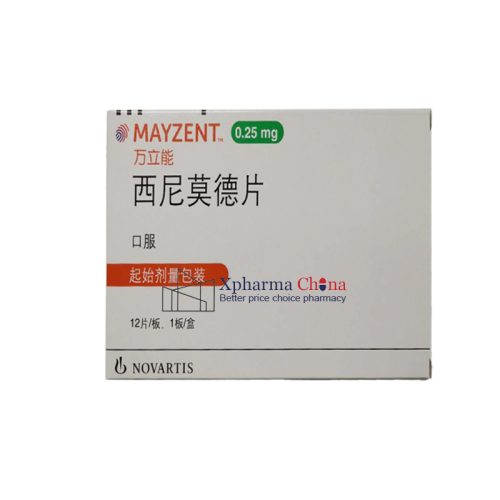
Mayzent Siponimod Tablets
Brand Name:万立能 ®(Mayzent®)
Generic Name: Siponimod
Strength: 0.25 mg per tablet, 12 tablets/blister, 1 blister/box (total 12 tablets/box)
Manufacturer: Novartis Pharma Stein AG
Marketing Authorization Holder: Novartis Pharma AG. Domestic filing entities are Beijing Novartis Pharma Co., Ltd. and Novartis (China) Limited.
Approval Date in China: May 7, 2020
Registration Number: 国药准字 HJ20200010
Storage: Store at 20°C–25°C (68°F–77°F) in the original package, protected from light and moisture. Brief exposure to 15°C–30°C (59°F–86°F) is permitted. Keep out of the sight and reach of children.
Price&Cost:Contact Us now for the best price of Siponimod (Mayzent)
1. Indications and Usage
Relapsing Forms of Multiple Sclerosis (MS):
Indicated for the treatment of adult patients with relapsing forms of MS, to include clinically isolated syndrome, relapsing-remitting disease, and active secondary progressive disease (SPMS).
2. Dosage and Administration
Route of Administration:
For Oral Use ONLY. Can be taken with or without food at the same time each day.
Genotype Testing:
Mandatory: CYP2C9 genotype testing must be performed before initiating therapy.
Contraindication: Contraindicated in patients with the CYP2C933 genotype due to significantly increased drug exposure and toxicity risk.
Dosing Schedule:
Titration: A 5-day titration schedule is required to minimize the risk of bradycardia.
Day 1: 0.25 mg
Day 2: 0.25 mg
Day 3: 0.5 mg
Day 4: 0.75 mg
Day 5: 2 mg (or 1 mg based on genotype)
Maintenance:
2 mg once daily: For CYP2C9 *1/*1, *1/*2, or *2/*2 genotypes.
1 mg once daily: For CYP2C9 *1/*3 or *2/*3 genotypes.
First-Dose Monitoring:
Due to the risk of bradycardia and AV block, patients must undergo first-dose monitoring (ECG, pulse, BP) in a healthcare facility for 6 hours after the first dose.
3. Mechanism of Action
S1P Receptor Modulation:
Siponimod binds with high affinity to S1P receptors 1 and 5.
Lymphocyte Sequestration:
By binding to S1P1 receptors on lymphocytes, it prevents their egress from lymph nodes. This reduces the number of circulating autoreactive lymphocytes capable of entering the CNS.
Neuroprotection:
Interaction with S1P5 receptors (expressed on oligodendrocytes) may contribute to neuroprotective effects, which is particularly relevant for progressive forms of MS.
4. Safety and Warnings
Bradycardia and AV Block:
Initiation causes transient bradycardia. Contraindicated in patients with recent MI, stroke, unstable angina, decompensated HF, or certain heart blocks (e.g., Mobitz II, 3rd-degree AV block) within the last 6 months.
Macular Edema:
Risk of macular edema, particularly in the first 3–4 months. Baseline ophthalmologic exam is required.
Infections:
Increased risk of infections. Screen for Tuberculosis (TB) and Hepatitis B (HBV) prior to initiation.
Hypertension:
May cause a transient increase in blood pressure; monitor BP periodically.
Teratogenicity:
May cause fetal harm. Females of reproductive potential must use effective contraception during treatment and for at least 3 days after stopping.
Vaccinations:
Avoid live-attenuated vaccines during treatment and for at least 1 week after stopping.
5. Adverse Reactions
Most Common (Incidence ≥5% and greater than placebo):
Headache, fatigue, hypertension, diarrhea, and elevated liver enzymes (ALT).
6. Drug Interactions
CYP2C9 Inhibitors:
Concomitant use with CYP2C9 inhibitors (e.g., fluconazole) may require dose adjustments or discontinuation.
CYP3A4 Inducers:
Strong inducers (e.g., rifampin) decrease siponimod exposure and should be avoided.
Beta-Blockers / Calcium Channel Blockers:
Concomitant use may cause additive effects on heart rate; caution is advised.
7. Pharmaceutical Information
Chemical Composition:
Active Ingredient: Siponimod.
Available Strength: 0.25 mg and 2 mg tablets.
Storage: Store at 20°C to 25°C (68°F to 77°F).
Only logged in customers who have purchased this product may leave a review.


Reviews
There are no reviews yet.