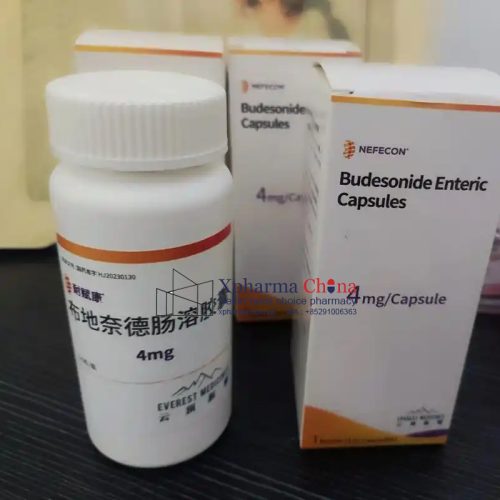
Nefecon®Budesonide Enteric Capsules
Brand Name:耐赋康®(Nefecon®)
Generic Name:Budesonide
Strength:4 mg /capsule
Manufacturer: Patheon Pharmaceuticals Inc
Marketing Authorization Holder:Everest Medicines
Approval Date in China:November 24, 2023
Registration Number:国药准字HJ20230130
Storage:Store tightly sealed at a temperature not exceeding 30°C, protect from light and moisture
Price&Cost:Contact Us now for the best price of Budesonide(Nefecon)
1. Indications and Usage
IgA Nephropathy (IgAN): Treatment of adult patients with primary immunoglobulin A nephropathy (IgAN) who are at risk of rapid progression.
Clinical Context: Typically indicated for patients with elevated proteinuria (e.g., Urine Protein-to-Creatinine Ratio [UPCR] ≥1.5 g/g) .
2. Dosage and Administration
Administration: Oral administration. Capsules must be swallowed whole (do not crush, chew, or open). Take in the morning, at least 1 hour before breakfast .
Standard Treatment Regimen (Total Duration: 9 Months) :
Loading/Maintenance Phase: 16 mg once daily for the first 8 months.
Tapering Phase 1: 8 mg once daily for 2 weeks.
Tapering Phase 2: 4 mg once daily for 2 weeks.
Missed Dose: If a dose is missed, do not double the dose. Resume at the next scheduled time .
3. Mechanism of Action
Budesonide is a corticosteroid with potent glucucocorticoid activity.
Targeted Release: The enteric coating ensures release in the distal ileum (specifically targeting Peyer’s patches).
Immunomodulation: It inhibits the proliferation and differentiation of mucosal B cells, thereby reducing the production of Galactose-deficient IgA1 (Gd-IgA1). Reducing Gd-IgA1 levels limits the formation of immune complexes that deposit in the glomerular mesangium, slowing kidney injury .
4. Safety and Warnings
Contraindications: Hypersensitivity to budesonide or any excipients; Severe hepatic impairment (Child-Pugh Class C) .
HPA Axis Suppression: Use of corticosteroids can lead to Cushing’s syndrome and adrenal suppression. Patients may require supplemental systemic corticosteroids during stress (e.g., surgery) .
Infection Risk: Immunosuppression increases the risk of infections (e.g., varicella, measles). Patients should avoid exposure to active infectious diseases.
Hepatic Impairment: Caution is advised in moderate to severe hepatic impairment (Child-Pugh B and C) due to increased systemic exposure .
5. Adverse Reactions
Common adverse reactions (incidence ≥5% and higher than placebo) are consistent with corticosteroid use and include:
Peripheral edema
Hypertension
Muscle spasms
Acne
Headache
Upper respiratory tract infection
Weight gain
6. Drug Interactions
CYP3A4 Inhibitors: Budesonide is primarily metabolized by CYP3A4. Co-administration with strong CYP3A4 inhibitors (e.g., ketoconazole, itraconazole, ritonavir) significantly increases systemic exposure and the risk of Cushing’s syndrome/adrenal suppression. Such combinations should generally be avoided or the budesonide dose reduced/monitored closely .
Grapefruit Juice: Avoid consumption of grapefruit or grapefruit juice as it may increase systemic exposure .
7. Pharmaceutical Information
Chemical Name: (11β,16α)-11,17,21-trihydroxypregna-1,4-diene-3,20-dione [Standard Budesonide structure].
Molecular Formula: C25H34O6.
Molecular Weight: 430.51.
Storage: Store at controlled room temperature. Protect from light and moisture [Implied standard].
Only logged in customers who have purchased this product may leave a review.
Reviews
There are no reviews yet.