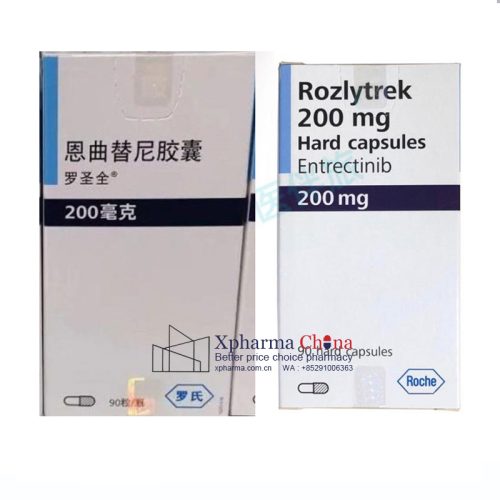
Rozlytrek®Entrectinib Hard capsules
Brand Name: 罗圣全® (Rozlytrek®)
Generic Name: Entrectinib
Strength: 200 mg per hard capsule, 90 capsules per bottle
Manufacturer: Mayne Pharma Inc.(受托生产);原研企业:F. Hoffmann-La Roche Ltd.(罗氏)
Marketing Authorization Holder: Roche Registration GmbH;境内代理人:罗氏制药(中国)有限公司
Approval Date in China: July 29, 2022
Registration Number:国药准字 HJ20220069
Storage: Store in a sealed container at a temperature not exceeding 30°C, protect from light and moisture, keep out of reach of children
Price&Cost:Contact Us now for the best price of Entrectinib(Rozlytrek)
1. Indications and Usage
ROS1-Positive NSCLC: Treatment of adult patients with metastatic non-small cell lung cancer (NSCLC) whose tumors are ROS1-positive .
NTRK Fusion-Positive Solid Tumors: Treatment of adult and pediatric patients (1 month of age and older) with solid tumors that have a neurotrophic tyrosine kinase receptor (NTRK) gene fusion, who have metastatic disease or where surgical resection is likely to result in severe morbidity, and who have no satisfactory alternative treatments or have progressed on prior treatment .
2. Dosage and Administration
Administration: Oral administration. Hard capsules must be swallowed whole with water. Do not chew, open, or crush the capsules as contents are bitter .
Food Requirement: Can be taken with or without food .
Standard Dose:
Adults: 600 mg once daily .
Pediatrics (NTRK): Dose is determined by body surface area (BSA) and age (e.g., 300 mg/m² for BSA ≤0.50 m², up to 600 mg for BSA ≥1.51 m²) .
Missed Dose: If a dose is missed, take it as soon as possible unless it is within 12 hours of the next scheduled dose. Do not make up for the missed dose .
Vomiting: If vomiting occurs immediately after administration, do not re-administer the dose .
3. Mechanism of Action
Entrectinib is a potent, selective, orally available tropomyosin receptor kinase (TRK) inhibitor.
It inhibits the TRK family of kinases (TRKA, TRKB, and TRKC) encoded by NTRK genes, as well as ROS1 and ALK.
By blocking these kinases, it inhibits the phosphorylation of TRK, ROS1, and ALK, leading to inhibition of tumor cell proliferation and induction of apoptosis .
4. Safety and Warnings
Congestive Heart Failure: Entrectinib can cause a decrease in left ventricular ejection fraction (LVEF). Monitor LVEF by echocardiogram before initiation and periodically during treatment .
CNS Effects: Can cause cognitive, psychiatric, or vestibular adverse reactions (e.g., dizziness, confusion). Patients should avoid driving or operating machinery if these occur .
Fractures: Increased risk of bone fractures. Monitor for signs of pain or fracture .
Hepatotoxicity: Monitor liver enzymes (ALT, AST) and bilirubin regularly .
Hyperuricemia: Monitor serum uric acid levels periodically .
QTc Interval Prolongation: Monitor ECG and electrolytes periodically .
5. Adverse Reactions
Common adverse reactions (incidence ≥20%) include:
CNS: Dizziness, cognitive impairment, dysgeusia (taste disturbance).
Gastrointestinal: Constipation, diarrhea, nausea, vomiting.
Musculoskeletal: Arthralgia, myalgia.
General: Fatigue, edema, weight gain, pyrexia .
6. Drug Interactions
CYP3A Inhibitors: Avoid co-administration with strong or moderate CYP3A inhibitors (e.g., ketoconazole, clarithromycin) as they increase Entrectinib exposure. If unavoidable, reduce dose .
CYP3A Inducers: Avoid co-administration with strong CYP3A inducers (e.g., rifampin) as they reduce efficacy .
QTc Prolonging Drugs: Avoid co-administration with drugs known to prolong the QT interval .
7. Pharmaceutical Information
Chemical Name: (R)-N4- (5- (3, 5-difluorobenzyl) -1, 2, 4-oxadiazol-3-yl) -N- (2- (4-ethyl-4H-1, 2, 4-triazol-3-yl) -2- (3, 5-difluorophenyl) ethyl) pyridine-3, 4-dicarboxamide .
Molecular Formula: C30H25ClF4N8O3 .
Storage: Store at 20°C to 25°C (68°F to 77°F); excursions permitted to 15°C to 30°C (59°F to 86°F) .
Only logged in customers who have purchased this product may leave a review.

Reviews
There are no reviews yet.