
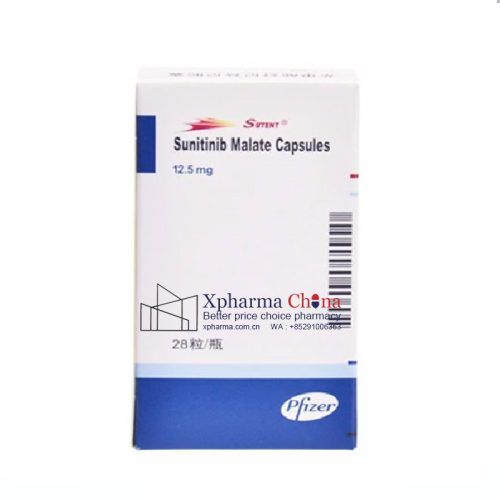
Sutent®Sunitinib Malate Capsules
Brand Name: 索坦 ®(Sutent®)
Generic Name: Sunitinib Malate
Strength: 12.5 mg per capsule, 28 capsules per bottle
Manufacturer: Pfizer Italia S.r.l.
Marketing Authorization Holder: PFIZER EUROPE MA EEIG;境内责任人:辉瑞投资有限公司
Approval Date in China: Original approval in 2009, updated registration in 2017
Registration Number: 国药准字HJ20171137
Storage: Store at 25℃, short-term transportation between 15℃–30℃ is permitted; seal tightly, protect from light and moisture, keep away from children
Price&Cost:Contact Us now for the best price of Sunitinib Malate(Sutent)
1. Indications and Usage
Gastrointestinal Stromal Tumor (GIST): Treatment of patients with imatinib-resistant or -intolerant GIST .
Advanced Renal Cell Carcinoma (RCC): Treatment of patients with advanced RCC .
Pancreatic Neuroendocrine Tumors (pNET): Treatment of adult patients with progressive, non-functioning pNET .
2. Dosage and Administration
Administration: Oral administration. Capsules must be swallowed whole with water. Can be taken with or without food .
Standard Dose:
GIST and RCC: 50 mg once daily for 4 weeks, followed by a 2-week rest period (Schedule 4/2) .
pNET: 37.5 mg once daily, continuously (no rest period) .
Dose Adjustment: Dose reductions (e.g., to 37.5 mg or 25 mg) or increases may be recommended based on individual safety and tolerability. Adjustments are also required when co-administered with CYP3A4 inhibitors or inducers .
3. Mechanism of Action
Sunitinib is a multi-targeted receptor tyrosine kinase (RTK) inhibitor.
It inhibits multiple RTKs involved in tumor growth, pathologic angiogenesis, and metastatic progression, including PDGFR, VEGFR, KIT, FLT3, CSF-1R, and RET .
By blocking these receptors, it “starves” the tumor of blood supply and inhibits tumor cell proliferation.
4. Safety and Warnings
Cardiac Dysfunction: Can cause left ventricular dysfunction and heart failure. Monitor LVEF prior to and during treatment .
Hypertension: Monitoring of blood pressure is recommended during treatment .
Hepatotoxicity: Monitor liver function tests (ALT, AST, bilirubin) regularly .
QTc Interval Prolongation: Monitor ECG and electrolytes periodically, especially in patients with cardiac history .
Thyroid Dysfunction: Monitor thyroid function tests periodically, as hypothyroidism is common .
Hemorrhage and Adrenal Insufficiency: Monitor for signs of bleeding and adrenal insufficiency .
5. Adverse Reactions
Common adverse reactions (incidence ≥10%) include:
General: Fatigue, asthenia, pyrexia.
Gastrointestinal: Diarrhea, nausea, stomatitis, vomiting, dyspepsia, constipation, abdominal pain, altered taste.
Skin: Skin discoloration (yellowing), rash, hand-foot syndrome .
Cardiovascular: Hypertension.
Laboratory Abnormalities: Neutropenia, thrombocytopenia, anemia, increased lipase, increased creatinine .
6. Drug Interactions
CYP3A4 Inhibitors: Concomitant use with strong CYP3A4 inhibitors (e.g., ketoconazole) increases Sunitinib exposure. Dose reduction is required .
CYP3A4 Inducers: Concomitant use with strong CYP3A4 inducers (e.g., rifampin) decreases Sunitinib exposure. Dose increase may be required .
Grapefruit Juice: Avoid consumption of grapefruit or grapefruit juice as it may increase drug exposure .
7. Pharmaceutical Information
Chemical Name: Indoline-5-carboxamide, N-(2-(diethylamino)ethyl)-2-oxo-1-(2-(4-(2-pyrimidinyl)-1-piperazinyl)ethyl)-, (indol-5-yl)acetate (1:1) .
Molecular Formula: C22H27FN4O2 · C4H6O5 .
Storage: Store at 20°C to 25°C (68°F to 77°F); excursions permitted to 15°C to 30°C (59°F to 86°F) .
Only logged in customers who have purchased this product may leave a review.

Reviews
There are no reviews yet.