
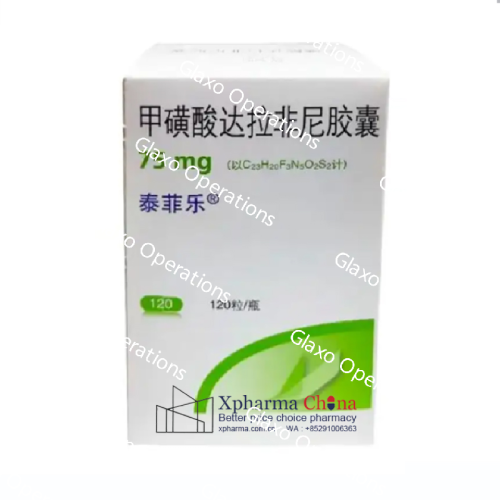
Tafinlar® Dabrafenib Mesylate Capsules
Brand Name:泰菲乐 ®(Tafinlar®)
Generic Name:Dabrafenib Mesylate
Strength:75 mg per capsule, 120 capsules per bottle
Manufacturer: Glaxo Operations (UK) Ltd. (original manufacturer, later transferred to Novartis)
Marketing Authorization Holder:Novartis Pharma AG; Domestic marketing authorization holder: Beijing Novartis Pharma Co., Ltd.
Approval Date in China:December 19, 2019
Registration Number:国药准字HJ20190066
Storage:Store in a light-proof, airtight container below 30°C in a dry place; keep the desiccant inside the original bottle after opening, and avoid access by children.
Price&Cost:Contact Us now for the best price of Dabrafenib Mesylate(Tafinlar)
1. Indications and Usage
- Unresectable or Metastatic Melanoma: Treatment of patients with BRAF V600E or V600K mutation-positive unresectable or metastatic melanoma (often in combination with trametinib) .
- Non-Small Cell Lung Cancer (NSCLC): Treatment of patients with BRAF V600E mutation-positive metastatic NSCLC .
- Anaplastic Thyroid Cancer (ATC): Treatment of patients with BRAF V600E mutation-positive anaplastic thyroid cancer .
2. Dosage and Administration
- Administration: Oral administration. Capsules must be swallowed whole (do not open, crush, or break). Take on an empty stomach (at least 1 hour before or 2 hours after a meal) .
- Dosing Regimen:
- Monotherapy: 150 mg twice daily (approx. every 12 hours) .
- Combination Therapy (with Trametinib): Dabrafenib 150 mg twice daily + Trametinib 2 mg once daily .
- Missed Dose: Do not take a missed dose if it is less than 6 hours before the next scheduled dose. Resume at the next scheduled time .
3. Mechanism of Action
Dabrafenib is a BRAF kinase inhibitor.
It selectively inhibits the activity of mutant BRAF (V600E, V600K, V600D) kinases, which leads to inhibition of the RAS-RAF-MEK-ERK signaling pathway, resulting in reduced cell proliferation and induction of apoptosis in tumor cells .
4. Safety and Warnings
- Cutaneous Squamous Cell Carcinoma (cuSCC): Treatment-emergent cuSCC or keratoacanthoma may occur due to paradoxical activation of the MAPK pathway in BRAF wild-type cells. Monitor skin examinations every 2 months during treatment and for up to 6 months after discontinuation .
- Hyperglycemia: Monitor blood glucose levels, especially in patients with pre-existing diabetes .
- Ocular Toxicity: Retinal vein occlusion (RVO) and uveitis may occur. Baseline and periodic ophthalmologic examinations are recommended .
- Hemorrhage: Severe and fatal hemorrhagic events have been reported. Monitor for signs of bleeding .
- Embryo-Fetal Toxicity: May cause fetal harm. Effective contraception is required for females of reproductive potential .
5. Adverse Reactions
Common adverse reactions (incidence ≥20%) when used as monotherapy include:
- Pyrexia , Headache, Fatigue.
- Arthralgia , Palmar-plantar erythrodysesthesia
- Rash, Pruritus, Hyperkeratosis
- Diarrhea, Vomiting, Nausea .
6. Drug Interactions
- CYP450 Substrate/Inducer:
- Dabrafenib is metabolized primarily by CYP3A4 and CYP2C8. Avoid strong inhibitors (e.g., ketoconazole) and strong inducers (e.g., rifampin) .
- Dabrafenib induces CYP3A4, CYP2C9, etc. It may decrease the exposure of sensitive substrates (e.g., oral contraceptives, warfarin). Monitor these drugs closely .
7. Pharmaceutical Information
- Chemical Name: Dabrafenib mesylate.
- Molecular Formula: C23H23Br2FN3O4S·CH4O3S .
- Molecular Weight: 815.53 .
- Storage: Store at 20°C to 25°C (68°F to 77°F); excursions permitted to 15°C to 30°C (59°F to 86°F) .
Only logged in customers who have purchased this product may leave a review.
Reviews
There are no reviews yet.