
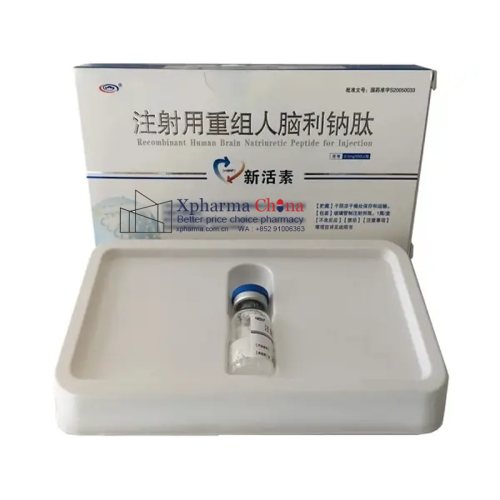
Xinhuosu Recombinant Human Brain Natriuretic Peptide for Injection
Brand Name:新活素 ®(Xinhuosu®)
Generic Name: Recombinant Human Brain Natriuretic Peptide
Strength: 0.5 mg (500 U) per vial, 1 vial per box
Manufacturer: Chengdu Tiantaishan Pharmaceutical Co., Ltd.
Marketing Authorization Holder: Chengdu Tiantaishan Pharmaceutical Co., Ltd.
Approval Date in China: 2005
Registration Number: 国药准字S20050033
Storage: Store and transport at 2°C–8°C, protected from light; do not freeze. Refer to the full package insert for detailed storage instructions.
Price&Cost:Contact Us now for the best price of Recombinant Human Brain Natriuretic Peptide(Xinhuosu)
1. Indications and Usage
Acute Decompensated Heart Failure:
Intravenous treatment of patients with acute decompensated heart failure who have dyspnea at rest or with minimal exertion (NYHA Class > II) .
2. Dosage and Administration
Route of Administration:
For Intravenous (IV) Injection and Infusion ONLY.
Recommended Dosage:
Loading Dose: Administer 1.5 µg/kg intravenously over approximately 60 seconds.
Maintenance Infusion: Immediately follow with a continuous infusion at a rate of 0.0075 µg/kg/min .
Duration: Typically administered continuously for 24 to 72 hours, depending on clinical response .
Critical Administration Instructions:
Reconstitution: Dissolve with Sterile Water for Injection. Do not shake vigorously; gently swirl to avoid foaming .
Compatibility: Do not mix with heparin, insulin, furosemide, or drugs containing sodium metabisulfite in the same line. Do not use heparin-bonded catheters .
3. Mechanism of Action
Vasodilation:
Binds to natriuretic peptide receptors on vascular smooth muscle cells, increasing intracellular cGMP, which leads to the relaxation of both arterial and venous smooth muscles .
Hemodynamic Effects:
Reduces systemic vascular resistance (afterload) and pulmonary capillary wedge pressure (preload), thereby improving cardiac output .
Renal Effects:
Acts as a natural antagonist to the Renin-Angiotensin-Aldosterone System (RAAS), promoting natriuresis (sodium excretion) and diuresis without increasing myocardial oxygen consumption .
4. Safety and Warnings
Hypotension:
The most common adverse reaction is a significant drop in blood pressure.
Contraindication: Contraindicated in patients with cardiogenic shock or systolic blood pressure <90 mmHg .
Renal Function Impairment:
May cause transient elevation of serum creatinine. Monitor renal function periodically .
Cautions:
Use with caution in patients with severe valvular stenosis, restrictive cardiomyopathy, or cardiac tamponade .
5.Adverse Reactions and Clinical Research
Most Common Adverse Reactions:
Hypotension, headache, nausea, vomiting, sweating, and transient increase in serum creatinine .
Clinical Research Highlights:
Clinical trials demonstrated that the drug rapidly improves dyspnea and hemodynamic parameters compared to standard therapy.
Symptomatic hypotension was the primary reason for dose reduction or discontinuation .
6.Drug Interactions
ACE Inhibitors:
Concomitant use with oral ACE inhibitors may increase the risk of symptomatic hypotension .
Incompatible Drugs:
Physically incompatible with heparin, insulin, bumetanide, enalaprilat, ethacrylate sodium, hydralazine, and furosemide when administered via the same IV catheter .
7.Pharmaceutical Information
Chemical Composition:
Active Ingredient: Recombinant Human Brain Natriuretic Peptide.
Appearance: White to off-white lyophilized powder.
Packaging: Single-use vial (0.5 mg / 500 Units).
Storage: Store at 2°C to 8°C (36°F to 46°F). Protect from light .
Only logged in customers who have purchased this product may leave a review.
Reviews
There are no reviews yet.