Zeposia®Ozanimod Hydrochloride Capsules
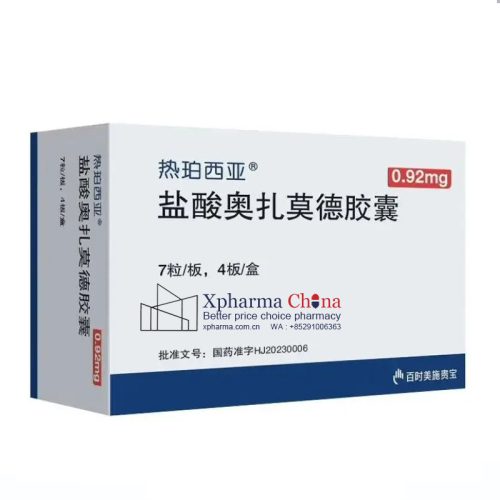
Brand Name: 热珀西亚®(Zeposia®)
Generic Name: Ozanimod Hydrochloride
Strength: 0.92 mg per capsule, 7 capsules per blister, 4 blisters per box
Manufacturer: Celgene International Sarl
Marketing Authorization Holder: Bristol-Myers Squibb
Approval Date in China: February 2, 2023
Registration Number: 国药准字HJ20230006
Storage: Store sealed at 20℃–25℃, short-term transportation between 15℃–30℃ is permitted; protect from light and moisture, keep out of sight and reach of children
Price&Cost:Contact Us now for the best price of Ozanimod Hydrochloride(Zeposia)
1. Indications and Usage
Relapsing Forms of Multiple Sclerosis (RMS): Treatment of adults with RMS, including clinically isolated syndrome (CIS), relapsing-remitting MS (RRMS), and active secondary progressive MS (SPMS) .
Moderately to Severely Active Ulcerative Colitis (UC): Treatment of adults with moderately to severely active UC .
2. Dosage and Administration
Administration: Oral administration. Capsules should be swallowed whole and may be taken with or without food .
Titration (Dose Escalation): To minimize cardiac risks, treatment must be initiated with a 7-day titration period:
Days 1–4: 0.23 mg once daily.
Days 5–7: 0.46 mg once daily.
Day 8 onwards: Recommended maintenance dose of 0.92 mg once daily .
Missed Dose:
During the 7-day titration: If a dose is missed, restart the titration schedule.
After titration: Resume at the usual scheduled time .
3. Mechanism of Action
Ozanimod is a selective sphingosine 1-phosphate (S1P) receptor modulator.
It binds with high affinity to S1P1 and S1P5 receptors. By agonizing S1P1 receptors on lymphocytes, it causes internalization of the receptor, rendering lymphocytes unresponsive to S1P signals.
This sequesters lymphocytes in lymph nodes, reducing their circulation in the blood and migration into the central nervous system (CNS), thereby reducing neuroinflammation .
4. Safety and Warnings
Infections: May increase the risk of infections (e.g., upper respiratory, urinary tract). Active chronic infections (e.g., Hepatitis, TB) are contraindications .
Bradycardia and AV Block: Can cause a transient decrease in heart rate and AV block. Baseline ECG is required before initiation. First-dose monitoring is recommended for patients with specific cardiac risks .
Macular Edema: May cause macular edema. A comprehensive eye exam (including macular imaging) is recommended prior to treatment and periodically thereafter .
Hypertension: Monitor blood pressure regularly during treatment .
Hepatotoxicity: Monitor liver enzymes. Discontinue if severe liver injury occurs .
Fetal Toxicity: May cause fetal harm. Contraception is required for females of reproductive potential during treatment and for at least 3 months after the final dose .
5. Adverse Reactions
Common adverse reactions (incidence ≥4%) include:
Infections: Upper respiratory infections, nasopharyngitis, urinary tract infections, herpes zoster .
Gastrointestinal: Diarrhea, nausea, headache.
Cardiovascular: Hypertension, first-degree AV block.
Laboratory Abnormalities: Increased ALT, increased GGT, decreased lymphocyte count .
6. Drug Interactions
MAO Inhibitors: Concomitant use with Monoamine Oxidase (MAO) inhibitors is contraindicated .
CYP2C8 Inhibitors: Co-administration with strong CYP2C8 inhibitors (e.g., gemfibrozil) significantly increases exposure; dose adjustment or avoidance is recommended .
Live Vaccines: Avoid live attenuated vaccines during treatment and for 3 months after discontinuation .
7. Pharmaceutical Information
Chemical Name: 5-(3-{(1S)-1-[(2-hydroxyethyl)amino]-2,3-dihydro-1H-inden-4-yl}-1,2,4-oxadiazol-5-yl)-2-(propan-2-yloxy)benzonitrile hydrochloride .
Molecular Formula: C23H24N4O3 · HCl.
Storage: Store at 20°C to 25°C (68°F to 77°F); excursions permitted to 15°C to 30°C (59°F to 86°F) .
Only logged in customers who have purchased this product may leave a review.

Reviews
There are no reviews yet.