1. Indications and Usage
Myocardial Perfusion Imaging (MPI): Indicated for myocardial perfusion imaging using radiopharmaceuticals in patients unable to undergo adequate exercise stress testing.
2. Dosage and Administration
Route of Administration: Intravenous injection ONLY.
Recommended Dosage: 0.4 mg (5 mL) administered as a rapid bolus injection over approximately 10 seconds into an arm vein.
Administration Details: Immediately after injection, flush the line with 5 mL of 0.9% sodium chloride injection.
Timing: The radiopharmaceutical for MPI must be administered directly through the same catheter 10 to 20 seconds after the regadenoson injection.
3. Mechanism of Action
A2A Receptor Agonism: Regadenoson selectively activates the adenosine A2A receptors located on coronary vascular smooth muscle cells.
Coronary Vasodilation: This activation causes coronary vasodilation, increasing myocardial blood flow up to 4-5 times resting levels, creating a contrast between healthy and ischemic myocardium.
4. Safety and Warnings
Cardiac Conduction Abnormalities: May cause bradycardia, atrioventricular (AV) block, or sinus node dysfunction. Contraindicated in patients with second or third-degree AV block unless a functioning pacemaker is present.
Bronchospasm: May cause bronchoconstriction. Use with caution in patients with asthma or chronic obstructive pulmonary disease (COPD).
Hemodynamic Changes: Can cause hypotension or hypertension. Patients with left main coronary stenosis or severe aortic stenosis are at increased risk.
Emergency Preparedness: Resuscitation equipment must be available during administration. Aminophylline can be used to reverse severe or persistent adverse reactions.
5. Adverse Reactions and Clinical Research
Most Common Adverse Reactions: Dyspnea, headache, flushing, chest discomfort, angina, dizziness, nausea, abdominal discomfort, taste disturbance, and feeling hot.
Cardiac and Respiratory Events: Palpitations, atrial fibrillation, flutter, and transient obstructive airway obstruction have been reported.
6. Drug Interactions
Methylxanthines: Caffeine and theophylline (non-selective adenosine receptor antagonists) may interfere with vasodilation. These drugs should be withheld for at least 12 hours before administration.
Dipyridamole: May alter the effects of regadenoson; withhold for at least 2 days if possible.
Cardioactive Drugs: Beta-blockers or calcium channel blockers may blunt the heart rate response but do not significantly affect coronary vasodilation.
7. Pharmaceutical Information
Chemical Composition: Active ingredient: Regadenoson.
Appearance: Clear, colorless to pale yellow liquid.
Packaging: Available in single-dose syringes or ampules (0.4 mg/5 mL).
Storage: Store at 25°C (77°F); excursions permitted to 20°-28°C (68°-82°F). Protect from light.
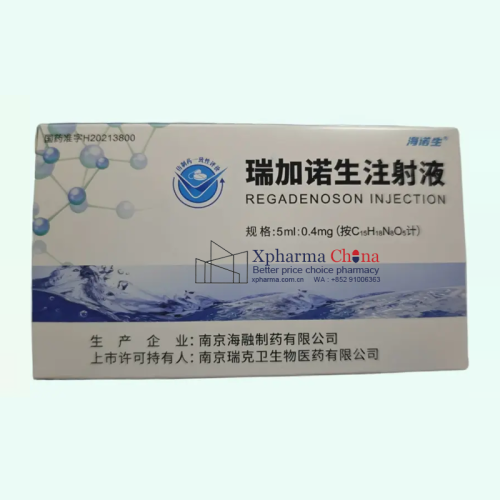
Hainuosheng Regadenoson Injection
Brand Name:海诺生 ®(Hainuosheng®)
Generic Name: Regadenoson
Strength: 0.4 mg per 5 mL vial (calculated as C₁₅H₁₈N₈O₅)
Manufacturer: Nanjing Heron Pharmaceutical Co., Ltd.
Marketing Authorization Holder: Nanjing Ruikewei Biomedical Co., Ltd.
Approval Date in China: October 26, 2021
Registration Number:国药准字 H20213800
Storage: Store at controlled room temperature of 25°C; temporary storage between 15°C and 30°C is permitted, protected from light. Refer to the full package insert for detailed storage specifications.
Price&Cost:Contact Us now for the best price of Regadenoson(Hainuosheng)
Only logged in customers who have purchased this product may leave a review.

Reviews
There are no reviews yet.