1. Indications and Usage
Hypoprothrombinemia: Indicated for the treatment of hypoprothrombinemia caused by vitamin K deficiency or by the use of vitamin K antagonists (e.g., warfarin).
Neonatal Bleeding: Used for the prevention and treatment of bleeding disorders in newborns (often administered as an injection, but oral formulations exist for specific protocols).
Antidote for Superwarfarins: Used as an antidote for poisoning by anticoagulant rodenticides.
2. Dosage and Administration
Adults (Hypoprothrombinemia): The usual dosage is 5–10 mg daily, administered orally. The dose may be increased if necessary, but should be adjusted based on prothrombin time (PT) monitoring.
Newborns: The usual dose is 3 mg, administered orally or intramuscularly.
Administration: Can be taken with or without food. For patients on warfarin, the dose must be carefully titrated to maintain the INR within the therapeutic range without causing excessive bleeding or thrombosis.
3. Mechanism of Action
Clotting Factor Synthesis: Vitamin K₁ (Phytonadione) is a cofactor for the enzyme gamma-glutamyl carboxylase.
Post-Translational Modification: This enzyme catalyzes the carboxylation of glutamate residues on specific amino acids in clotting factors II, VII, IX, and X, as well as proteins C and S. This carboxylation is essential for these factors to bind calcium and participate in the coagulation cascade.
4. Safety and Warnings
Anaphylactoid Reactions: Although this is the oral form, rapid administration of Vitamin K can cause severe hypersensitivity reactions (anaphylaxis, shock, dyspnea) if given parenterally. Oral administration is generally safer but caution is advised.
Hemolytic Anemia: High doses of Vitamin K analogues (not K₁) can cause hemolytic anemia in newborns.
Thromboembolism: Rapid normalization of coagulation factors in patients on warfarin can precipitate thromboembolic events.
Contraindications: Contraindicated in patients with active bleeding due to vitamin K antagonists if the goal is to maintain anticoagulation.
5. Adverse Reactions and Clinical Research
Common Adverse Reactions: Mild flushing, sweating, dizziness, and bitter taste.
Serious Adverse Reactions: Anaphylactoid reactions (more common with IV/IM), hemolytic anemia (in neonates with high doses of analogues), and hyperbilirubinemia.
Clinical Findings: Clinical studies confirm that Vitamin K₁ is the most effective and specific antidote for warfarin overdose, rapidly normalizing INR when administered correctly.
6. Drug Interactions
Anticoagulants: Antagonizes the effects of vitamin K antagonists (e.g., warfarin, acenocoumarol).
Cholestyramine/Mineral Oil: These can interfere with the absorption of Vitamin K from the gastrointestinal tract.
Salicylates: May increase the risk of bleeding when used concurrently with anticoagulants.
7. Pharmaceutical Information
Active Ingredient: Vitamin K₁ (Phytonadione).
Strengths: Typically available as 1 mg, 2.5 mg, and 5 mg tablets.
Appearance: White or yellowish-white tablets, often film-coated.
Storage: Store in a tight, light-resistant container, protected from moisture.
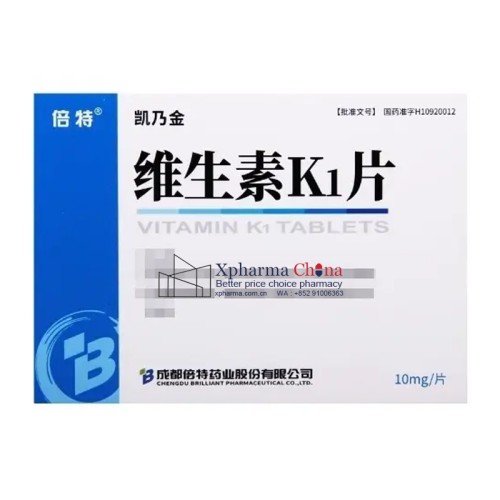
Kainaijin Vitamin K₁ Tablets
Brand Name: 凯乃金®(Kainaijin®)
Generic Name: Vitamin K₁
Strength: 10mg per tablet
Manufacturer: Chengdu Brilliant Pharmaceutical Co.,Ltd.
Marketing Authorization Holder: Chengdu Brilliant Pharmaceutical Co.,Ltd.
Approval Date in China: 2002‑07‑10
Registration Number: 国药准字 H10920012
Storage: Store in a sealed, dry place, protected from light.
Price&Cost:Contact Us now for the best price of Vitamin K₁(Kainaijin)
Only logged in customers who have purchased this product may leave a review.

Reviews
There are no reviews yet.