
1. Indications and Usage
Edema: Indicated for the management of edema associated with congestive heart failure, liver cirrhosis, and renal disease.
Hypertension: Indicated for the management of primary hypertension, alone or in combination with other antihypertensive agents.
2. Dosage and Administration
Edema: The usual starting dose is 10 mg once daily. If the response is inadequate, the dose may be increased to 20 mg once daily.
Hypertension: The usual starting dose is 2.5–5 mg once daily. If blood pressure is not adequately controlled after 4–6 weeks, the dose may be increased to 10 mg once daily.
Administration: Should be taken in the morning to avoid nocturnal diuresis.
3. Mechanism of Action
Loop Diuretic Effect: Torasemide acts on the thick ascending limb of the loop of Henle in the kidney, inhibiting the Na+-K+-2Cl- cotransporter system.
Diuresis: This inhibition increases the excretion of sodium, chloride, and water, producing a potent diuretic effect.
4. Safety and Warnings
Electrolyte Imbalance: The most common risk is hypokalemia, hyponatremia, and metabolic alkalosis. Regular monitoring of electrolytes is essential.
Hepatic Encephalopathy: In patients with liver cirrhosis and ascites, rapid diuresis may precipitate hepatic encephalopathy due to sudden changes in fluid and electrolyte balance.
Contraindications: Contraindicated in patients with anuria or known hypersensitivity to torasemide, sulfonamide-derived drugs, or urea derivatives.
5. Adverse Reactions and Clinical Research
Common Adverse Reactions: Dizziness, headache, nausea, weakness, vomiting, and hypotension.
Metabolic and Other Effects: May cause hyperglycemia, hyperuricemia, and hypomagnesemia.
Serious Adverse Reactions: Severe electrolyte disturbances, arrhythmias (especially in patients on digitalis), and thrombotic events.
6. Drug Interactions
Cardiac Glycosides: Hypokalemia induced by torasemide may increase the toxicity of digoxin or other antiarrhythmic drugs.
NSAIDs: Nonsteroidal anti-inflammatory drugs (e.g., indomethacin) may diminish the diuretic and antihypertensive effects of torasemide.
Lithium: Loop diuretics may reduce lithium clearance, increasing the risk of lithium toxicity.
Aminoglycosides: May increase the risk of ototoxicity.
7. Pharmaceutical Information
Active Ingredient: Torasemide.
Chemical Name: 1-Isopropyl-3-(4-m-toluidinopyridine-3-sulphonyl)urea.
Molecular Formula: C16H20N4O3S
Strengths: Typically available as 2.5 mg, 5 mg, 10 mg, and 20 mg capsules.
Appearance: White or almost white powder.
Storage: Protect from light and store in a tightly closed container.
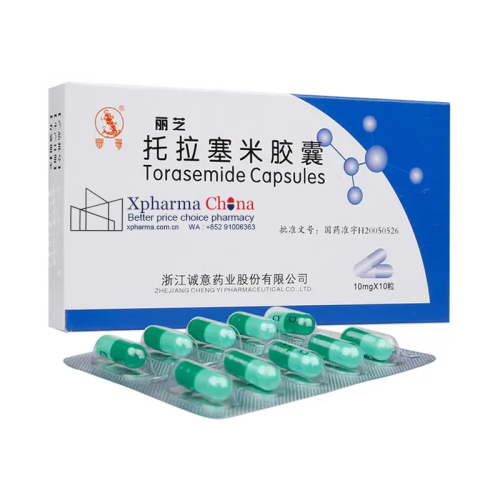
Lizhi Torasemide Capsules
Brand Name: 丽芝®(Lizhi®)
Generic Name: Torasemide
Strength: 10mg per capsule, 10 capsules per box
Manufacturer: Zhejiang Chengyi Pharmaceutical Co., Ltd.
Marketing Authorization Holder: Zhejiang Chengyi Pharmaceutical Co., Ltd.
Approval Date in China: 2005‑05‑16
Registration Number: 国药准字 H20050526
Storage: Store in a sealed, dry place, protected from light.
Price&Cost:Contact Us now for the best price of Torasemide(Lizhi)
Only logged in customers who have purchased this product may leave a review.


Reviews
There are no reviews yet.