
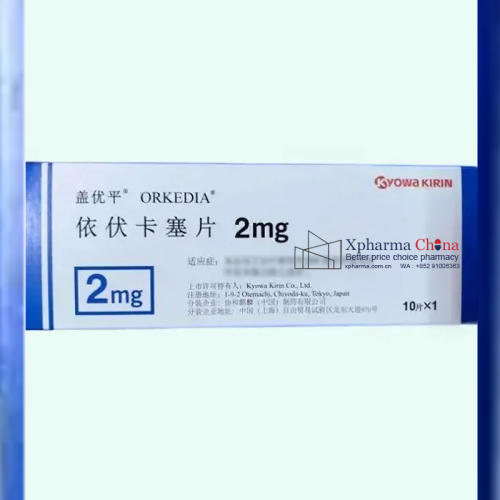
Orkedia Evocalcet Tablets
Brand Name:盖优平 ®(Orkedia®)
Generic Name: Evocalcet
Strength: 2 mg per tablet, 10 tablets per box
Manufacturer: Kyowa Kirin Co., Ltd. Ube Plant
Marketing Authorization Holder: Kyowa Kirin Co., Ltd.
Approval Date in China: June 12, 2024
Registration Number: 国药准字HJ20240034
Storage: Store sealed below 25°C, protected from light and moisture. Avoid high temperature and humid environments. Refer to the full package insert for detailed storage specifications.
Price&Cost:Contact Us now for the best price of Evocalcet(Orkedia)
1. Indications and Usage
Secondary Hyperparathyroidism: Treatment of secondary hyperparathyroidism in adult patients with chronic kidney disease on maintenance dialysis.
2. Dosage and Administration
Route of Administration: Oral administration ONLY.
Recommended Dosage:
Initial Dosing: Typically 1 mg once daily. The starting dose may be increased to 2 mg once daily if serum calcium concentration is ≥9.0 mg/dL and intact parathyroid hormone (iPTH) levels are ≥500 pg/mL.
Titration: Dosage should be adjusted within the range of 1–12 mg once daily, carefully monitoring iPTH and serum calcium levels. Dose increments of 1 mg should be spaced by at least 2 weeks.
Critical Administration Instructions:
Hypocalcemia Management: If serum calcium drops below 8.4 mg/dL, do not increase the dose; consider administering calcium/vitamin D preparations. If calcium drops to ≤7.5 mg/dL, discontinue the drug immediately.
Monitoring: Check serum calcium at least weekly when initiating or adjusting the dose, and at least every 2 weeks during maintenance.
3. Mechanism of Action
Calcium-Sensing Receptor Agonism: Evocalcet binds to calcium-sensing receptors (CaSR) on parathyroid gland cells.
Inhibition of PTH Secretion: This activation inhibits the secretion of parathyroid hormone (PTH), thereby lowering serum PTH levels.
Selectivity: It has high selectivity for CaSR with fewer off-target effects compared to first-generation calcimimetics, leading to reduced gastrointestinal side effects.
4. Safety and Warnings
Hypocalcemia: The most significant risk. Symptoms may include QT interval prolongation, numbness, muscle spasms, arrhythmias, and seizures.
QT Interval Prolongation: Can occur as a result of hypocalcemia.
Hypersensitivity: Contraindicated in patients with a history of hypersensitivity to the drug or its excipients.
Pregnancy and Lactation: Contraindicated in pregnant or potentially pregnant women.
5. Adverse Reactions and Clinical Research
Most Common Adverse Reactions: Hypocalcemia (16.2%) and QT interval prolongation (0.6%).
Other Common Adverse Reactions: Nausea, vomiting, abdominal discomfort, diarrhea, decreased appetite, and dizziness.
Laboratory Abnormalities: Increases in liver enzymes (AST, ALT, γ-GTP) and creatine kinase (CK).
Clinical Research Highlights: Phase 3 trials demonstrated non-inferiority to cinacalcet in achieving target iPTH levels, with a significantly lower incidence of gastrointestinal-related adverse events.
6. Drug Interactions
Calcium and Vitamin D Preparations: Concomitant use may alter serum calcium levels; careful monitoring is required.
CYP450 Substrates: Evocalcet does not significantly inhibit CYP450 enzymes, minimizing pharmacokinetic interactions with other drugs.
7. Pharmaceutical Information
Chemical Composition: Active Ingredient: Evocalcet. Excipients: Microcrystalline cellulose, anhydrous dicalcium phosphate, etc.
Appearance: Film-coated tablets (1 mg or 2 mg).
Packaging: Blister packaging.
Storage: Store below 30°C, protected from moisture and light.
Only logged in customers who have purchased this product may leave a review.
Reviews
There are no reviews yet.