
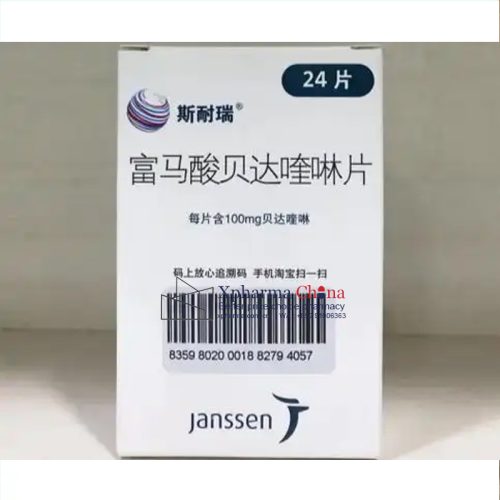
1. Description
Sirturo (bedaquiline fumarate) is a diarylquinoline antimycobacterial drug, specifically targeting the bacterial ATP synthase proton pump of Mycobacterium tuberculosis. Chemically, it is (1R,2S)-1-(6-bromo-2-methoxy-3-quinolyl)-4-dimethylamino-2-(1-naphthyl)-1-phenylbutan-2-ol fumarate. It is supplied as 100mg uncoated tablets, with excipients including microcrystalline cellulose, hypromellose, croscarmellose sodium, colloidal silicon dioxide, magnesium stearate.
2. Indications
As part of a combination antibacterial regimen, it is indicated for the treatment of pulmonary multi-drug resistant tuberculosis (MDR-TB) in adult and pediatric patients aged 5 years and older, when other effective treatment regimens cannot be constructed. It must not be used as monotherapy for tuberculosis.
3. Dosage and Administration
3.1 Administration
Sirturo is for oral use only, tablets should be taken with food to improve bioavailability. Swallow the tablets whole with water; for patients who cannot swallow intact tablets, the 100mg tablets can be dispersed in water and ingested immediately. It must always be used in combination with at least 3 other anti-tuberculosis drugs confirmed to be effective for the patient’s MDR-TB strain.
3.2 Dosage
Adults (≥18 years, body weight ≥30kg): 400mg once daily for the first 2 weeks, followed by 200mg 3 times per week (with at least 48 hours between doses) for the subsequent 22 weeks, total treatment course of 24 weeks.
Pediatric Patients (5-17 years): Adjust dose by body weight: 15-29kg take 200mg daily for 2 weeks then 100mg 3 times weekly; ≥30kg follow the adult dosing regimen.
Renal Impairment: No initial dose adjustment for mild to moderate renal impairment; use with caution in severe renal impairment (eGFR <30mL/min/1.73m²) due to limited clinical data.
Hepatic Impairment: No dose adjustment for mild hepatic impairment; avoid use in moderate to severe hepatic impairment unless the clinical benefit outweighs the risk.
4. Warnings and Precautions
QT Prolongation: Bedaquiline can prolong the QT interval. Perform ECG monitoring before initiation, at 2 weeks and 12 weeks of treatment. Avoid co-administration with other QT-prolonging drugs.
Increased Mortality: In placebo-controlled clinical trials, higher all-cause mortality was observed in the bedaquiline group. Use the drug only when no other effective treatment options are available.
Hepatotoxicity: Monitor serum hepatic transaminases and bilirubin at baseline and monthly during treatment. Discontinue treatment if liver injury related symptoms and persistent elevated transaminases occur.
Drug Resistance Risk: Monotherapy will rapidly induce bedaquiline-resistant Mycobacterium tuberculosis strains, which must be strictly avoided.
Patient Adherence: Directly observed therapy (DOT) is strongly recommended to ensure full course administration and prevent resistance.
5. Contraindications
Confirmed severe hypersensitivity to bedaquiline fumarate or any excipients in the formulation.
Concomitant use with strong CYP3A4 inducers (e.g. rifampicin, rifapentine) that can significantly reduce bedaquiline plasma concentration.
Patients with congenital long QT syndrome, history of torsades de pointes, or uncorrected severe hypokalemia/hypomagnesemia.
6. Adverse Reactions
Common (≥10% incidence): Nausea, arthralgia, headache, vomiting, dizziness.
Less Common (1-10% incidence): Prolonged QT interval, hepatic enzyme elevation, pruritus, diarrhea.
Serious Adverse Reactions: Severe ventricular arrhythmia secondary to QT prolongation, severe drug-induced liver injury, and rare cases of hypersensitivity pneumonitis.
7. Drug Interactions
Strong CYP3A4 Inducers: Rifamycins, carbamazepine and St. John's Wort can reduce bedaquiline AUC by more than 50%, leading to treatment failure and drug resistance, co-administration is contraindicated.
Strong CYP3A4 Inhibitors: Systemic azole antifungals, macrolide antibiotics can increase bedaquiline exposure by 2-3 times, avoid long-term combined use.
QT-Prolonging Drugs: Co-administration with fluoroquinolones, clofazimine, amiodarone will produce additive QT prolongation effect, strictly avoid combination if possible.
Anti-Tuberculosis Agents: No significant pharmacokinetic interaction with pyrazinamide, ethambutol or cycloserine has been observed.
8. Use in Specific Populations
Pregnancy: Use only if the potential benefit justifies the potential risk to the fetus, as there are no adequate well-controlled human studies.
Lactation: Breastfeeding is not recommended during treatment, bedaquiline is excreted in human milk and may cause liver and cardiac risks to infants.
Pediatric Use: Safety and efficacy are confirmed in patients aged 5 years and older; not recommended for children under 5 years old due to insufficient data.
Geriatric Use: Elderly patients (≥65 years) should be monitored closely for QT prolongation and liver function changes, as they are more sensitive to drug-related toxicities.
Renal/Hepatic Impairment: Strictly monitor adverse reactions in severe renal impairment, and avoid use in moderate to severe hepatic impairment.

Reviews
There are no reviews yet.