
- Indications and Usage hATTR-CM: Indicated for the treatment of adult patients with hereditary transthyretin-mediated amyloid cardiomyopathy (ATTR-CM) to reduce cardiovascular death and cardiovascular-related hospitalizations. wtATTR-CM: Indicated for the treatment of adult patients with wild-type ATTR-CM to reduce cardiovascular death and cardiovascular-related hospitalizations. hATTR-PN: Indicated for the treatment of adult patients with hereditary transthyretin-mediated polyneuropathy to slow the progression of neuropsychiatric manifestations.
- Dosage and Administration Recommended Dosage: The recommended dosage is 20 mg taken orally once daily. Administration: The capsules should be swallowed whole with water and can be taken with or without food. Dosing Consistency: Unlike standard tafamidis free acid formulations, the meglumine salt formulation (Vyndamax) is typically maintained at 20 mg daily without mandatory tapering in long-term clinical practice.
- Mechanism of Action TTR Inhibition: Tafamidis is a selective transthyretin kinetic inhibitor. Stabilization Pathway: It binds with high affinity to the thyroxine-binding sites of the transthyretin (TTR) tetramer, stabilizing the quaternary structure and preventing dissociation into monomers. Fibril Prevention: By inhibiting tetramer dissociation, the drug prevents the misfolding and polymerization of monomers into amyloid fibrils, thereby slowing the progression of cardiac and neurological damage.
- Safety and Warnings Fetal Embryolethality: Based on animal studies, tafamidis can cause fetal harm; however, human data on major birth defects is limited. Breastfeeding Contraindication: It is not known if tafamidis is excreted in human milk, and breastfeeding is generally discouraged during treatment due to potential adverse effects on infants.
- Adverse Reactions and Clinical Research Clinical Trials: The global Phase 3 ATTR-ACT trial demonstrated that tafamidis significantly reduces the risk of all-cause death by 30% and cardiovascular-related hospitalizations by 32% over 30 months compared to placebo. Common Adverse Reactions: Peripheral edema, diarrhea, pyrexia, ventricular tachycardia, abdominal pain, muscle spasms, and pallor are among the frequently reported adverse reactions.
- Drug Interactions Metabolic Pathway: Tafamidis is primarily metabolized by glucuronidation via uridine 5′-diphospho-glucuronosyltransferases (UGT1A1 and UGT1A3). CYP Interactions: It is not metabolized by the cytochrome P450 (CYP) enzyme system, making interactions with CYP inducers or inhibitors highly unlikely. Excretory Pathways: It is neither a substrate nor an inhibitor of P-glycoprotein (P-gp), suggesting a low risk for transporter-mediated interactions.
- Pharmaceutical Information Active Ingredient: Tafamidis (as meglumine salt) . Dosage Form: 20 mg soft capsules; the meglumine salt form has higher water solubility compared to the free acid formulation. Storage: Store at 20°C to 25°C (68°F to 77°F) in the original package to protect from moisture and light.
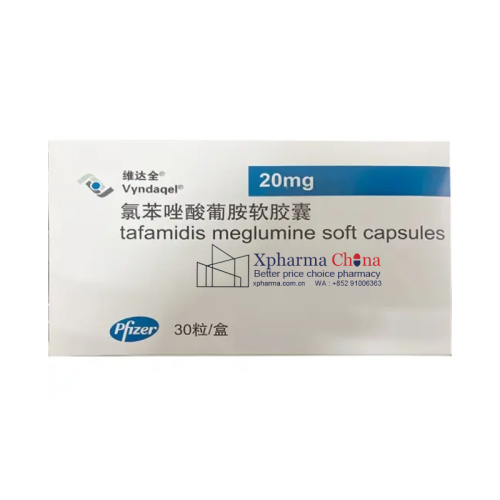
Weidaquan Tafamidis Meglumine Soft Capsules
Brand Name:维达全 ®(Weidaquan®)
Generic Name: Tafamidis Meglumine
Strength: 20 mg per soft capsule, 30 capsules per box
Manufacturer: Catalent Pharma Solutions, LLC
Marketing Authorization Holder: Pfizer Europe MA EEIG
Approval Date in China: February 05, 2020
Registration Number:国药准字 HJ20200001
Storage: Store tightly sealed at controlled room temperature between 15°C and 30°C, protected from light and moisture. Refer to the full package insert for detailed storage specifications.
Price&Cost:Contact Us now for the best price of Tafamidis Meglumine(Weidaquan)
Only logged in customers who have purchased this product may leave a review.


Reviews
There are no reviews yet.