
1. Indications and Usage
HCV Infection: Treatment of chronic hepatitis C virus (HCV) infection in adults and pediatric patients aged 3 years and older, in combination with other direct-acting antivirals (DAAs).
2. Dosage and Administration
Route of Administration: Oral administration ONLY.
Recommended Dosage:
Adults: Typically 300 mg twice daily.
Pediatrics: Dosing based on body weight (e.g., 15 mg/kg twice daily for specific weight ranges).
Critical Administration Instructions:
Food Requirement: Must be taken with food to ensure adequate systemic absorption.
Combination Therapy: Must be used as part of a fixed-dose combination regimen (e.g., with Glecaprevir) and not as monotherapy to prevent viral resistance.
Missed Dose: If a dose is missed, it should be taken as soon as remembered on the same day. If missed by more than 12 hours, skip the dose and resume the regular schedule the next day.
3. Mechanism of Action
NS5B Polymerase Inhibition: Ravidasvir is a non-nucleoside inhibitor (NNI) of the HCV NS5B RNA-dependent RNA polymerase.
Viral Replication Blockade: It binds to a hydrophobic pocket of the NS5B protein, inducing a conformational change that locks the polymerase in an inactive state.
Selectivity: This mechanism specifically blocks HCV replication with a high genetic barrier to resistance and no cross-resistance with other NNIs or nucleos(t)ide analog inhibitors.
4. Safety and Warnings
Hepatotoxicity: Risk of significant ALT/AST elevations. Monitor liver function tests before initiation and periodically during treatment.
HBV Reactivation: Potential risk of Hepatitis B virus (HBV) reactivation in co-infected patients. Screen for HBV status prior to treatment.
Drug Interactions: Concomitant use with strong inducers of both CYP3A4 and BSEP (e.g., rifampin, carbamazepine) is contraindicated due to the risk of reduced exposure and therapeutic failure.
5. Adverse Reactions and Clinical Research
Most Common Adverse Reactions: Headache, fatigue, diarrhea, and nausea.
Laboratory Abnormalities: Asymptomatic increases in ALT, AST, and bilirubin.
Clinical Research Highlights: Phase 3 clinical trials (e.g., PEARLS program) demonstrated robust sustained virologic response (SVR12) rates (>95%) across various HCV genotypes in both treatment-naïve and treatment-experienced populations.
6. Drug Interactions
CYP3A4 and BSEP Modulators: Ravidasvir is a substrate of CYP3A4 and BSEP. Strong inducers of these pathways significantly reduce drug exposure.
OATP1B1/3 Inhibitors: Concomitant use with OATP1B1/3 inhibitors (e.g., cyclosporine) may increase ravidasvir exposure.
Acid-Reducing Agents: Generally have minimal impact on absorption compared to other DAAs, but clinical guidance should be followed.
7. Pharmaceutical Information
Chemical Composition: Active Ingredient: Ravidasvir Hydrochloride.
Appearance: Film-coated tablets (often part of a fixed-dose combination tablet).
Packaging: Blister packaging or bottles.
Storage: Store at controlled room temperature; protect from moisture.
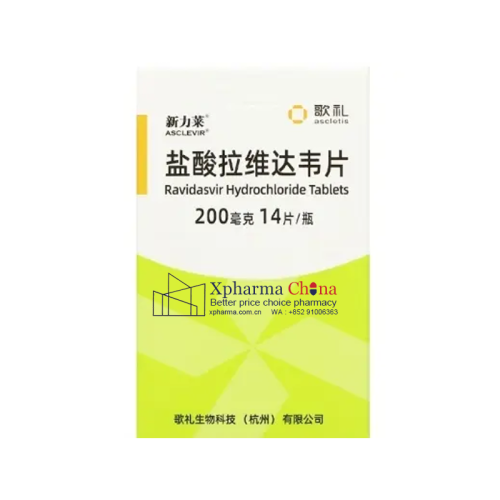
Xinlilai Ravidasvir Hydrochloride Tablets
Brand Name: 新力莱 ®(Xinlilai®)
Generic Name: Ravidasvir Hydrochloride
Strength: 200 mg per tablet, 14 tablets per bottle
Manufacturer: Ascletis Pharma (Zhejiang) Co., Ltd.
Marketing Authorization Holder: Ascletis BioTech (Hangzhou) Co., Ltd.
Approval Date in China: July 31, 2020
Registration Number: 国药准字H20200008
Storage: Store tightly sealed at room temperature, protected from light and moisture. Refer to the full package insert for detailed storage specifications.
Price&Cost:Contact Us now for the best price of Ravidasvir Hydrochloride(Xinlilai)
Only logged in customers who have purchased this product may leave a review.

Reviews
There are no reviews yet.