
1. Indications and Usage
ALK-Positive NSCLC: Treatment of patients with anaplastic lymphoma kinase (ALK)-positive metastatic non-small cell lung cancer (NSCLC) .
Clinical Stages:
Second-line Therapy: Patients who have received crizotinib as prior therapy (resistant or intolerant) .
First-line Therapy: Newly diagnosed patients (approved in US/EU/Japan; specific regional approval status varies) .
2. Dosage and Administration
Administration: Oral administration. The capsule must be swallowed whole with water.
Food Requirement: Must be taken with food (any meal or snack). Taking with food reduces gastrointestinal side effects and ensures consistent absorption .
Standard Dose:
Recommended Dose: 450 mg once daily at the same time each day .
Missed Dose: If a dose is missed, it should be taken as soon as possible unless it is within 12 hours of the next scheduled dose. Do not make up for the missed dose .
Dose Adjustment:
Reduce dose in 150 mg decrements (to 300 mg, then 150 mg) based on individual tolerability .
Strong CYP3A Inhibitors: If co-administration with strong CYP3A inhibitors (e.g., ketoconazole, ritonavir) is unavoidable, reduce the dose by approximately one-third (e.g., from 450 mg to 300 mg once daily) .
3. Mechanism of Action
Ceritinib is a second-generation ALK tyrosine kinase inhibitor (TKI).
It binds to the ATP-binding pocket of the ALK receptor tyrosine kinase, inhibiting its autophosphorylation and downstream signaling pathways (such as STAT3).
It is designed to be more potent than crizotinib and can inhibit many crizotinib-resistant ALK mutations .
4. Safety and Warnings
Hepatotoxicity: Severe liver damage may occur. Monitor liver enzymes (ALT, AST) and bilirubin before initiation and monthly thereafter .
Gastrointestinal Toxicity: Severe diarrhea, nausea, vomiting, and abdominal pain are common. Anti-diarrheals and anti-emetics should be used as needed .
QT Interval Prolongation: Can prolong the QT interval. Monitor ECG and electrolytes periodically .
Non-Infectious Pneumonitis: Severe or fatal pneumonitis can occur. Interrupt therapy if suspected and permanently discontinue if confirmed .
Heart Rate Disorders: Can cause symptomatic bradycardia. Monitor heart rate and blood pressure .
Hyperglycemia: Monitor fasting blood glucose levels, especially in patients with diabetes .
Embryo-Fetal Toxicity: May cause fetal harm. Contraception is required .
5. Adverse Reactions
Common adverse reactions (incidence ≥25%) include:
Diarrhea, Nausea, Vomiting, Abdominal pain.
Fatigue, Decreased appetite.
Constipation, Dysgeusia (taste disturbance).
Elevated liver enzymes (ALT/AST) .
6. Drug Interactions
CYP3A Inhibitors: Avoid strong CYP3A inhibitors (e.g., ketoconazole, clarithromycin, itraconazole, ritonavir) as they significantly increase Ceritinib exposure. If unavoidable, reduce dose .
CYP3A Inducers: Avoid strong CYP3A inducers (e.g., rifampin, carbamazepine, St. John’s wort) as they reduce efficacy .
P-gp Substrates: Ceritinib is a P-gp substrate; co-administration with P-gp inhibitors may increase exposure .
7. Pharmaceutical Information
Chemical Name: 5-Chloro-N²-[2-isopropoxy-5-methyl-4-(4-piperidinyl)phenyl]-N⁴-[2-(isopropylsulfonyl)phenyl]-2,4-pyrimidinediamine
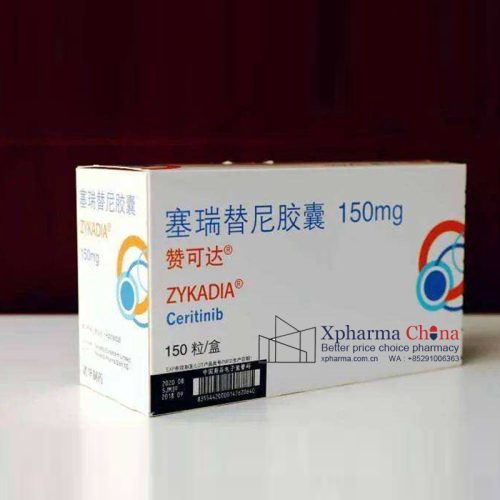
Zykadia®Ceritinib Capsules
Brand Name: 赞可达® (Zykadia®)
Generic Name: Ceritinib
Strength: 150 mg per capsule, 150 capsules per box
Manufacturer: Novartis Pharma Stein AG (Switzerland)
Marketing Authorization Holder: Novartis Pharma AG; Domestic marketing: Beijing Novartis Pharma Co., Ltd.
Approval Date in China: May 31, 2018
Registration Number: 国药准字H20180025
Storage: Store in the original packaging at a temperature not exceeding 25°C, allow short-term transportation between 15–30°C, protect from light and moisture, keep out of reach of children
Price&Cost:Contact Us now for the best price of Ceritinib(Zykadia)
Only logged in customers who have purchased this product may leave a review.

Reviews
There are no reviews yet.