
1. Indications and Usage
Mantle Cell Lymphoma (MCL): Treatment of adult patients with MCL who have received at least one prior therapy .
Chronic Lymphocytic Leukemia (CLL) / Small Lymphocytic Lymphoma (SLL): Treatment of adult patients with CLL or SLL .
2. Dosage and Administration
Administration: Oral administration. Capsules must be swallowed whole with water. Do not chew, open, or crush the capsule.
Food Requirement: Can be taken with or without food .
Standard Dose:
Recommended Dose: 100 mg twice daily (approximately every 12 hours) .
Missed Dose: If a dose is missed, take it as soon as possible unless it is within 3 hours of the next scheduled dose. Do not make up for the missed dose .
Dose Modification: Interrupt treatment or reduce dose for toxicities such as severe neutropenia, thrombocytopenia, or bleeding .
3. Mechanism of Action
Acalabrutinib is a potent, selective, oral small-molecule inhibitor of Bruton’s tyrosine kinase (BTK).
It covalently binds to the cysteine residue in the ATP-binding site of BTK, inhibiting BTK enzymatic activity.
BTK is an essential signaling molecule in the B-cell antigen receptor (BCR) pathway.
By blocking this pathway, acalabrutinib inhibits B-cell proliferation and tumor growth .
4. Safety and Warnings
Hemorrhage: Serious and fatal hemorrhagic events can occur. Monitor for signs of bleeding. Interrupt therapy for 3–7 days prior to major surgery .
Atrial Fibrillation: Acalabrutinib can cause atrial fibrillation. Monitor for palpitations, dizziness, or syncope and manage accordingly .
Infections: Serious and fatal infections can occur. Monitor for signs of infection (e.g., fever, chills) and treat promptly .
Cytopenias: Severe neutropenia and thrombocytopenia may occur. Monitor Complete Blood Counts (CBC) regularly .
5. Adverse Reactions
Common adverse reactions (incidence ≥20%) include:
Headache, Diarrhea.
Fatigue, Asthenia, Pyrexia.
Musculoskeletal pain (e.g., arthralgia, myalgia).
Hemorrhagic events (e.g., bruising, petechiae, epistaxis).
Nausea, Rash.
Neutropenia, Thrombocytopenia, Anemia .
6. Drug Interactions
CYP3A Inhibitors: Avoid co-administration with strong CYP3A inhibitors (e.g., ketoconazole, clarithromycin) as they increase Acalabrutinib exposure. If unavoidable, reduce dose to 100 mg once daily .
CYP3A Inducers: Avoid co-administration with strong CYP3A inducers (e.g., rifampin) as they reduce efficacy .
Acid-Reducing Agents:
PPIs: Avoid co-administration with Proton Pump Inhibitors (e.g., omeprazole) as they may significantly reduce solubility.
H2 Blockers/Antacids: Separate administration by 2 hours .
7. Pharmaceutical Information
Chemical Name: 2-(3,3-difluoro-1-(4-fluorophenyl)cyclobutylamino)-N-(6-oxo-5,6-dihydro-1,6-naphthyridin-3-yl)pyridine-3-carboxamide .
Molecular Formula: C22H20F3N5O2 .
Storage: Store at 20°C to 25°C (68°F to 77°F); excursions permitted to 15°C to 30°C (59°F to 86°F) .
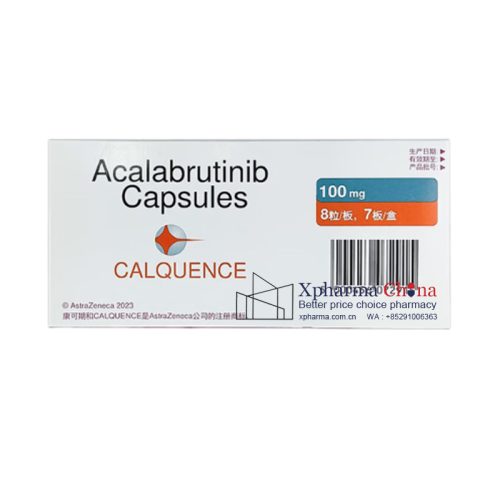
Calquence®Acalabrutinib Capsules
Brand Name: 康可期 ®(Calquence®)
Generic Name: Acalabrutinib
Strength: 100 mg per capsule; 8 capsules per blister, 7 blisters per box (total 56 capsules/box)
Manufacturer: AstraZeneca AB
Marketing Authorization Holder: AstraZeneca AB; Domestic agent: AstraZeneca Investment (China) Co., Ltd.
Approval Date in China: March 23, 2023
Registration Number: 国药准字HJ20233138
Storage: Store at 20°C–25°C, brief transportation between 15°C–30°C is permitted; keep sealed, protected from light and moisture, keep away from children
Price&Cost:Contact Us now for the best price of Acalabrutinib(Calquence)
Only logged in customers who have purchased this product may leave a review.
Reviews
There are no reviews yet.