1. Indications and Usage
Hepatocellular Carcinoma (HCC): Treatment of patients with unresectable hepatocellular carcinoma who have not received prior systemic therapy .
Differentiated Thyroid Cancer (DTC): Treatment of patients with progressive, locally advanced, metastatic, or radioactive iodine-refractory differentiated thyroid cancer .
Renal Cell Carcinoma (RCC): In combination with everolimus for patients with advanced RCC who have received prior anti-angiogenic therapy .
2. Dosage and Administration
Administration: Oral administration. Swallow capsules whole. If swallowing is difficult, the capsule contents may be dispersed in water or apple juice (do not crush), let stand for 10 minutes, stir for 3 minutes, and drink immediately. Rinse with more liquid and drink .
Food Requirement: Can be taken with or without food .
Standard Dose:
HCC: 12 mg once daily (if body weight ≥60 kg) or 8 mg once daily (if body weight <60 kg) .
DTC: 24 mg once daily .
Missed Dose: If a dose is missed and can be taken at least 12 hours before the next scheduled dose, take it as soon as possible. Otherwise, skip the missed dose .
3. Mechanism of Action
Lenvatinib is a multi-kinase inhibitor. It inhibits the kinase activity of vascular endothelial growth factor (VEGF) receptors VEGFR1, VEGFR2, and VEGFR3, which are critical for angiogenesis.
It also inhibits other receptor tyrosine kinases (RTKs) involved in tumor angiogenesis and oncogenic signaling, including fibroblast growth factor receptors (FGFRs), PDGFRα, KIT, and RET .
4. Safety and Warnings
Hypertension: Severe hypertension is common. Blood pressure must be monitored and controlled before and during treatment .
Proteinuria and Nephrotic Syndrome: Monitor urine protein regularly. Severe proteinuria or nephrotic syndrome requires dose interruption or discontinuation .
Cardiac Dysfunction: Can cause heart failure. Monitor for signs of heart failure .
Hepatotoxicity: Monitor liver function tests regularly .
Gastrointestinal Perforation and Fistula: Fatal or serious cases have occurred. Permanently discontinue if perforation occurs .
Thyroid Dysfunction: Monitor thyroid function, especially in patients with DTC .
Embryo-Fetal Toxicity: May cause fetal harm. Contraception is required for females and males during treatment and for at least 1 week after the final dose .
5. Adverse Reactions
Common adverse reactions (incidence ≥30%) include:
Hypertension, Fatigue, Diarrhea.
Arthralgia, Myalgia, Decreased appetite.
Nausea, Vomiting, Stomatitis, Headache.
Weight decreased, Proteinuria, Palmar-plantar erythrodysesthesia syndrome (PPES), Dysphonia .
6. Drug Interactions
CYP3A Substrate: Lenvatinib is metabolized by CYP3A4. Avoid co-administration with strong CYP3A4 inhibitors (e.g., ketoconazole) or inducers (e.g., rifampin) as they may alter drug exposure .
P-gp Substrate: Lenvatinib is a P-gp substrate. P-gp inhibitors may increase its exposure .
7. Pharmaceutical Information
Chemical Name: 4-[3-chloro-4-[(cyclopropylcarbamoyl)amino]phenoxy]-7-methanesulfonate
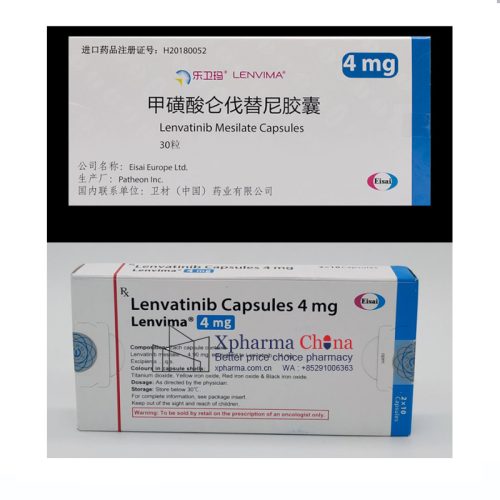
Lenvima®Lenvatinib Mesilate Capsules
Brand Name: 乐卫玛® (Lenvima®)
Generic Name: Lenvatinib Mesilate
Strength: 4 mg per capsule, 30 capsules per box
Manufacturer: Patheon Inc.
Marketing Authorization Holder: Eisai Europe Ltd.;国内联系单位:卫材(中国)药业有限公司
Approval Date in China: September 4, 2018
Registration Number: 国药准字H20180052
Storage: Store below 30°C, sealed and protected from light, keep out of sight and reach of children
Price&Cost:Contact Us now for the best price of Lenvatinib Mesilate(Lenvima)
Only logged in customers who have purchased this product may leave a review.


Reviews
There are no reviews yet.