
1. Indications and Usage
Hyperphosphatemia in CKD Patients on Dialysis: Treatment of adult patients with chronic kidney disease (CKD) on dialysis to lower serum phosphorus levels.
It is indicated as an add-on therapy to phosphate binders for patients who have an inadequate response or are intolerant to any dose of phosphate binders.
It is applicable to adult patients with chronic kidney disease (CKD) undergoing dialysis to reduce serum phosphorus levels. As an additional treatment for insufficient response or intolerance to phosphate binders.
2. Dosage and Administration
Administration: Oral administration.
Recommended Dose: 30 mg twice daily.
Timing: Take within 30 minutes before the first and last meals of the day.
Dialysis Administration: For patients on hemodialysis, do not administer the dose before dialysis (to avoid missing the dose if dialysis is prolonged). Instead, take the dose before the first meal after dialysis.
Dose Adjustment: To manage tolerability (specifically diarrhea), the dose may be reduced to 10 mg twice daily. If diarrhea resolves, the dose may be increased back to 30 mg twice daily.
3. Mechanism of Action
Tenapanor is a minimally absorbed inhibitor of intestinal sodium absorption.
It works by inhibiting the NHE3 (sodium-hydrogen exchanger 3) transporter on the apical membrane of intestinal epithelial cells.
Phosphate Reduction: Inhibition of NHE3 reduces the paracellular absorption of phosphate, leading to increased fecal phosphate excretion and lower serum phosphorus levels.
Sodium & Water: It also increases sodium excretion in the stool, which draws water into the intestinal lumen, resulting in softer stools.
4. Safety and Warnings
Diarrhea: Diarrhea is the most common dose-limiting adverse reaction. Patients should be monitored for signs of dehydration and electrolyte imbalance. Dose reduction is recommended if severe diarrhea occurs.
Gastrointestinal Obstruction: Contraindicated in patients with known or suspected gastrointestinal obstruction.
Dehydration: Monitor for dehydration, especially in dialysis patients who may already be fluid restricted.
Pediatric Use: Contraindicated in pediatric patients younger than 6 years of age.
5. Adverse Reactions
The most common adverse reaction is Diarrhea (incidence 34%-53% in clinical trials).
Gastrointestinal: Diarrhea, constipation, nausea, abdominal pain, dyspepsia.
Metabolic: Hypophosphatemia (if combined with phosphate binders), hyperkalemia.
6. Drug Interactions
Antidiarrheals: Agents affecting intestinal motility (e.g., loperamide) may alter the efficacy or safety profile of Tenapanor.
Phosphate Binders: When used concomitantly with phosphate binders, monitor serum phosphorus to avoid hypophosphatemia.
OATP2B1 Substrates: Tenapanor may reduce the exposure of OATP2B1 substrates (e.g., enalapril). Monitor for loss of efficacy and adjust dosage as needed.
7. Pharmaceutical Information
Chemical Name: 2-(3,5-dichlorophenyl)-N-[4-(4-propyl-1H-1,2,3-triazol-1-yl)phenyl]acetamide hydrochloride.
Molecular Formula: C17H15Cl2N5O · HCl.
Storage: Store at 20°C to 25°C (68°F to 77°F); excursions permitted to 15°C to 30°C (59°F to 86°F). Keep container tightly closed in a dry place.
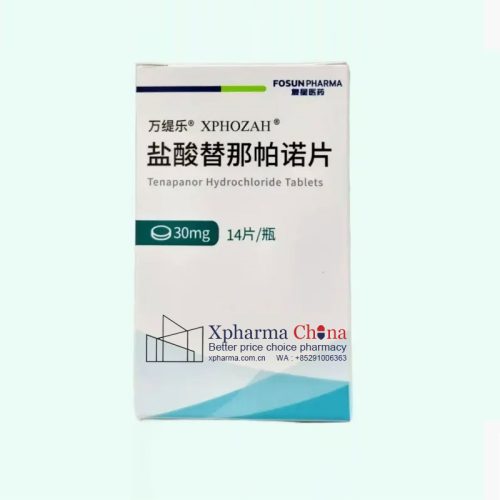
Xphozah Tenapanor Hydrochloride Tablets
Brand Name: 万缇乐® (Xphozah®)
Generic Name: Tenapanor Hydrochloride
Strength: 30 mg per tablet, 14 tablets per bottle
Manufacturer: Patheon Pharmaceuticals Inc.
Marketing Authorization Holder: Ardelyx, Inc.;境内商业化责任人:上海复星医药产业发展有限公司
Approval Date in China: February 25, 2025
Registration Number: 国药准字HJ20250020
Storage: Store at 20℃–25℃, short-term fluctuation between 15℃–30℃ is acceptable; keep the bottle tightly sealed, retain the desiccant inside the original bottle, protect from moisture, and keep out of sight and reach of children
Price&Cost:Contact Us now for the best price of Tenapanor Hydrochloride(Xphozah)
Only logged in customers who have purchased this product may leave a review.


Reviews
There are no reviews yet.