
1. Indications and Usage
Multidrug-Resistant Tuberculosis (MDR-TB):
Indicated as part of an appropriate combination regimen for the treatment of adult patients with multidrug-resistant pulmonary tuberculosis (MDR-TB) for whom an effective treatment regimen cannot otherwise be composed due to drug resistance or intolerance.
2. Dosage and Administration
Administration: Oral administration. Must be taken with food to enhance bioavailability. Tablets should be swallowed whole with water.
Dosing (Adults):
Recommended Dose: 100 mg twice daily.
Duration: Continuous treatment for 24 weeks.
Dose Adjustment:
Hepatic Impairment: No adjustment for mild impairment. Not recommended for moderate to severe impairment.
Renal Impairment: No adjustment for mild to moderate impairment. Not recommended for severe impairment due to lack of data.
Hypokalemia/Hypomagnesemia: Correct electrolyte imbalances before initiation.
3. Mechanism of Action
Nitro-imidazo-oxazole Derivative: Delamanid is a novel antimycobacterial agent.
Pathway: It inhibits the synthesis of methoxy- and keto-mycolic acids, which are essential components of the mycobacterial cell wall.
Activation: The drug is activated by deazaflavin-dependent N(5)-oxidoreductase (F420) in Mycobacterium tuberculosis.
Physiological Effect: Disruption of cell wall synthesis leads to bacterial cell death. It shows no cross-resistance with currently used anti-tuberculosis drugs.
4. Safety and Warnings
QTc Prolongation: Delamanid causes QT interval prolongation. It is contraindicated in patients with QTc > 450 ms. Baseline and periodic ECG monitoring is required.
Hepatotoxicity: Elevations in liver enzymes can occur. Monitor liver function tests (ALT, AST) before and during treatment.
Serum Albumin: Delamanid is highly bound to albumin. Use is contraindicated in patients with serum albumin < 2.8 g/dL due to increased risk of QTc prolongation.
Pregnancy and Lactation: Contraindicated in pregnant women and women of childbearing potential not using contraception.
5. Adverse Reactions
Most Common: Nausea, vomiting, headache, insomnia, dizziness, nausea, and diarrhea.
Laboratory Abnormalities: Hypokalemia, hypomagnesemia, anemia, leukopenia, and increased hepatic enzymes.
6. Drug Interactions
CYP3A4 Inducers: Contraindicated with strong CYP3A4 inducers (e.g., rifampicin, carbamazepine, phenytoin, phenobarbital) as they significantly reduce delamanid plasma concentrations.
QTc-Prolonging Drugs: Caution advised with other drugs known to prolong QTc interval (e.g., fluoroquinolones, amiodarone). Frequent ECG monitoring is recommended.
CYP3A4 Inhibitors: Delamanid is not a significant inhibitor or substrate of CYP3A4, but interactions via plasma protein binding displacement may occur.
7. Pharmaceutical Information
Chemical Name: (2R)-2-methyl-6-nitro-2-[(4-{4-[4-(trifluoromethoxy)phenoxy]piperidin-1-yl}phenoxy)methyl]-2,3-dihydroimidazo
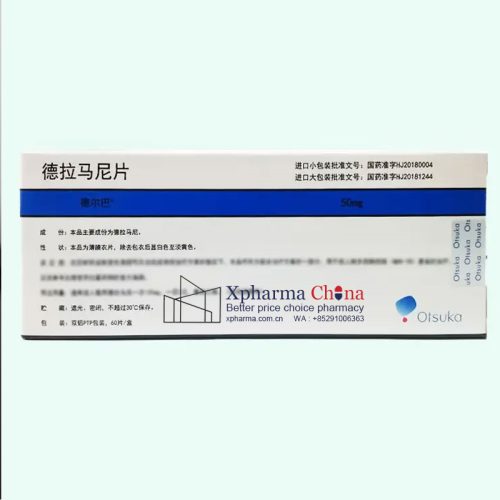
Deltyba Delamanid Film-coated Tablets
Brand Name: 德尔巴 ®(Deltyba®)
Generic Name: Delamanid
Strength: 50 mg per film-coated tablet, 60 tablets per box
Manufacturer: Otsuka Pharmaceutical Co.,Ltd. Tokushima Itano Factory
Marketing Authorization Holder: 浙江大冢制药有限公司(大冢制药中国主体)
Approval Date in China: March 23, 2018
Registration Number: 国药准字 HJ20180004(进口小包装);国药准字 HJ20181244(进口大包装)
Storage: Seal tightly, protect from light, store at temperature not exceeding 30℃; keep out of sight and reach of children
Price&Cost:Contact Us now for the best price of Delamanid(Deltyba)
Only logged in customers who have purchased this product may leave a review.

Reviews
There are no reviews yet.