
1. Indications and Usage
First-Line Treatment of Metastatic Non-Small Cell Lung Cancer (NSCLC):
Indicated for the first-line treatment of patients with metastatic NSCLC with non-resistance T790M mutation EGFR mutations (exon 19 deletions or exon 21 L858R substitution mutations).
Locally Advanced or Metastatic Squamous NSCLC:
Indicated for the first-line treatment of patients with locally advanced or metastatic squamous NSCLC after failure of at least one platinum-based chemotherapy.
2. Dosage and Administration
Recommended Dosage:
Adults: 40 mg orally once daily.
Administration Instructions:
Administer at least 1 hour before or 3 hours after meals.
Swallow the tablets whole with water.
Dose Modifications:
Dose reductions to 30 mg or 20 mg are recommended based on individual safety and tolerability, particularly for severe or intolerant diarrhea, skin toxicity, or interstitial lung disease.
3. Mechanism of Action
Irreversible ErbB Family Blocker:
Afatinib is an orally available, irreversible tyrosine kinase inhibitor (TKI).
Physiological Effect:
It binds covalently to the kinase domains of EGFR (ErbB1), HER2 (ErbB2), and HER4 (ErbB4), blocking downstream signaling pathways (such as MAPK and PI3K/Akt) that regulate cell proliferation and survival in tumor cells.
4. Safety and Warnings
Interstitial Lung Disease (ILD):
Fatal cases of ILD have been reported. Afatinib should be permanently discontinued in patients who develop suspected drug-induced ILD.
Diarrhea:
Severe and prolonged diarrhea can lead to dehydration and renal failure. Patients should be instructed to use anti-diarrheal agents (e.g., loperamide) at the first sign of loose stools.
Hepatotoxicity:
Elevations in liver enzymes have been observed. Monitor liver function before initiation and periodically during treatment.
Corneal Disorders:
Cases of keratitis and ulcerative keratitis have been reported. Patients should be monitored for signs and symptoms such as eye pain, photophobia, or redness.
Embryo-Fetal Toxicity:
Based on its mechanism of action, afatinib can cause fetal harm.
5. Adverse Reactions
Most Common:
Diarrhea, rash/acneiform dermatitis, stomatitis, paronychia, decreased appetite, and pruritus.
Laboratory Abnormalities:
Increased alanine aminotransferase (ALT), increased aspartate aminotransferase (AST), decreased serum potassium.
6. Drug Interactions
P-glycoprotein (P-gp) Inhibitors:
Concomitant use of P-gp inhibitors (e.g., ritonavir, cyclosporine, ketoconazole) may increase afatinib exposure. Dosing intervals should be separated, or dose reduction considered.
P-gp Inducers:
Concomitant use of P-gp inducers (e.g., rifampin, carbamazepine) may decrease afatinib exposure. Dose increase may be considered.
7. Pharmaceutical Information
Chemical Name:
(2E)-N-[4-[(3-Chloro-4-fluorophenyl)amino]-7-[[(3S)-tetrahydrofuran-3-yl]oxy]quinazolin-6-yl]-4-(dimethylamino)but-2-enamide (2Z)-but-2-enedioate (1:2)
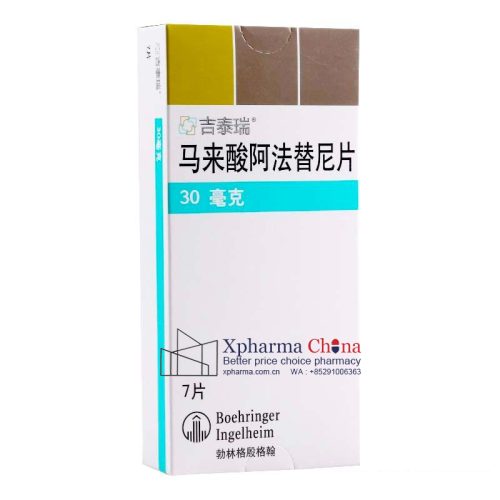
Gilotrif Afatinib Dimaleate Tablets
Brand Name: 吉泰瑞 ®(Gilotrif®)
Generic Name: Afatinib Dimaleate
Strength: 30 mg per tablet, 7 tablets per box
Manufacturer: Boehringer Ingelheim Pharma GmbH & Co. KG
Marketing Authorization Holder: Boehringer Ingelheim (China) Investment Co., Ltd.
Approval Date in China: April 24, 2017
Registration Number: 国药准字HJ20170066
Storage: Store at 20–25℃, brief excursions allowed between 15–30℃; keep in original package, sealed, protected from light and moisture; keep out of reach of children
Price&Cost:Contact Us now for the best price of Afatinib Dimaleate(Gilotrif)
Only logged in customers who have purchased this product may leave a review.
Reviews
There are no reviews yet.