
1. Indications and Usage
Unresectable or Metastatic Melanoma:
Indicated for the treatment of patients with unresectable or metastatic melanoma with the BRAF V600E mutation.
Note: Patients must be tested for the BRAF V600E mutation using an FDA-approved test before starting treatment. Vemurafenib is not indicated for patients with wild-type BRAF melanoma.
2. Dosage and Administration
Recommended Dosage:
Adults: 960 mg (four 240 mg tablets) orally twice daily.
Administration Instructions:
Administer orally without regard to meal timing.
Swallow tablets whole with water; do not crush or chew.
Dose Modifications:
Dose reductions (to 720 mg or 480 mg twice daily) are recommended based on individual safety and tolerability, particularly for severe skin toxicity, QTc prolongation, or other severe adverse reactions.
For Cutaneous Squamous Cell Carcinoma (cSCC), dose reduction is generally not recommended; management usually involves dermatological treatment.
3. Mechanism of Action
Selective BRAF Inhibitor:
Vemurafenib is a small molecule, kinase inhibitor that selectively inhibits the mutated BRAF V600E protein.
Physiological Effect:
It inhibits the proliferation of BRAF V600E mutant tumor cells in vitro and in vivo by blocking the RAF/MEK/ERK signaling pathway. It does not effectively inhibit wild-type BRAF and may paradoxically activate the MAPK pathway in cells with wild-type BRAF.
4. Safety and Warnings
New Primary Malignancies:
Treatment may lead to the development of cutaneous squamous cell carcinoma (cuSCC) or keratoacanthoma. Regular skin examinations are recommended.
Photosensitivity:
Severe photosensitivity reactions may occur. Patients should use sunscreen and protective clothing when outdoors.
QTc Prolongation:
Vemurafenib can prolong the QTc interval. ECG and electrolyte monitoring is recommended.
Embryo-Fetal Toxicity:
Based on its mechanism of action, Vemurafenib can cause fetal harm.
5. Adverse Reactions
Most Common:
Arthralgia, rash, alopecia, fatigue, photosensitivity reaction, nausea, pruritus, and skin papilloma.
Laboratory Abnormalities:
Increased ALT, increased AST, increased GGT, increased lipase, hypophosphatemia, and hypocalcemia.
6. Drug Interactions
CYP1A2 and CYP3A4:
Vemurafenib is a moderate inhibitor of CYP1A2 and an inducer of CYP3A4. It may increase CYP1A2 substrate exposure and decrease CYP3A4 substrate exposure.
P-gp and BCRP:
Vemurafenib is a P-gp and BCRP inhibitor. Caution is advised when co-administering with P-gp substrates (e.g., digoxin).
CYP Substrates:
Avoid concurrent use of strong CYP3A4 inducers or inhibitors.
7. Pharmaceutical Information
Chemical Name:
N-[3-[5-(4-Chlorophenyl)-1H-pyrrolo[2,3-b]pyridine-3-carbonyl]-2,4-difluorophenyl]propane-1-sulfonamide
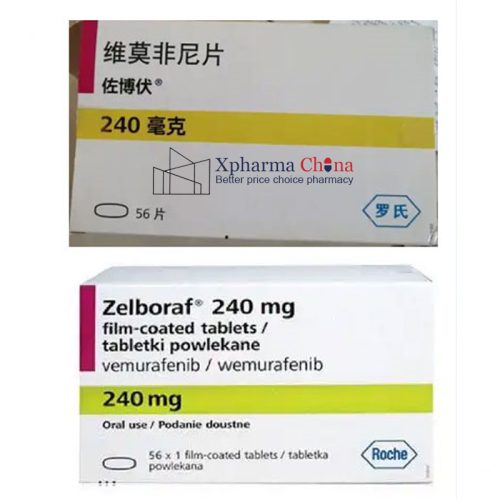
Zelboraf Vemurafenib Film-coated Tablets
Brand Name: 佐博伏® (Zelboraf®)
Generic Name: Vemurafenib
Strength: 240 mg per film-coated tablet, 56 tablets per box
Manufacturer: F. Hoffmann-La Roche Ltd.
Marketing Authorization Holder: Roche (China) Investment Co., Ltd.
Approval Date in China: March 6, 2017
Registration Number:国药准字 HJ20170019
Storage: Store at 25℃; brief temperature excursions between 15–30℃ are permitted; keep in the original package, protected from light and moisture, and out of reach of children
Price&Cost:Contact Us now for the best price of Vemurafenib(Zelboraf)
Only logged in customers who have purchased this product may leave a review.


Reviews
There are no reviews yet.