
1. Indications and Usage
Alzheimer’s Disease (AD):
Indicated for the treatment of adult patients with mild cognitive impairment and mild dementia due to Alzheimer’s disease.
Diagnostic Confirmation:
Prior to initiation, confirmation of the presence of amyloid-beta pathology is required (e.g., via PET imaging or CSF biomarker testing).
2. Dosage and Administration
Recommended Dosage:
Loading Phase: 700 mg administered as an intravenous infusion every 4 weeks for the first 3 doses.
Maintenance Phase: 1400 mg administered as an intravenous infusion every 4 weeks thereafter.
Administration Instructions:
Administer as an intravenous infusion over approximately 30 minutes.
Must be diluted with 0.9% Sodium Chloride Injection prior to administration.
MRI Monitoring: Baseline MRI is recommended before treatment. Subsequent MRIs are recommended before the 4th, 7th, and 16th infusions (or as clinically indicated) to monitor for Amyloid-Related Imaging Abnormalities (ARIA).
Discontinuation Criteria:
Treatment may be discontinued once PET imaging confirms that amyloid plaques have been reduced to a level below a pre-specified threshold.
3. Mechanism of Action
Amyloid-Targeting Antibody:
Donanemab is a humanized IgG1 monoclonal antibody.
Physiological Effect:
It binds specifically to the N3pG epitope on the amyloid-beta (Aβ) peptide. This binding promotes the clearance of Aβ plaques from the brain, which are a hallmark pathological feature of Alzheimer’s disease, thereby slowing the progression of cognitive and functional decline.
4. Safety and Warnings
Amyloid-Related Imaging Abnormalities (ARIA):
ARIA occurs in a significant proportion of patients. It includes ARIA with edema (ARIA-E) and ARIA with hemosiderin deposition (ARIA-H).
Symptoms: Can be asymptomatic or present with headache, confusion, dizziness, vision changes, or nausea.
Management: Dosage adjustments or discontinuation are required based on the severity of ARIA observed on MRI.
Infusion-Related Reactions:
Reactions such as chills, rash, nausea, or shortness of breath may occur during or after infusion.
Hypersensitivity:
Serious hypersensitivity reactions have been reported.
5. Adverse Reactions
Most Common:
Infusion-related reactions, ARIA (edema and/or hemosiderin deposition), headache, urinary tract infection, pyrexia, fall, diarrhea, cough, and dizziness.
6. Drug Interactions
Anticoagulants and Antiplatelets:
Caution is advised when co-administering with anticoagulants or antiplatelet agents, as they may increase the risk of intracranial hemorrhage (a form of ARIA-H).
7. Pharmaceutical Information
Storage:
Store in the original carton at 2°C to 8°C (36°F to 46°F). Do not freeze or shake.
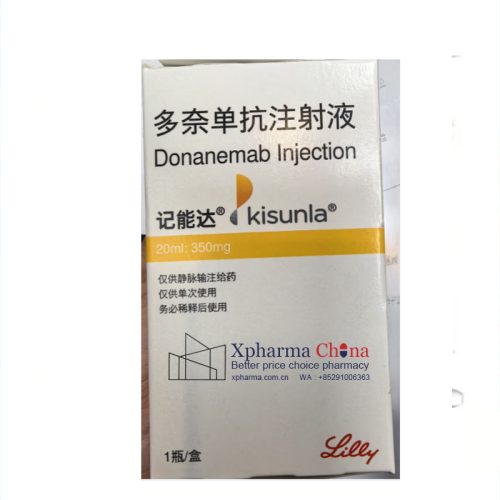
Kisunla Donanemab Injection
Brand Name: 记能达 ®(Kisunla®)
Generic Name: Donanemab
Strength: 350mg/20mL per vial, 1 vial per box
Manufacturer: Eli Lilly France SAS
Marketing Authorization Holder: Eli Lilly and Company;中国境内持证与商业化主体:礼来贸易有限公司
Approval Date in China: December 17, 2024
Registration Number: 国药准字 SJ20240047
Storage: Store and transport at 2℃ ~ 8℃, protected from light; do not freeze, do not shake violently, keep out of reach of children
Price&Cost:Contact Us now for the best price of Donanemab (Kisunla)
Only logged in customers who have purchased this product may leave a review.

Reviews
There are no reviews yet.