1. Indications and Usage
Advanced Renal Cell Carcinoma (RCC):
Indicated for the treatment of advanced RCC .
Imatinib-Resistant or Intolerant Gastrointestinal Stromal Tumor (GIST):
Indicated for the treatment of GIST after disease progression on or intolerance to imatinib mesylate .
Progressive, Well-Differentiated Pancreatic Neuroendocrine Tumors (pNET):
Indicated for the treatment of advanced pNET .
2. Dosage and Administration
Route of Administration:
For Oral Use ONLY.
Recommended Dosage (RCC and GIST):
Dose: 50 mg once daily.
Schedule: Administered on a schedule of 4 weeks on treatment, followed by 2 weeks off(Schedule 4/2) .
Recommended Dosage (pNET):
Dose: 37.5 mg once daily.
Schedule: Continuous daily dosing (no scheduled rest period) .
Administration Instructions:
Take with or without food.
Swallow capsules whole. Do not open or crush.
Missed Dose:
If a dose is missed, take it as soon as the patient remembers unless it is less than 6 hours before the next scheduled dose. In that case, skip the missed dose and resume at the next scheduled time .
3. Mechanism of Action
Tyrosine Kinase Inhibitor (TKI):
Sunitinib inhibits multiple receptor tyrosine kinases (RTKs), including VEGFR, PDGFR, KIT, FLT3, CSF-1R, and RET .
Anti-angiogenesis and Anti-proliferation:
By blocking these receptors, it inhibits tumor angiogenesis (blood vessel formation) and tumor cell proliferation .
4. Safety and Warnings
Cardiac Dysfunction:
Can cause left ventricular systolic dysfunction and congestive heart failure (CHF). Monitor LVEF at baseline and periodically .
Hypertension:
Can cause severe hypertension. Monitor blood pressure regularly .
Hepatotoxicity:
Monitor liver function tests (LFTs). Severe hepatic impairment is not recommended .
Bleeding Events:
Risk of hemorrhagic events, including fatal outcomes.
Embryo-Fetal Toxicity:
Can cause fetal harm. Effective contraception is required during treatment .
5. Adverse Reactions
Most Common:
Fatigue, diarrhea, nausea, dyspepsia, abdominal pain, hypertension, skin discoloration (yellowing), and hand-foot syndrome (palmar-plantar erythrodysesthesia) .
Hematologic:
Neutropenia, thrombocytopenia, anemia .
6. Drug Interactions
Metabolic Pathway:
Sunitinib is primarily metabolized by CYP3A4.
Strong CYP3A4 Inhibitors (e.g., Ketoconazole, Itraconazole, Clarithromycin, Grapefruit): Avoid co-administration. If unavoidable, reduce the sunitinib dose .
Strong CYP3A4 Inducers (e.g., Rifampin): Avoid co-administration as they significantly decrease sunitinib exposure .
7. Pharmaceutical Information
Chemical Composition:
Active Ingredient: Sunitinib Malate.
Appearance: Hard gelatin capsules containing yellow to orange granules .
Storage: Store at 25°C (77°F); excursions permitted to 15°C–30°C (59°F–86°F) .
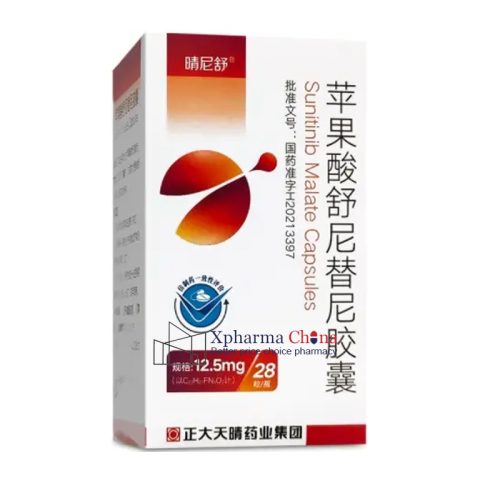
Sutent Sunitinib Malate Capsules
Brand Name: 晴尼舒 ®(Sutent®)
Generic Name: Sunitinib Malate
Strength: 12.5 mg per capsule, 28 capsules per bottle
Manufacturer: Chia Tai Tianqing Pharmaceutical Group Co., Ltd.
Marketing Authorization Holder: Chia Tai Tianqing Pharmaceutical Group Co., Ltd.
Approval Date in China: May 27, 2021
Registration Number: 国药准字 H20213397
Storage: Store in a cool and dry place (temperature not exceeding 25°C), protected from light and moisture. Keep out of reach of children.
Price&Cost:Contact Us now for the best price of Sunitinib Malate (Sutent)
Only logged in customers who have purchased this product may leave a review.
Reviews
There are no reviews yet.