1. Indications and Usage
High-Risk Neuroblastoma:
Treatment of patients aged ≥12 months with high-risk neuroblastoma:
Who have responded at least to induction chemotherapy, followed by myeloablative therapy and stem cell transplantation.
With relapsed or refractory neuroblastoma (with or without residual disease).
Note: Active progressive disease should be stabilized before initiating treatment.
2. Dosage and Administration
Route of Administration:
For Intravenous (IV) Infusion ONLY. Must be administered in a hospital setting with immediate access to resuscitation equipment.
Recommended Dosage:
Treatment typically consists of 5 consecutive cycles (each cycle is 35 days).
Standard Dose: Total dose of 100 mg/m² per cycle.
Option A (Continuous Infusion): 10 mg/m²/day continuously for 10 days (240 hours).
Option B (Short Infusion): 20 mg/m²/day for 5 days, infused over 8 hours each day.
Critical Administration Instructions (Premedication):
Analgesics (Mandatory): Opioids (e.g., IV Morphine) and non-opioid analgesics (e.g., Acetaminophen/Ibuprofen) must be administered. Gabapentin is recommended starting 3 days prior to infusion.
Antihistamines: To prevent allergic reactions.
Dilution: Dilute in 0.9% Sodium Chloride containing 1% Human Albumin.
3. Mechanism of Action
GD2 Targeting:
Dinutuximab beta binds specifically to Disialoganglioside 2 (GD2), a cell surface glycolipid highly expressed on neuroblastoma cells.
Immune Activation:
ADCC (Antibody-Dependent Cellular Cytotoxicity): Recruits immune effector cells (NK cells, macrophages) to kill the tumor.
CDC (Complement-Dependent Cytotoxicity): Activates the complement system to lyse the tumor cell.
4. Safety and Warnings
Severe Infusion-Related Reactions:
May occur (e.g., hypotension, bronchospasm, fever). Requires close monitoring during administration.
Severe Pain (Neuropathic):
Extremely common. Often requires continuous IV opioids throughout the infusion.
Capillary Leak Syndrome (CLS):
Can cause leakage of fluids and proteins from blood vessels.
Ocular/Neurological Toxicity:
May cause blurred vision, mydriasis (dilated pupils), or other visual changes.
5. Adverse Reactions & Clinical Research
Most Common Adverse Reactions:
Severe pain (neuropathic), pyrexia (fever), thrombocytopenia, lymphopenia, infusion reactions, hypotension, hyponatremia, nausea, vomiting, diarrhea, rash, and acute kidney injury.
Clinical Research Highlights:
Survival Benefit: In a pivotal Phase 3 trial involving high-risk neuroblastoma patients, the addition of dinutuximab beta (plus IL-2 and GM-CSF) significantly improved survival rates compared to standard therapy alone.
Efficacy Data: The study showed a 3-year survival rate of approximately 71% in the dinutuximab beta group, compared to roughly 54-58% in the control groups.
Safety Profile: In clinical studies, severe infusion reactions occurred in approximately 26% of patients. Severe neuropathic pain was observed in up to 9% of patients.
6. Drug Interactions
Immunosuppressants: Use with caution with other immunosuppressive agents.
Nephrotoxic Drugs: Caution advised with drugs that may affect renal function (e.g., NSAIDs), as Dinutuximab beta can cause nephrotoxicity.
No CYP Interactions: As a monoclonal antibody, it is not metabolized by CYP450 enzymes.
7. Pharmaceutical Information
Chemical Composition:
Active Ingredient: Dinutuximab beta (Recombinant chimeric monoclonal antibody).
Appearance: Clear, colorless to slightly yellowish liquid.
Packaging: Single-use vial (20 mg/4.5 mL).
Storage: Store in a refrigerator at 2°C to 8°C (36°F to 46°F). Do not freeze or shake.
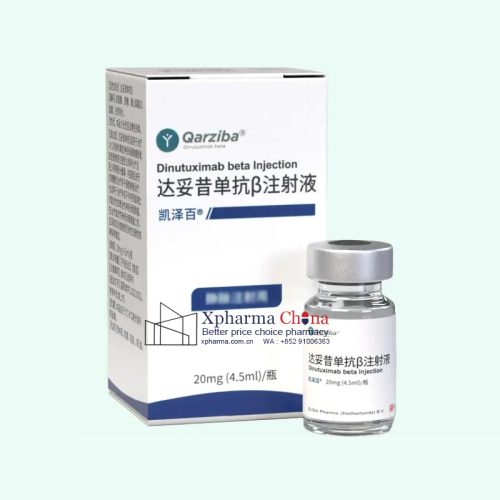
Qarziba Dinutuximab beta Injection
Brand Name: 凯泽百 ®(Qarziba®)
Generic Name: Dinutuximab beta
Strength: 20 mg per vial (4.5 mL per vial)
Manufacturer: EUSA Pharma (Netherlands) B.V.
Marketing Authorization Holder: EUSA Pharma (Netherlands) B.V.
Domestic Responsible Entity: EUSA Pharma Trading (Shanghai) Co., Ltd.
Approval Date in China: November 25, 2021
Registration Number: 国药准字SJ20210036
Storage: Store refrigerated at 2°C–8°C, protect from light, do not freeze or shake violently. Once diluted, use the infusion solution immediately. Refer to the full package insert for detailed storage and handling specifications.
Price&Cost:Contact Us now for the best price of Dinutuximab beta(Qarziba)
Only logged in customers who have purchased this product may leave a review.

Reviews
There are no reviews yet.