
1. Indications and Usage
NRAS-mutant Melanoma: Treatment of adult patients with unresectable locally advanced or metastatic NRAS-mutant melanoma who have progressed on or are intolerant to prior anti-PD-1/PD-L1 therapy.
2. Dosage and Administration
Route of Administration: Oral administration ONLY.
Recommended Dosage: 12 mg twice daily (approximately every 12 hours). May be taken with or without food.
Critical Administration Instructions:
Capsule Handling: Capsules must be swallowed whole. Do not chew, dissolve, or open the capsules.
Missed Dose: If a dose is missed, it may be taken as soon as possible on the same day, provided it is at least 8 hours before the next scheduled dose. Do not take more than one dose on the same day.
Dose Modifications: Dose interruption, reduction (to 9 mg or 6 mg), or permanent discontinuation may be required based on the severity of adverse reactions.
3. Mechanism of Action
BTK Inhibition: Tunlametinib is a selective, oral Bruton’s tyrosine kinase (BTK) inhibitor.
Pathway Blockade: It binds covalently to BTK, inhibiting the B-cell receptor signaling pathway, which plays a critical role in B-cell development, proliferation, and survival.
4. Safety and Warnings
Cardiac Toxicity: Risk of left ventricular ejection fraction (LVEF) decline and symptomatic congestive heart failure. Baseline and periodic cardiac monitoring are required.
Ocular Toxicity: Risk of retinal pigment epithelium detachment (RPED), retinal vein occlusion (RVO), and retinal artery occlusion. Baseline and periodic ophthalmic examinations are necessary.
Interstial Lung Disease/Pneumonitis: May cause interstitial lung disease or pneumonitis; permanent discontinuation is required if diagnosed.
Dermatologic Toxicity: High incidence of rash, including severe reactions. Dose interruption or reduction may be needed for severe or intolerable rashes.
Musculoskeletal Toxicity: Risk of elevated creatine phosphokinase (CPK) and myalgia.
Embryo-Fetal Toxicity: May cause fetal harm; effective contraception is required during and after treatment.
5. Adverse Reactions and Clinical Research
Most Common Adverse Reactions: Rash, fatigue, musculoskeletal pain, nausea, diarrhea, and increased CPK.
Serious Adverse Reactions: Cardiac dysfunction, retinal detachment, severe skin rashes, and interstitial lung disease.
Clinical Research Highlights: Clinical trials have demonstrated significant objective response rates in NRAS-mutant melanoma patients who have exhausted standard immunotherapy options.
6. Drug Interactions
CYP3A Inhibitors: Strong CYP3A inhibitors (e.g., ketoconazole, ritonavir) may increase the exposure of tunlametinib; dose reduction is recommended.
CYP3A Inducers: Strong CYP3A inducers (e.g., rifampin, carbamazepine) may decrease the exposure and efficacy of tunlametinib; concomitant use should be avoided.
Sensitive P-gp Substrates: Concomitant use with sensitive P-gp substrates (e.g., digoxin, dabigatran) may increase their plasma concentrations; monitor for toxicity.
7. Pharmaceutical Information
Chemical Composition: Active Ingredient: Tunlametinib.
Appearance: Opaque white hard capsules containing white or off-white pellets.
Packaging: Blister packs (e.g., 12 capsules/box).
Storage: Store at controlled room temperature (20°C to 25°C). Protect from moisture.
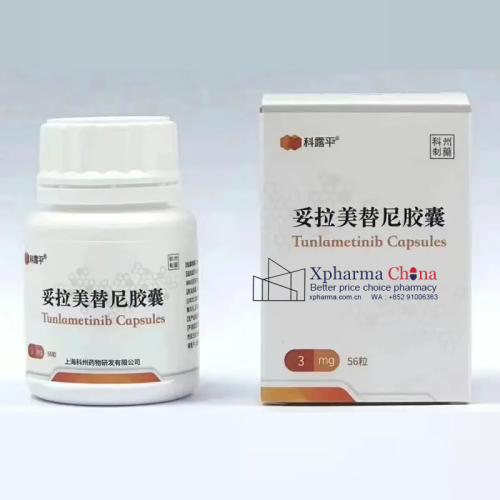
Keluping Tunlametinib Capsules
Brand Name:科露平 ®(Keluping®)
Generic Name: Tunlametinib
Strength: 3 mg per capsule, 56 capsules per bottle
Manufacturer: Shanghai Kezhou Pharmaceutical R&D Co., Ltd.
Marketing Authorization Holder: Shanghai Kezhou Pharmaceutical R&D Co., Ltd.
Approval Date in China: March 12, 2024
Registration Number: 国药准字H20240008
Storage: Store hermetically sealed, protected from light at a temperature not exceeding 30°C. Refer to the full package insert for detailed storage specifications.
Price&Cost:Contact Us now for the best price of Tunlametinib(Keluping)
Only logged in customers who have purchased this product may leave a review.
Reviews
There are no reviews yet.