
1. Indications and Usage
Metastatic NSCLC with EGFR Mutations: Treatment of locally advanced or metastatic non-small cell lung cancer (NSCLC) with epidermal growth factor receptor (EGFR) exon 19 deletion or exon 21 (L858R) substitution mutations, as detected by an FDA-approved test.
Metastatic Squamous NSCLC: Treatment of locally advanced or metastatic squamous non-small cell lung cancer (NSCLC) that has progressed during or after platinum-based chemotherapy.
2. Dosage and Administration
Standard Regimen: The recommended dose is 40 mg taken orally once daily. There is insufficient evidence to support a dose of 50 mg.
Administration: Take Afatinib at least 1 hour before or 2 hours after food. Swallow the tablet whole with water.
Duration: Continue treatment until disease progression or unacceptable toxicity.
Dose Modifications: For toxic reactions, interrupt therapy and resume at a reduced dose (typically in 10 mg decrements) based on severity.
3. Mechanism of Action
EGFR Inhibition: Afatinib is an irreversible inhibitor of the ErbB family of receptor tyrosine kinases, including EGFR (ErbB1), HER2 (ErbB2), and HER4 (ErbB3).
Covalent Binding: It binds covalently to the ATP-binding site of these receptors, inhibiting downstream signaling pathways and preventing tumor cell growth and proliferation.
4. Safety and Warnings
Diarrhea: Diarrhea is very common and can be severe. Prompt treatment with antidiarrheals (e.g., loperamide) is required.
Interstitial Lung Disease (ILD)/Pneumonitis: Can be fatal. Interrupt or permanently discontinue Afatinib if ILD is suspected or confirmed.
Skin Toxicity: Acne-like rash and paronychia are common. Severe dermatologic reactions may require dose interruption or reduction.
Pulmonary Toxicity: Monitor for respiratory symptoms; ILD requires immediate evaluation.
Embryo-Fetal Toxicity: Can cause fetal harm; advise females of reproductive potential to use effective contraception.
5. Adverse Reactions and Clinical Research
Common Adverse Reactions: Diarrhea, rash/acne, stomatitis/mucositis, paronychia, dry skin, nail toxicity, and diarrhea.
Clinical Research: Clinical trials have demonstrated significant improvements in progression-free survival and overall survival in patients with EGFR-mutated NSCLC compared to standard chemotherapy.
6. Drug Interactions
P-gp Inhibitors: Strong P-gp inhibitors (e.g., ketoconazole, cyclosporine) may increase Afatinib exposure if administered before Afatinib.
P-gp Inducers: Strong P-gp inducers (e.g., rifampin, phenytoin) may decrease Afatinib exposure and efficacy.
Antacids: Antacids containing magnesium or aluminum may decrease Afatinib absorption; separate administration by at least 2 hours.
7. Pharmaceutical Information
Active Ingredient: Afatinib Dimaleate.
Excipients: The product contains lactose; contraindicated in patients with rare hereditary galactose intolerance, Lapp lactase deficiency, or glucose-galactose malabsorption.
Storage: Store at room temperature. Protect from moisture.
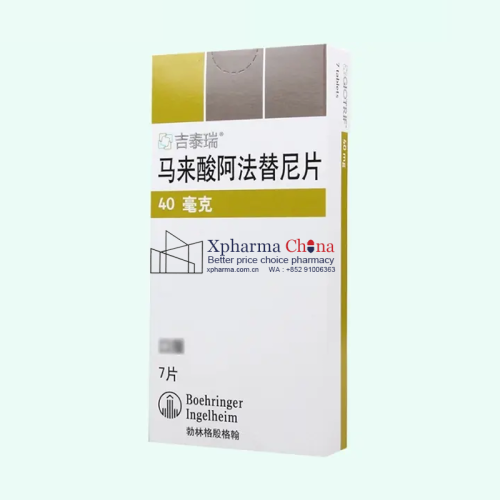
Giotrif Afatinib Dimaleate Tablets
Brand Name: 吉泰瑞®(Giotrif®)
Generic Name: Afatinib Dimaleate
Strength: 40 mg per tablet, 7 tablets per box
Manufacturer: Boehringer Ingelheim Pharma GmbH & Co. KG (Germany)
Marketing Authorization Holder: Boehringer Ingelheim International GmbH
Approval Date in China: 2017
Registration Number:国药准字 J20170028
Storage: Store at a temperature not exceeding 25°C, protect from light and moisture in original packaging; keep out of reach of children, follow full storage guidance in the package insert
Price&Cost:Contact Us now for the best price of Afatinib Dimaleate(Giotrif)
Only logged in customers who have purchased this product may leave a review.

Reviews
There are no reviews yet.