
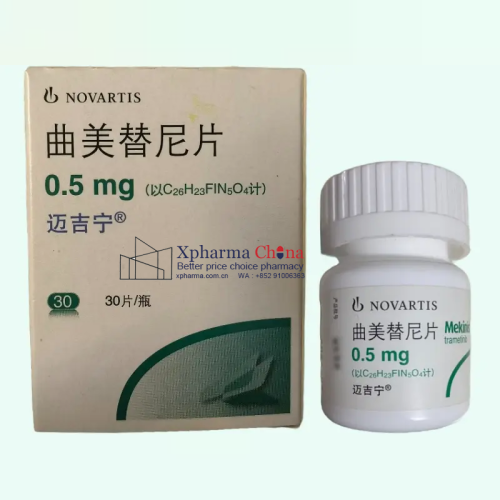
1. Description
Mekinist (trametinib dimethyl sulfoxide) is a reversible, highly selective inhibitor of mitogen-activated extracellular signal-regulated kinase 1/2 (MEK1/2). Chemically, it is N-[3-[3-cyclopropyl-5-(2-fluoro-4-iodophenylamino)-6,8-dimethyl-2,4,7-trioxo-3,4,6,7-tetrahydro-2H-pyrido[4,3-d]pyrimidin-1-yl]phenyl]acetamide dimethyl sulfoxide. The tablets are supplied as 0.5mg, 1mg and 2mg strengths, containing trametinib with inactive excipients including mannitol, microcrystalline cellulose, sodium lauryl sulfate, croscarmellose sodium, magnesium stearate, and film-coating components.
2. Indications
Unresectable or Metastatic Melanoma: As a single agent or in combination with dabrafenib for the treatment of adult patients with BRAF V600E or V600K mutation-positive unresectable or metastatic melanoma.
Adjuvant Melanoma: In combination with dabrafenib for the adjuvant treatment of adult patients with BRAF V600 mutation-positive melanoma and lymph node involvement following complete surgical resection.
Metastatic Non-Small Cell Lung Cancer (NSCLC): In combination with dabrafenib for the treatment of adult patients with BRAF V600E mutation-positive metastatic non-small cell lung cancer.
Locally Advanced or Metastatic Anaplastic Thyroid Cancer: In combination with dabrafenib for the treatment of adult patients with BRAF V600E mutation-positive locally advanced or metastatic anaplastic thyroid cancer who have no satisfactory locoregional treatment options.
3. Dosage and Administration
3.1 Administration Instructions
Mekinist is for oral use only. It should be taken at least 1 hour before a meal or 2 hours after a meal, to avoid food affecting its absorption. Tablets must be swallowed whole with water, and must not be chewed, crushed, split or dissolved, as this may destroy the drug’s controlled-release properties.
3.2 Dosage
Single Agent (Melanoma): The recommended adult dose is 2mg taken orally once daily, at approximately the same time each day.
Combination with Dabrafenib: The recommended dose is 2mg trametinib once daily, co-administered with 150mg dabrafenib taken orally twice daily.
Dose Adjustments for Adverse Reactions: Based on the severity of toxicities, interrupt treatment, reduce the dose to 1.5mg once daily, then further to 1mg once daily. Permanently discontinue if intolerable 1mg daily dose-related toxicities occur.
Renal Impairment: No initial dose adjustment is required for mild to moderate renal impairment. Use with caution in severe renal impairment, as clinical data are limited.
Hepatic Impairment: No initial dose adjustment is needed for mild hepatic impairment. Reduce the dose appropriately in moderate to severe hepatic impairment, due to reduced drug clearance.
Pediatric Patients: Not approved for use in children under 18 years of age, as safety and efficacy have not been established.
4. Warnings and Precautions
Cardiomyopathy: Trametinib may reduce left ventricular ejection fraction (LVEF). Monitor LVEF by echocardiogram or MUGA scan before initiation, 1 month after starting treatment, then every 2-3 months during therapy.
Ocular Toxicities: Risk of serious retinal pigment epithelial detachment, retinal vein occlusion (RVO) and blurred vision. Perform ophthalmological evaluation at any time when patients report new or persistent visual symptoms.
Interstitial Lung Disease (ILD)/Pneumonitis: Fatal cases have been reported. Permanently discontinue Mekinist in patients with diagnosed treatment-related ILD or pneumonitis of any grade.
Fever: Common when combined with dabrafenib. Severe febrile reactions and fever-related complications (dehydration, hypotension, renal failure) may occur. Interrupt treatment and manage with antipyretics, steroids, or supportive care.
Hemorrhage: Serious, including fatal, hemorrhagic events can occur. Monitor for signs and symptoms of bleeding, and permanently discontinue for grade 3 or 4 hemorrhage.
Venous Thromboembolism: Increased risk of deep venous thrombosis (DVT) and pulmonary embolism (PE). Evaluate patients for acute chest pain, shortness of breath or limb swelling.
Skin Toxicity: Common adverse reactions include rash, dermatitis acneiform, dry skin, and pruritus. Monitor for severe skin lesions, and manage with topical or systemic therapies as needed.
5. Contraindications
Severe hypersensitivity to trametinib or any of the tablet excipients, including anaphylaxis and angioedema.
Concomitant use of high-dose vitamin E supplementation, as trametinib formulations contain vitamin E, which may increase bleeding risk when combined with anticoagulants.
Not for use in patients with BRAF wild-type melanoma or NSCLC, as it may lead to tumor promotion.
6. Adverse Reactions
Most Common (≥ 20% incidence): Rash, diarrhea, lymphedema, peripheral edema, fatigue, nausea, acneiform dermatitis, stomatitis, hypertension, hemorrhage, dry skin, pruritus, headache, arthralgia, myalgia.
Serious Adverse Reactions: Cardiomyopathy, retinal vein occlusion, interstitial lung disease, severe fever, serious hemorrhage, venous thromboembolism, acute renal failure, liver function abnormality.
When used in combination with dabrafenib, additional common reactions include pyrexia, chills, fatigue, vomiting, abdominal pain and dizziness.
7. Drug Interactions
CYP3A4/CYP2C8 Inhibitors: Strong inhibitors (e.g. ketoconazole, gemfibrozil) may increase trametinib plasma concentration, leading to higher toxicity risk. Avoid co-administration if possible, and closely monitor adverse reactions if combined.
CYP3A4/CYP2C8 Inducers: Strong inducers (e.g. rifampin, phenytoin) may reduce trametinib exposure, potentially decreasing therapeutic efficacy. Concomitant use is not recommended.
Antiplatelet/Anticoagulant Agents: Trametinib contains vitamin E, which can prolong bleeding time. Co-administration with warfarin, aspirin or other anticoagulants may increase hemorrhage risk, requiring frequent monitoring of INR and bleeding signs.
Drugs that Affect Gastric pH: Proton pump inhibitors or antacids do not significantly alter trametinib absorption, and can be co-administered without dose adjustment.
8. Use in Specific Populations
Pregnancy: Can cause fetal harm when administered to a pregnant woman. Advise females of reproductive potential to use effective contraception during treatment and for 4 months after the final dose.
Lactation: Trametinib is excreted in human milk. Women should not breastfeed during treatment and for 4 months after the last dose, to avoid potential serious adverse reactions in nursing infants.
Pediatric Use: Safety and effectiveness in pediatric patients have not been established. Not recommended for use in children and adolescents under 18 years old.
Geriatric Use: No overall differences in safety or effectiveness were observed between elderly patients (≥ 65 years) and younger patients, but greater sensitivity of some older individuals cannot be ruled out.
Female and Male Reproductive Potential: May impair fertility in females and males. Advise patients of the potential effect on fertility before initiating treatment.
Hepatic/Renal Impairment: No formal dedicated studies have been conducted. Mild to moderate impairment does not require initial dose adjustment, but close clinical monitoring is advised. Use with extreme caution in severe impairment.



Reviews
There are no reviews yet.