1. Indications and Usage
Monotherapy: Indicated as an adjunct to diet and exercise to improve glycemic control in adults with type 2 diabetes mellitus.
Combination Therapy: Can be used in combination with metformin, a sulfonylurea, or insulin.
Restrictions: Due to cardiovascular risks, regulatory agencies often restrict its use to patients who cannot achieve glycemic control with other agents.
2. Dosage and Administration
Starting Dose: The recommended starting dose is 2 mg or 4 mg once daily, or 2 mg twice daily, taken without regard to meals.
Titration: The dose can be increased to a maximum of 8 mg once daily or 4 mg twice daily. Dose escalation is typically done after 8 to 12 weeks if the glycemic response is inadequate.
Combination with Insulin: Concomitant use with insulin is not recommended due to an increased risk of heart failure and hypoglycemia. If used together, the insulin dose should be reduced.
3. Mechanism of Action
PPAR-γ Activation: Rosiglitazone is a thiazolidinedione and acts as a highly selective ligand for peroxisome proliferator-activated receptor-gamma (PPAR-γ).
Insulin Sensitization: Activation of PPAR-γ regulates insulin-responsive genes involved in glucose and lipid metabolism, increasing insulin sensitivity in skeletal muscle and adipose tissue and decreasing hepatic glucose output.
4. Safety and Warnings
Cardiovascular Risk: Rosiglitazone may cause fluid retention and increase the risk of congestive heart failure. It is contraindicated in patients with NYHA Class III or IV heart failure. Evidence suggests a potential increased risk of myocardial infarction.
Hepatotoxicity: While the risk is lower than its predecessor (troglitazone), liver function monitoring is still advised.
Fractures: An increased incidence of bone fractures, particularly in women, has been observed.
Macular Edema: Cases of diabetic macular edema with visual impairment have been reported.
5. Adverse Reactions and Clinical Research
Common Adverse Reactions: Upper respiratory tract infection, pharyngitis, headache, and edema.
Fluid Retention: Edema and weight gain are common dose-dependent adverse reactions.
Hypoglycemia: Occurs frequently when used in combination with insulin or sulfonylureas.
Other Adverse Effects: Anemia and dyspnea have been reported.
6. Drug Interactions
CYP2C8 Inhibitors: Concomitant use with gemfibrozil (a strong CYP2C8 inhibitor) significantly increases rosiglitazone exposure. The dose should be limited to 4 mg daily.
CYP2C8 Inducers: Rifampin (a strong inducer) decreases rosiglitazone exposure, potentially reducing efficacy.
Insulin and Sulfonylureas: Concurrent use may increase the risk of hypoglycemia and heart failure.
Oral Contraceptives: Rosiglitazone may increase the clearance of ethinyl estradiol and levonorgestrel, potentially reducing contraceptive efficacy.
7. Pharmaceutical Information
Active Ingredient: Rosiglitazone Maleate.
Strengths: Typically available as 2 mg, 4 mg, and 8 mg tablets.
Appearance: Film-coated tablets, varying in color depending on the strength (e.g., white to off-white, yellow, or pink).
Storage: Store at controlled room temperature (20°C to 25°C) in a dry place, protected from light and moisture.
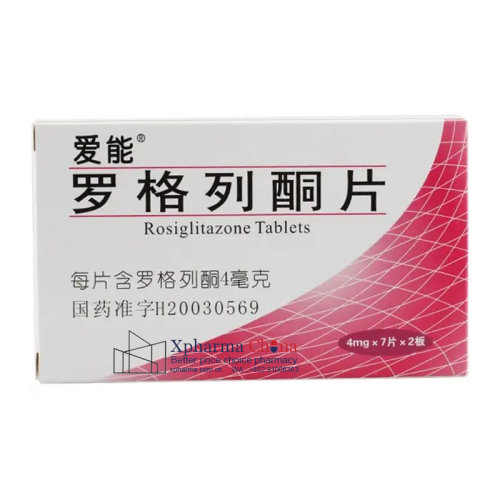
Aineng Rosiglitazone Tablets
Brand Name: 爱能®(Aineng®)
Generic Name: Rosiglitazone
Strength: 4 mg per tablet, 14 tablets per box
Manufacturer: Jiangsu Hengrui Pharmaceuticals Co., Ltd.
Marketing Authorization Holder: Jiangsu Hengrui Pharmaceuticals Co., Ltd.
Approval Date in China: 2003‑06‑12
Registration Number: 国药准字H20030569
Storage: Store in a sealed, dry place, protected from light.
Price&Cost:Contact Us now for the best price of Rosiglitazone(Aineng)
Only logged in customers who have purchased this product may leave a review.

Reviews
There are no reviews yet.