
1. Indications and Usage
Atrial Fibrillation/Flutter: Indicated for patients with paroxysmal or persistent atrial fibrillation/flutter to maintain sinus rhythm.
Symptom Reduction: Reduces the risk of hospitalization due to cardiovascular problems and lowers the risk of stroke or systemic embolism in combination with standard therapy.
2. Dosage and Administration
Standard Dose: 400 mg (two 200 mg tablets) twice daily (morning and evening).
Administration: Must be taken with meals to ensure proper absorption.
Missed Dose: If a dose is missed, it should be taken with the next meal. Do not take a double dose to make up for a forgotten one.
3. Mechanism of Action
Multi-Channel Blockade: Dronedarone affects multiple cardiac ion channels (potassium, sodium, and calcium), stabilizing the cardiac membrane and prolonging the refractory period.
Adrenergic Effects: It reduces sympathetic tone on the heart by blocking adrenergic receptors, helping to control heart rate and rhythm.
4. Safety and Warnings
Black Box Warning: Contraindicated in patients with severe heart failure (NYHA Class IV) or permanent atrial fibrillation. Its use in these patients increases the risk of cardiovascular death, heart failure hospitalization, and stroke.
Hepatic Toxicity: Can cause severe liver injury. Baseline and periodic monitoring of liver function tests (LFTs) is mandatory.
QT Prolongation: May cause QT/QTc prolongation; caution is advised in patients with electrolyte imbalances or congenital long QT syndrome.
5. Adverse Reactions and Clinical Research
Common Adverse Reactions: Diarrhea, nausea, vomiting, and asthenia (weakness).
Serious Adverse Reactions: Hepatic failure, interstitial lung disease, QT prolongation, and increased risk of arrhythmias.
Clinical Findings: Clinical trials (e.g., ANDROMEDA, PALLAS) demonstrated efficacy in rhythm control but highlighted significant cardiovascular risks in specific patient subgroups.
6. Drug Interactions
Strong CYP3A4 Inhibitors: Concomitant use with strong CYP3A4 inhibitors (e.g., ketoconazole, itraconazole, clarithromycin) is contraindicated as it increases dronedarone exposure.
P-Gp Inhibitors: Strong P-glycoprotein (P-gp) inhibitors (e.g., verapamil, quinidine) can increase plasma concentrations.
Antiarrhythmics: Contraindicated with Class IA (e.g., quinidine, procainamide) or Class III (e.g., amiodarone, sotalol) antiarrhythmics due to increased arrhythmia risk.
7. Pharmaceutical Information
Active Ingredient: Dronedarone Hydrochloride.
Strengths: Typically available as 200 mg tablets (orphan name: MOWRISFAT).
Appearance: White to off-white, round, biconvex, film-coated tablets.
Storage: Store below 30°C (86°F). Keep in the original package to protect from moisture.
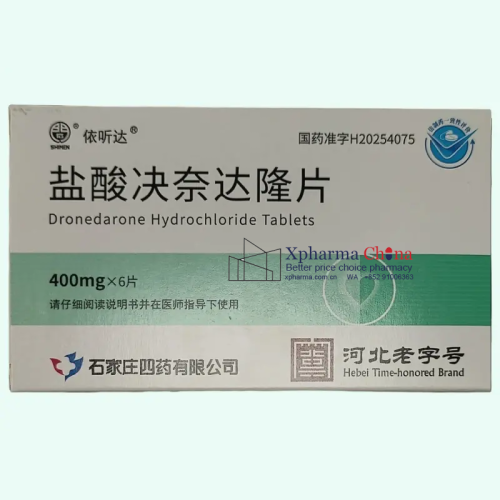
Yixinda Dronedarone Hydrochloride Tablets
Brand Name: 依昕达®(Yixinda®)
Generic Name: Dronedarone Hydrochloride
Strength: 400mg per tablet, 6 tablets per box
Manufacturer: Shijiazhuang No.4 Pharmaceutical Co., Ltd.
Marketing Authorization Holder: Shijiazhuang No.4 Pharmaceutical Co., Ltd.
Approval Date in China: 2025‑08‑21
Registration Number: 国药准字H20254075
Storage: Store in a sealed, dry place, protected from light.
Price&Cost:Contact Us now for the best price of Dronedarone Hydrochloride(Yixinda)
Only logged in customers who have purchased this product may leave a review.

Reviews
There are no reviews yet.