1. Indications and Usage
Neovascular (Wet) AMD: Indicated for the treatment of neovascular (wet) or exudative age-related macular degeneration.
Diabetic Macular Edema (DME): Indicated for the treatment of diabetic macular edema.
Macular Edema Following Retinal Vein Occlusion (RVO): Indicated for the treatment of macular edema following retinal artery or vein occlusion.
Myopic Choroidal Neovascularization: Indicated for the treatment of neovascularization secondary to myopia.
2. Dosage and Administration
Route of Administration: Intravitreal injection.
Dosage: The recommended dose is 0.5 mg (0.05 mL) administered intravitreally.
Frequency:
For Neovascular AMD, administer monthly for 3 consecutive months, then individualize based on disease activity.
For DME, administer monthly until best-corrected visual acuity (BCVA) and disease activity plateau, then individualize.
For Macular Edema following RVO, administer monthly until BCVA and disease activity plateau, then individualize.
Administration Precautions:
The drug must be administered in a hospital or clinic by a qualified ophthalmologist experienced in intravitreal injections and the management of these diseases.
Strict aseptic technique must be observed.
The patient should be instructed to use topical antibiotic eye drops before and after the procedure.
Intraocular pressure (IOP) and ocular perfusion must be monitored after administration.
3. Mechanism of Action
Ranibizumab is a recombinant humanized monoclonal antibody Fab fragment that binds to and inhibits human vascular endothelial growth factor (VEGF-A). By blocking VEGF, which promotes angiogenesis and vascular permeability, ranibizumab inhibits the growth of new blood vessels and reduces fluid leakage in the retina.
4. Safety and Warnings
Endophthalmitis: Serious ocular infections, including endophthalmitis, have been reported following intravitreal administration.
Retinal Detachment: Retinal detachment and retinal tears have been reported.
Increased Intraocular Pressure: Acute increase in intraocular pressure may occur within 60 minutes of intravitreal administration.
Arterial Thromboembolic Events: Serious arterial thromboembolic events (e.g., stroke, myocardial infarction) have been reported; caution is advised.
Contraindications: Contraindicated in patients with known hypersensitivity to ranibizumab or its excipients, and in patients with active or suspected ocular or periocular infections.
5. Adverse Reactions and Clinical Research
Adverse Reactions: The most common adverse reactions include vitreous floaters, conjunctival hemorrhage, eye pain, cataract, and increased intraocular pressure.
Clinical Research: Clinical trials have demonstrated significant improvements in visual acuity and reduction in central retinal thickness compared to sham procedures or laser photocoagulation.
6. Drug Interactions
No specific drug-drug interaction studies have been conducted. Due to the extremely low plasma concentrations following intravitreal administration, systemic drug interactions are considered to be unlikely.
7. Pharmaceutical Information
Appearance: Ranibizumab is a clear to slightly opalescent, colorless to pale yellow liquid.
Storage: Store in a refrigerator at 2°C to 8°C (36°F to 46°F). Do not freeze or shake. Protect from light.
Packaging: Available in single-use pre-filled syringes or single-use cartridges.
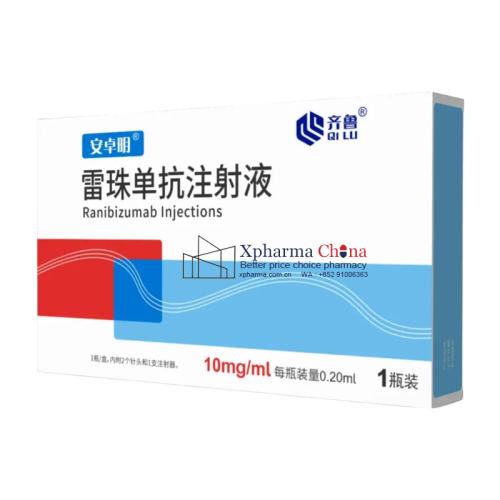
Anduoming Ranibizumab Injections
Brand Name: 安卓明 ®(Anduoming®)
Generic Name: Ranibizumab
Strength: 10mg/mL, 0.20mL per vial, 1 vial per box
Manufacturer: Qilu Pharmaceutical Co., Ltd.
Marketing Authorization Holder: Qilu Pharmaceutical Co., Ltd.
Approval Date in China: August 19, 2024
Registration Number: 国药准字S20240034
Storage: Store at 2°C–8°C protected from light; do not freeze. Keep out of reach of children. Refer to the full package insert for detailed storage specifications.
Price&Cost:Contact Us now for the best price of Ranibizumab(Anduoming)
Only logged in customers who have purchased this product may leave a review.
Reviews
There are no reviews yet.