
1. Indications and Usage
Pancreatic Cancer: Treatment of locally advanced or metastatic pancreatic cancer.
Non-Small Cell Lung Cancer (NSCLC): Treatment of locally advanced or metastatic NSCLC, alone or in combination with cisplatin.
Ovarian Cancer: Second-line treatment of locally advanced or metastatic ovarian cancer.
Urothelial Bladder Cancer: Treatment of locally advanced or metastatic transitional cell bladder cancer.
Breast Cancer: Treatment of locally advanced or metastatic breast cancer in combination with paclitaxel.
2. Dosage and Administration
Standard Regimen: 1000 mg/m² administered intravenously over 30 minutes once weekly for three consecutive weeks, followed by one week of rest (28-day cycle).
Dose Adjustments: Dosage must be reduced based on the degree of bone marrow suppression (neutrophils and platelets) and non-hematologic toxicity.
Administration: Reconstitute with 0.9% Sodium Chloride Injection to a concentration ≤40 mg/mL. Further dilute with 0.9% Sodium Chloride.
Storage: Store reconstituted solutions at room temperature and use within 24 hours. Do not refrigerate to avoid crystallization.
3. Mechanism of Action
Antimetabolite: A pyrimidine analog (nucleoside reverse transcriptase inhibitor).
Intracellular Activation: Phosphorylated intracellularly to active diphosphate (dFdCDP) and triphosphate (dFdCTP) forms.
Inhibition of DNA Synthesis: dFdCDP inhibits ribonucleotide reductase, depleting the pool of deoxynucleotides. dFdCTP incorporates into DNA, causing chain termination.
4. Safety and Warnings
Bone Marrow Suppression: The most common dose-limiting toxicity is myelosuppression (anemia, leukopenia, thrombocytopenia).
Renal Toxicity: Mild proteinuria and hematuria are common. Monitor for rare cases of renal failure and hemolytic uremic syndrome (HUS).
Hepatotoxicity: Elevated AST and ALT occur frequently and require regular monitoring.
Pulmonary Toxicity: Rare cases of interstitial pneumonia, pulmonary edema, and acute respiratory distress syndrome (ARDS) have been reported.
5. Adverse Reactions and Clinical Research
Common: Bone marrow suppression, elevated liver enzymes, nausea, vomiting, peripheral edema, flu-like symptoms, rash, and alopecia.
Serious: Febrile neutropenia, renal failure, pulmonary toxicity, and severe hypersensitivity reactions.
Clinical Research: Clinical trials have demonstrated significant clinical benefit in overall survival and response rates when used in combination regimens for pancreatic and lung cancers.
6. Drug Interactions
Ribavirin: Concomitant use is contraindicated due to the risk of severe and potentially fatal pulmonary toxicity.
Cisplatin: Often used in combination; requires careful monitoring for additive myelosuppression and nephrotoxicity.
Live Vaccines: Use with caution due to the immunosuppressive effects of chemotherapy.
7. Pharmaceutical Information
Active Ingredient: Gemcitabine Hydrochloride.
Appearance: White to off-white lyophilized powder or block-like substance.
Storage: Store at room temperature. Reconstituted solutions should be stored at room temperature and used within 24 hours. Do not refrigerate.
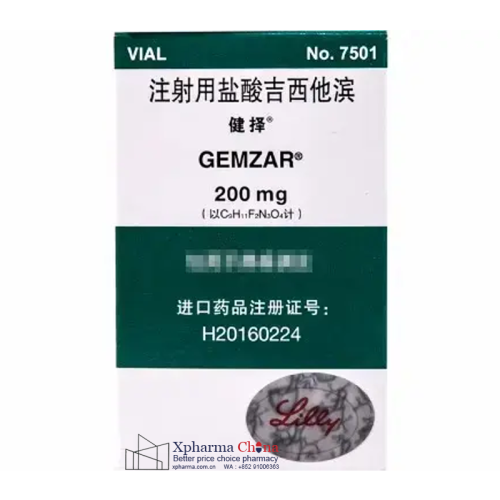
Gemzar Gemcitabine Hydrochloride for Injection
Brand Name: 健择®(Gemzar®)
Generic Name: Gemcitabine Hydrochloride
Strength: 200 mg per vial (calculated as C₉H₁₁F₂N₃O₄), 1 vial per box
Manufacturer: Eli Lilly and Company (USA)
Marketing Authorization Holder: Eli Lilly Suzhou Pharmaceutical Co., Ltd.
Approval Date in China: 2016
Registration Number: 国药准字H20160224
Storage: Store tightly sealed at room temperature below 25°C, protected from light; keep away from children, follow the full storage requirements in the package insert
Price&Cost:Contact Us now for the best price of Gemcitabine Hydrochloride(Gemzar)
Only logged in customers who have purchased this product may leave a review.
Reviews
There are no reviews yet.