1. Indications and Usage
Attention Deficit Hyperactivity Disorder (ADHD): Treatment of ADHD in patients aged 6 years and older, as monotherapy or as an adjunct to stimulant therapy.
2. Dosage and Administration
Route of Administration: Oral administration ONLY.
Pediatric Patients (6-17 years):
Starting Dose: 1 mg/day for patients weighing <50 kg; 2 mg/day for patients weighing ≥50 kg.
Titration: Increase by 1 mg at intervals of at least 1 week to reach the weight-based maintenance dose.
Maximum Dose: Capped based on weight tiers (e.g., 6 mg/day for patients weighing ≥50 kg).
Adult Patients (≥18 years):
Starting Dose: 1 mg/day (or 2 mg/day for patients not currently taking immediate-release guanfacine).
Titration: Increase by 1 mg at intervals of at least 1 week.
Maximum Dose: 4 mg/day (up to 6 mg/day for patients not currently taking immediate-release guanfacine).
Critical Administration Instructions:
Intake: Tablets must be swallowed whole; do not crush, chew, or break.
Timing: Administer consistently at the same time each day, preferably in the morning or at bedtime.
Tapering: Gradually taper the dose (by no more than 1 mg every 3-7 days) to minimize rebound hypertension.
3. Mechanism of Action
Receptor Agonism: Guanfacine is a selective α2A-adrenergic receptor agonist.
Cortical Regulation: It regulates neurotransmission in the prefrontal cortex and basal ganglia, enhancing executive function and attention while reducing impulsivity and hyperactivity.
4. Safety and Warnings
Cardiovascular Effects: May cause dose-dependent decreases in blood pressure and heart rate. Monitor vital signs regularly.
Syncope: Syncope has been reported. Patients should be advised to avoid dehydration and overheating.
Rebound Hypertension: Abrupt discontinuation can lead to clinically significant rebound hypertension and tachycardia.
Sedation: Somnolence and sedation are common. Caution is advised when operating machinery until the patient’s response is known.
5. Adverse Reactions and Clinical Research
Most Common Adverse Reactions: Somnolence (49.8%), headache, insomnia, dizziness, dry mouth, constipation, abdominal pain, and fatigue.
Common Grade 3-4 Adverse Reactions: Hypertension (rebound effect), syncope, and bradycardia.
Clinical Research Highlights: Clinical trials have demonstrated significant improvements in ADHD-rated scales (ADHD-RS) across pediatric and adult populations.
6. Drug Interactions
CYP3A4/5 Inhibitors: Concomitant use with strong CYP3A4/5 inhibitors (e.g., itraconazole, clarithromycin) requires a dose reduction to 1 mg/day.
CYP3A4/5 Inducers: Concomitant use with strong CYP3A4/5 inducers (e.g., rifampin, carbamazepine) may decrease therapeutic efficacy.
Central Nervous System Depressants: Concomitant use with alcohol or other CNS depressants may exacerbate sedation.
7. Pharmaceutical Information
Chemical Composition: Active Ingredient: Guanfacine Hydrochloride.
Appearance: White to off-white circular film-coated tablets (e.g., 1 mg, 2 mg, 3 mg, 4 mg, 6 mg).
Packaging: Blister packaging or bottles.
Storage: Store at controlled room temperature; protect from moisture.
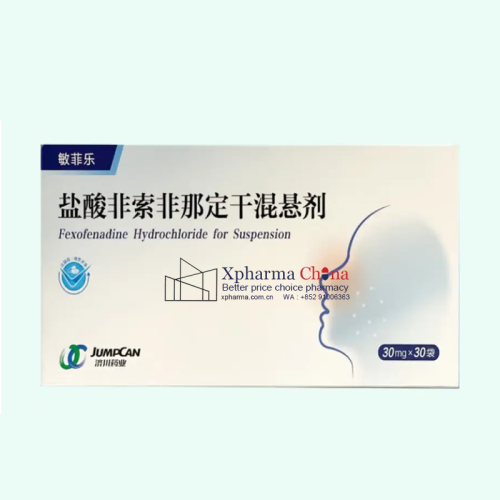
Minfeile Fexofenadine Hydrochloride for Suspension
Brand Name:敏菲乐 ®(Minfeile®)
Generic Name: Fexofenadine Hydrochloride
Strength: 30 mg per sachet, 30 sachets per box
Manufacturer: Jumpcan Pharmaceutical Group Co., Ltd.
Marketing Authorization Holder: Jumpcan Pharmaceutical Group Co., Ltd.
Approval Date in China: July 22, 2024
Registration Number:国药准字 H20243967
Storage: Store tightly sealed at room temperature, protected from light and moisture. Refer to the full package insert for detailed storage specifications.
Price&Cost:Contact Us now for the best price of Fexofenadine Hydrochloride(Minfeile)
Only logged in customers who have purchased this product may leave a review.
Reviews
There are no reviews yet.