1. Indications and Usage
Life-Threatening Ventricular Arrhythmias: Indicated for the treatment of documented, life-threatening ventricular arrhythmias, such as sustained ventricular tachycardia.
Atrial Fibrillation/Flutter: Indicated for the maintenance of normal sinus rhythm (delay in time to recurrence) in patients with symptomatic atrial fibrillation or flutter (AFIB/AFL) who are currently in sinus rhythm.
2. Dosage and Administration
Adult Initial Dose: The usual starting dosage is 80 mg twice daily. The dose may be increased in increments of 80 mg/day every 3 days to a maximum total daily dose of 320 mg.
Initiation Safety: To minimize the risk of drug-induced arrhythmia, oral sotalol must be initiated or re-initiated in a facility that can provide cardiac resuscitation and continuous electrocardiographic (ECG) monitoring.
Renal Impairment: Dosing intervals must be adjusted based on the calculation of creatinine clearance.
QT Monitoring: If the QT interval prolongs to 500 msec or greater, the dose must be reduced, the dosing interval lengthened, or the drug discontinued.
3. Mechanism of Action
Dual Antiarrhythmic Properties: Sotalol hydrochloride is a racemic mixture that exhibits both Class II (non-cardioselective beta-adrenoreceptor blocking) and Class III (cardiac action potential duration prolongation) antiarrhythmic properties.
Electrophysiological Effects: The beta-blocking effect slows the heart rate and decreases atrioventricular (AV) nodal conduction. The Class III effect prolongs the effective refractory periods of atrial and ventricular muscle and conduction tissue, which is reflected on the surface ECG as a dose-related prolongation of the QT interval.
4. Safety and Warnings
Black Box Warning (Life-Threatening Proarrhythmia): Sotalol can cause serious and potentially fatal ventricular arrhythmias, primarily Torsade de Pointes (TdP), associated with QT interval prolongation. Continuous ECG monitoring is required during initiation.
Contraindications: Contraindicated in patients with sinus bradycardia, sick sinus syndrome, second- or third-degree AV block (unless a functioning pacemaker is present), congenital or acquired long QT syndrome, cardiogenic shock, decompensated heart failure, bronchial asthma, and serum potassium < 4 mEq/L.
Electrolyte Monitoring: Any electrolyte disturbances (especially hypokalemia or hypomagnesemia) must be corrected prior to and during therapy.
Abrupt Discontinuation: Do not abruptly discontinue therapy in patients with coronary artery disease, as it may cause acute exacerbation of angina or myocardial infarction.
5. Adverse Reactions and Clinical Research
Common Adverse Reactions: The most frequent adverse reactions (≥2%) include fatigue (4%), bradycardia (<50 bpm) (3%), dyspnea (3%), proarrhythmia (3%), asthenia (2%), and dizziness (2%).
Serious Adverse Reactions: Life-threatening ventricular tachycardia (Torsade de Pointes), worsening heart failure, and severe hypotension.
Clinical Findings: Clinical trials demonstrate that significant Class III electrophysiological effects (QT prolongation) are seen at daily doses of 160 mg and above, while significant beta-blockade occurs at lower doses (≥25 mg/day).
6. Drug Interactions
Other Antiarrhythmics: Concomitant use with Class I or Class III antiarrhythmics, or other drugs that prolong the QT interval, is contraindicated due to additive proarrhythmic effects. Previous Class I/III agents should be discontinued for at least three half-lives prior to starting sotalol.
Digoxin and Calcium Channel Blockers: Concurrent use may increase the risk of bradycardia, hypotension, and heart failure.
Antacids: Aluminum- or magnesium-based antacids reduce sotalol exposure and should be taken at least 2 hours apart from sotalol.
Antidiabetic Agents: Sotalol may mask symptoms of hypoglycemia and alter glucose levels; insulin or oral antidiabetic drug dosages may need adjustment.
7. Pharmaceutical Information
Active Ingredient: Sotalol Hydrochloride.
Chemical Name: d,l-N-[4-[1-hydroxy-2-[(1-methylethyl)amino]ethyl]phenyl]methanesulfonamide monohydrochloride.
Molecular Formula: C12H20N2O3S·HCl (Molecular Weight: 308.8).
Strengths: Typically available as 80 mg, 120 mg, 160 mg, and 240 mg tablets.
Appearance: White to off-white, capsule-shaped, scored tablets (some formulations may be light blue depending on the manufacturer).
Storage: Store at 25°C (77°F); excursions permitted to 15-30°C (59-86°F). Keep in a tight, light-resistant container.
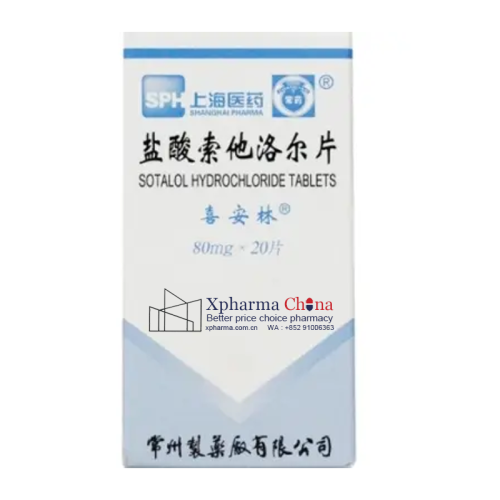
Xi’anlin Sotalol Hydrochloride Tablets
Brand Name: 喜安林®(Xi’anlin®)
Generic Name: Sotalol Hydrochloride
Strength: 80 mg per tablet
Manufacturer: Changzhou Pharmaceutical Factory Co., Ltd.
Marketing Authorization Holder: Changzhou Pharmaceutical Factory Co., Ltd.
Approval Date in China: 2002‑06‑21
Registration Number: H20023131
Storage: Store in light‑proof and tightly‑sealed container.
Price&Cost:Contact Us now for the best price of Sotalol Hydrochloride(Xi’anlin)
Only logged in customers who have purchased this product may leave a review.
Reviews
There are no reviews yet.