
1. Indications and Usage
Pancreatic Cancer: Treatment of locally advanced or metastatic pancreatic cancer.
Non-Small Cell Lung Cancer (NSCLC): Treatment of locally advanced or metastatic NSCLC, alone or in combination with cisplatin.
Ovarian Cancer: Treatment of locally advanced or metastatic ovarian cancer as second-line therapy.
Bladder Cancer: Treatment of locally advanced or metastatic urothelial (transitional cell) bladder cancer.
Breast Cancer: Treatment of locally advanced or metastatic breast cancer in combination with paclitaxel.
2. Dosage and Administration
Standard Regimen: The recommended dose is 1000 mg/m² administered intravenously over 30 minutes once weekly for three consecutive weeks, followed by one week of rest (28-day cycle).
Dose Adjustments: Dosage should be reduced based on the degree of bone marrow suppression (neutrophils and platelets) and non-hematologic toxicity.
Administration: The reconstituted solution should be further diluted in 0.9% Sodium Chloride Injection. It must not be refrigerated to avoid crystallization.
Special Populations: No dose adjustment is required for elderly patients based on age alone.
3. Mechanism of Action
Antimetabolite: Gemcitabine is a pyrimidine analog.
Incorporation into DNA: It is phosphorylated intracellularly to its active diphosphate and triphosphate forms.
Inhibition of DNA Synthesis: The active diphosphate inhibits ribonucleotide reductase, depleting the pool of deoxynucleotides required for DNA synthesis. The active triphosphate incorporates into DNA, causing chain termination.
4. Safety and Warnings
Bone Marrow Suppression: The most common dose-limiting toxicity is myelosuppression, manifesting as anemia, leukopenia, and thrombocytopenia.
Renal Toxicity: Mild proteinuria and hematuria are common. Rare cases of renal failure and hemolytic uremic syndrome (HUS) have been reported.
Hepatotoxicity: Elevations in AST and ALT occur frequently and require monitoring.
Hypersensitivity: Rare cases of severe hypersensitivity, including angioedema and bronchospasm, have been reported.
5. Adverse Reactions and Clinical Research
Common: Bone marrow suppression, elevated liver enzymes, nausea, vomiting, peripheral edema, flu-like symptoms, rash, and alopecia.
Serious: Febrile neutropenia, renal failure, pulmonary toxicity, and severe hypersensitivity reactions.
Clinical Research: Clinical trials have demonstrated significant clinical benefit in overall survival and response rates when used in combination regimens for pancreatic and lung cancers.
6. Drug Interactions
Ribavirin: Concomitant use is contraindicated due to the risk of severe and potentially fatal pulmonary toxicity.
Cisplatin: Often used in combination; requires careful monitoring for additive myelosuppression and nephrotoxicity.
Live Vaccines: Use with caution due to the immunosuppressive effects of chemotherapy.
7. Pharmaceutical Information
Active Ingredient: Gemcitabine Hydrochloride.
Appearance: White to off-white lyophilized powder or block-like substance.
Storage: Store at room temperature. Reconstituted solutions should be stored at room temperature and used within 24 hours. Do not refrigerate.
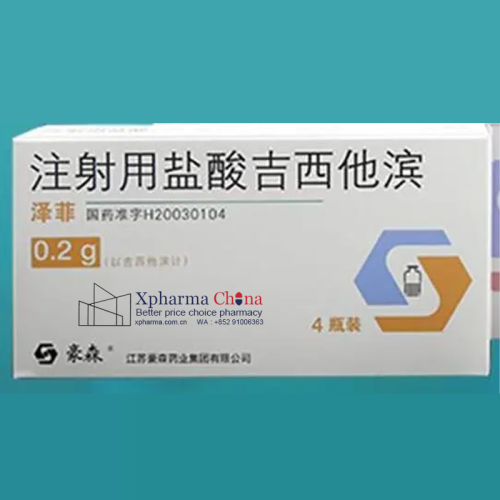
Zefei Gemcitabine Hydrochloride for Injection
Brand Name: 泽菲®(Zefei®)
Generic Name: Gemcitabine Hydrochloride
Strength: 0.2 g per vial (calculated as gemcitabine), 4 vials per box
Manufacturer: Jiangsu Hansoh Pharmaceutical Group Co., Ltd.
Marketing Authorization Holder: Jiangsu Hansoh Pharmaceutical Group Co., Ltd.
Approval Date in China: 2003
Registration Number: 国药准字H20030104
Storage: Keep tightly sealed, store in a cool dry place protected from light; keep out of reach of children, follow the complete storage specifications stated in the package insert
Price&Cost:Contact Us now for the best price of Gemcitabine Hydrochloride(Zefei)
Only logged in customers who have purchased this product may leave a review.
Reviews
There are no reviews yet.