FULL PRESCRIBING INFORMATION
1. INDICATIONS AND USAGE
ZEGFROVY is indicated for the treatment of adult patients with locally advanced or metastatic nonsmall cell lung cancer (NSCLC) with epidermal growth factor receptor (EGFR) exon 20 insertionmutations, as detected by an FDA-approved test [see Dosage and Administration (2.1)], whose
disease has progressed on or after platinum-based chemotherapy.
This indication is approved under accelerated approval based on overall response rate and duration of response [see Clinical Studies (14)]. Continued approval for this indication may be contingent upon verification and description of clinical benefit in confirmatory trial(s).
2. DOSAGE AND ADMINISTRATION
2.1 Patient Selection
Select patients for treatment with ZEGFROVY for locally advanced or metastatic NSCLC based on the presence of EGFR exon 20 insertion mutations in tumor tissue [see Clinical Studies (14)].
Information on FDA-approved tests is available at: http://www.fda.gov/CompanionDiagnostics.
2.2 Recommended Dosage
The recommended dosage of ZEGFROVY is 200 mg orally once daily with food [see Warnings and Precautions (5.2)] until disease progression or unacceptable toxicity. Swallow ZEGFROVY tablets whole. Do not split, crush, chew, or dissolve the tablets. Take ZEGFROVY at the same time each
day.
Missed Dose
If a dose of ZEGFROVY is missed within 12 hours, take the dose. If a dose of ZEGFROVY is missed by more than 12 hours, skip the missed dose and take the next dose at the regularly scheduled time.
Vomiting
If a ZEGFROVY dose is vomited, do not take an additional dose. Take the next dose at the regularly
scheduled time.
2.4 Dosage Modifications for Drug Interactions
Strong CYP3A Inhibitors
Avoid concomitant use of strong CYP3A inhibitors. If concomitant use cannot be avoided, reduce the ZEGFROVY dose from 200 mg to 150 mg [see Drug Interactions (7.1)].
After discontinuing a CYP3A inhibitor, resume the ZEGFROVY dose (after 3 to 5 half-lives of the
CYP3A inhibitor) that was taken prior to initiating the CYP3A inhibitor.
Strong and Moderate CYP3A Inducers
Avoid concomitant use of strong and moderate CYP3A inducers. If concomitant use cannot be avoided, increase the ZEGFROVY dose from 200 mg to 400 mg [see Drug Interactions (7.1)].
After discontinuing a CYP3A inducer, resume the ZEGFROVY dose (7 to 14 days after discontinuing the CYP3A inducer) that was taken prior to initiating the CYP3A inducer.
3. DOSAGE FORMS AND STRENGTHS
Tablets:
• 150 mg: yellow, biconvex film-coated tablets, debossed with “150” on one side and Dizal company logo on the other side.
• 200 mg: yellow, biconvex film-coated tablets, debossed with “200” on one side and Dizal company logo on the other side.
4. CONTRAINDICATIONS
None.
5. WARNINGS AND PRECAUTIONS
5.1 Interstitial Lung Disease/Pneumonitis
ZEGFROVY can cause severe and life-threatening interstitial lung disease (ILD)/pneumonitis.
In the safety population [see Adverse Reactions (6.1)], ILD/pneumonitis occurred in 1.7% of patients.
The median time to first onset for ILD/pneumonitis was 61 days (range: 35 to 86 days). ZEGFROVY was discontinued due to ILD/pneumonitis in 0.8% of patients.
Monitor patients for new or worsening pulmonary symptoms indicative of ILD/pneumonitis (e.g., dyspnea, cough, and fever). Immediately withhold ZEGFROVY in patients with suspected
ILD/pneumonitis and permanently discontinue ZEGFROVY if ILD/pneumonitis is confirmed [see Dosage and Administration (2.3)].
5.2 Gastrointestinal Adverse Reactions
ZEGFROVY can cause severe gastrointestinal adverse reactions including diarrhea, nausea, and vomiting.
In the safety population [see Adverse Reactions (6.1)], serious gastrointestinal adverse reactions occurred in 1.7% of patients, including 0.8% Grade 3 nausea. Diarrhea occurred in 73% of patients
who received ZEGFROVY, including 2.5% Grade 3. Diarrhea leading to dosage interruption or dose reduction occurred in 5% of patients and required permanent discontinuation of ZEGFROVY in 0.8% of patients. Nausea and vomiting occurred in 43% of patients, including 3.3% Grade 3 events.
Nausea and vomiting leading to dosage interruption or dose reduction occurred in 7% of patients and permanent discontinuation of ZEGFROVY in 0.8% of patients.
Administer ZEGFROVY with food to reduce gastrointestinal adverse reactions. Monitor patients for gastrointestinal toxicity, and provide supportive care, including anti-diarrheals, anti-emetics, or fluid replacement, as indicated. Withhold, reduce the dose, or permanently discontinue ZEGFROVY based
on severity [see Dosage and Administration (2.3)].
5.3 Dermatologic Adverse Reactions
ZEGFROVY can cause severe rash including acneiform dermatitis and pruritus.
Based on the safety population [see Adverse Reactions (6.1)], dermatologic adverse reactions occurred in 68% of patients including 9% acneiform dermatitis. Grade 3 dermatologic adverse reactions were 7% rash, 0.8% acneiform dermatitis, and 0.8% pruritus.
Instruct patients to use alcohol-free (e.g., isopropanol-free, ethanol-free) emollient cream during treatment with ZEGFROVY and to avoid the use of irritating skin products (e.g., products containing retinol or retinoic acid, benzoyl peroxides).
Withhold, reduce the dose, or permanently discontinue ZEGFROVY based on severity [see Dosage and Administration (2.3)].
5.4 Ocular Toxicity
ZEGFROVY can cause ocular toxicity including keratitis, dry eye symptoms, blurred vision, and visual impairment.
Based on the safety population [see Adverse Reactions (6.1)], ocular toxicity occurred in 13% of patients who received ZEGFROVY, including keratitis (0.8%).
Promptly refer patients with new or worsening eye symptoms to an ophthalmologist. Advise discontinuation of contact lenses until ocular symptoms are evaluated. Withhold, reduce the dose, or permanently discontinue ZEGFROVY based on severity [see Dosage and Administration (2.3)].
5.5 Embryo-Fetal Toxicity
Based on findings from animal studies and its mechanism of action, ZEGFROVY can cause fetal harm when administered to a pregnant woman.
In animal reproduction studies, oral administration of sunvozertinib to pregnant animals during the period of organogenesis resulted in structural abnormalities at concentrations below the human exposure at the recommended dose based on area under the curve (AUC) [see Use in Specific
Populations (8.1)].
Advise pregnant women and females of reproductive potential of the potential risk to a fetus. Advise females of reproductive potential to use effective non-hormonal contraception during treatment with ZEGFROVY and for 2 weeks after the last dose, since ZEGFROVY can render some hormonal
contraceptives ineffective [see Drug Interactions (7.2)]. Advise male patients with female partners of reproductive potential to use effective contraception during treatment with ZEGFROVY and for 2 weeks after the last dose [see Use in Specific Populations (8.1, 8.3)].
6. ADVERSE REACTIONS
The following adverse reactions are described elsewhere in the labeling:
• Interstitial Lung Disease/Pneumonitis [see Warnings and Precautions (5.1)]
• Gastrointestinal Adverse Reactions [see Warnings and Precautions (5.2)]
• Dermatologic Adverse Reactions [see Warnings and Precautions (5.3)]
• Ocular Toxicity [see Warnings and Precautions (5.4)]
6.1 Clinical Trials Experience
Because clinical trials are conducted under widely varying conditions, adverse reaction rates observed in the clinical trials of a drug cannot be directly compared to rates in the clinical trials of another drug and may not reflect the rates observed in practice.
The pooled safety populations described in WARNINGS AND PRECAUTIONS reflect exposure to ZEGFROVY as a single agent at a dose of 200 mg orally once daily in 121 patients with locally advanced or metastatic NSCLC from two clinical trials WU-KONG1 (NCT03974022) [see Clinical
Studies (14)] and WU-KONG2 (n=3). Among 121 patients who received ZEGFROVY, 56% wereexposed for 6 months or longer and 28% were exposed for greater than one year. In this pooled safety population, the most common (≥20%) adverse reactions were diarrhea, rash, decreased
appetite, stomatitis, fatigue, nausea, paronychia, vomiting, constipation, musculoskeletal pain, pruritus, dry skin, urinary tract infection, abdominal pain and decreased weight. The most common (≥2%) Grade 3 or 4 laboratory abnormalities were decreased lymphocytes, increased lipase,
decreased hemoglobin, increased amylase, increased creatine kinase, decreased neutrophils,decreased potassium, increased aspartate aminotransferase, increased alanine aminotransferase,
decreased sodium, increased magnesium, and increased alkaline phosphatase.
EGFR Exon 20 Insertion Mutation-Positive Locally Advanced or Metastatic NSCLC Previously
Treated with Platinum-Based Chemotherapy The safety of ZEGFROVY was evaluated in WU-KONG1B [see Clinical Studies (14)] in patients with
locally advanced or metastatic NSCLC with EGFR exon 20 insertion mutations in a multinational,open-label, dose randomization clinical trial. Eligible patients must have had disease progression on or after platinum-based chemotherapy and received ZEGFROVY 200 mg orally once daily until
disease progression or intolerable toxicity. The median age of patients who received ZEGFROVY was 62 years (range: 35-88); 67% were females; 65% were Asian and 33% were White; 97% were not of Hispanic or Latino ethnicity.
Serious adverse reactions occurred in 41% of patients who received ZEGFROVY. Serious adverse reactions in ≥2% of patients who received ZEGFROVY were pneumonia (9%); dyspnea (4.4%); and pancreatitis, device related infection and rash (2.2% each). Fatal adverse reactions occurred in 2.2%
of patients who received ZEGFROVY including thrombosis (1.1%) and COVID-19 infection (1.1%).
Permanent discontinuation of ZEGFROVY due to adverse reactions occurred in 8% of patients. Adverse reactions leading to treatment discontinuation of ZEGFROVY in ≥2% of patients were pneumonia and rash (2.2% each).
Dosage interruption of ZEGFROVY due to adverse reactions occurred in 48% of patients. Adverse reactions requiring dosage interruption of ZEGFROVY in ≥5% of patients were vomiting (9%),pneumonia (8%), and rash (8%).
Dose reduction of ZEGFROVY due to adverse reactions occurred in 23% of patients. Adversereactions requiring dose reduction of ZEGFROVY in ≥3% of patients were rash (4.4%) and diarrhea
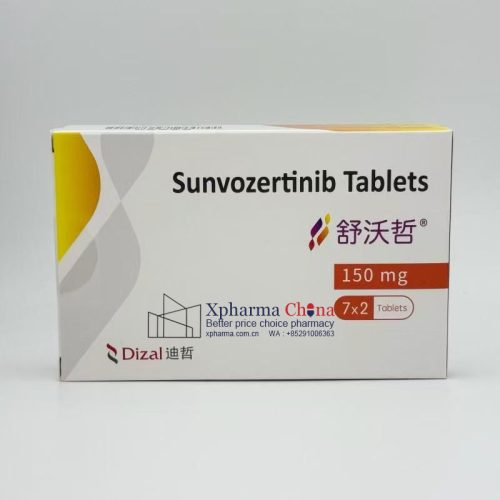
ZEGFROVY Sunvozertinib Tablets
Trade name: zegfrovy ®
Generic name: sunvozertinib
specifications: 150mg*28T
R & D company: dizal (Jiangsu) Pharmaceutical Co., Ltd
Storage conditions: store at room temperature and avoid moisture
Price&Cost: Contact Us now for the best price of Sunvozertinib(ZEGFROVY)
Only logged in customers who have purchased this product may leave a review.
Reviews
There are no reviews yet.