
1. Indications and Usage
Pulmonary Arterial Hypertension: Indicated for the treatment of pulmonary arterial hypertension (WHO Group 1) to delay disease progression and improve exercise capacity.
Combination Therapy: Can be used as monotherapy or in combination with other PAH treatments (e.g., endothelin receptor antagonists or phosphodiesterase-5 inhibitors), depending on the patient’s clinical status.
2. Dosage and Administration
Initiation: Start at 200 μg twice daily.
Titration: Increase the dose by 200 μg twice weekly (e.g., to 400 μg, then 600 μg) as tolerated, until the target maintenance dose is reached.
Target Dose: The recommended target maintenance dose is 800–1600 μg twice daily, or the highest dose tolerated by the patient.
Administration: Take with food to minimize gastrointestinal side effects. If a dose is missed, take it as soon as remembered unless it is within 6 hours of the next dose, in which case skip the missed dose. Do not double the dose.
Discontinuation: Do not discontinue abruptly; taper the dose gradually to avoid rebound pulmonary hypertension symptoms.
3. Mechanism of Action
Prostacyclin Receptor Agonism: Selexipag is a selective agonist of the IP prostacyclin receptor.
Vasodilation and Antiproliferation: Activation of this receptor increases intracellular cAMP levels in pulmonary vascular smooth muscle cells, leading to vasodilation and inhibition of smooth muscle cell proliferation, thereby reducing pulmonary vascular resistance.
4. Safety and Warnings
Hypotension: Selexipag can cause systemic hypotension due to its vasodilatory effects. Patients should be monitored for dizziness or syncope, especially during dose titration.
Hepatic Impairment: Use with caution in patients with mild to moderate hepatic impairment. It is not recommended in severe hepatic impairment.
Pregnancy and Lactation: Animal studies have shown adverse effects. Use only if the potential benefit justifies the risk to the fetus. It is unknown if excreted in human milk.
5. Adverse Reactions and Clinical Research
Common Adverse Reactions: The most frequent adverse reactions are headache, jaw pain (mandibular pain), nausea, diarrhea, myalgia, flushing, and vomiting. These are often related to prostacyclin receptor activation and may decrease in intensity with continued use.
Clinical Findings: The pivotal TRIUMPH trial demonstrated that selexipag significantly improved exercise capacity (6-minute walk distance) and reduced the composite risk of death or morbidity events in PAH patients.
6. Drug Interactions
CYP2C8 Substrates: Selexipag is a moderate inhibitor of CYP2C8. Concomitant use with sensitive CYP2C8 substrates (e.g., repaglinide, rosiglitazone) may increase their plasma concentrations.
Strong CYP2C8 Inhibitors/Inducers: Concomitant use with strong CYP2C8 inhibitors (e.g., gemfibrozil) or inducers (e.g., rifampin) may significantly alter selexipag exposure.
Hypotensive Agents: Concurrent use with other vasodilators or antihypertensives may potentiate hypotension.
7. Pharmaceutical Information
Active Ingredient: Selexipag.
Strengths: Typically available as 200 μg, 400 μg, and 800 μg tablets.
Appearance: Oval-shaped, film-coated tablets, white to off-white.
Storage: Store at 25°C (77°F), with excursions permitted to 15°C–30°C (59°F–86°F). Protect from moisture.
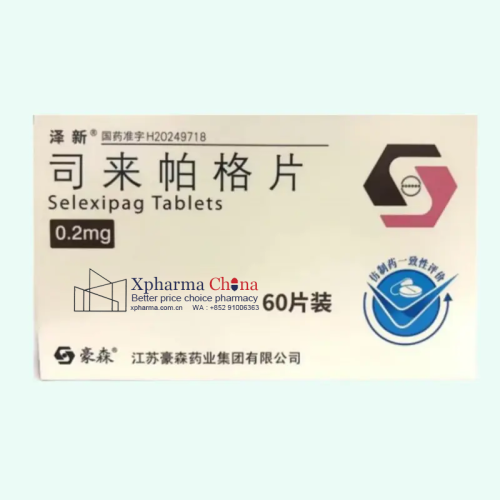
Zexin Selexipag Tablets
Brand Name: 泽新®(Zexin®)
Generic Name: Selexipag
Strength: 0.2mg per tablet, 60 tablets per box
Manufacturer: Jiangsu Hansoh Pharmaceutical Group Co., Ltd.
Marketing Authorization Holder: Jiangsu Hansoh Pharmaceutical Group Co., Ltd.
Approval Date in China: 2024‑11‑15
Registration Number: 国药准字 H20249718
Storage: Store in a sealed, dry place, protected from light.
Price&Cost:Contact Us now for the best price of Selexipag(Zexin)
Only logged in customers who have purchased this product may leave a review.
Reviews
There are no reviews yet.