
1. Indications and Usage
Non-Hodgkin Lymphoma: Treatment of adult patients with relapsed or refractory B-cell Non-Hodgkin Lymphoma (NHL).
2. Dosage and Administration
Route of Administration: Intravenous infusion ONLY.
Recommended Dosage: 20 mg/m² administered every 4 weeks for up to 6 cycles.
Critical Administration Instructions:
Dilution: Dilute in 250 mL of 5% Dextrose Injection. Do not administer undiluted.
Infusion Time: Administer over at least 60 minutes. For the first cycle, infuse slowly over the initial 15 minutes to reduce infusion reaction risks.
Contrainaindications: Intramuscular, subcutaneous, and intrathecal administrations are strictly prohibited.
Handling: Use a dedicated infusion line; do not mix with other drugs.
3. Mechanism of Action
DNA Interaction: Mitoxantrone intercalates into DNA, inhibiting nucleic acid synthesis.
Enzyme Inhibition: It inhibits Topoisomerase II, leading to single- and double-strand DNA breaks and subsequent cell death.
Liposomal Advantage: Encapsulation in liposomes enhances tumor targeting and alters pharmacokinetic profiles compared to the conventional formulation.
4. Safety and Warnings
Severe Myelosuppression: Significant leukopenia and thrombocytopenia are dose-limiting toxicities. Monitor complete blood counts before each cycle.
Cardiotoxicity: Risk of cardiomyopathy and left ventricular ejection fraction decline. Perform echocardiogram or MUGA scan prior to treatment; lifetime cumulative dose limits apply.
Secondary Malignancies: Potential leukemogenic effect (therapy-related MDS/AML) has been observed with anthraquinone derivatives.
Blue Discoloration: The drug and urine may turn blue-green; this is a harmless, expected phenomenon.
5. Adverse Reactions and Clinical Research
Most Common Adverse Reactions: Nausea, vomiting, diarrhea, alopecia, leukopenia, and thrombocytopenia.
Clinical Research Highlights: Phase 2 studies have demonstrated objective response rates in heavily pre-treated B-cell NHL populations.
6. Drug Interactions
Concomitant Chemotherapy: Concurrent use with other myelosuppressive agents may exacerbate bone marrow suppression.
Cardiotoxic Agents: Concomitant use with other anthracyclines or thoracic radiation significantly increases the risk of cardiotoxicity.
7. Pharmaceutical Information
Chemical Composition: Active Ingredient: Mitoxantrone Hydrochloride (encapsulated in liposomes).
Appearance: Deep blue, opaque suspension.
Packaging: Single-dose vials (e.g., 5 mg/5 mL).
Storage: Store at 2°C to 8°C; protect from light and freezing. Do not shake.
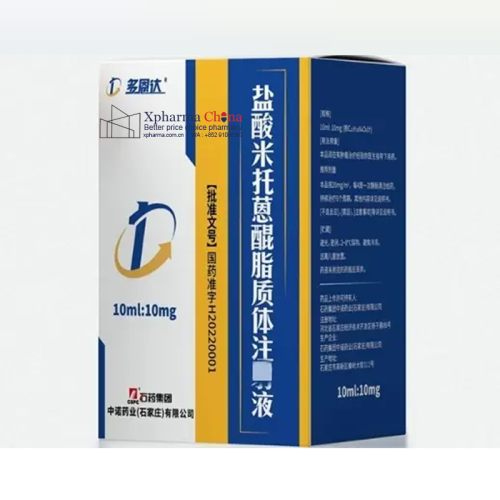
Du’enda Mitoxantrone Hydrochloride Liposome Injection
Brand Name:多恩达 ®(Du’enda®)
Generic Name: Mitoxantrone Hydrochloride
Strength: 10 mg per 10 mL vial, 1 vial per box
Manufacturer: CSPC Zhongnuo Pharmaceutical (Shijiazhuang) Co., Ltd.
Marketing Authorization Holder: CSPC Zhongnuo Pharmaceutical (Shijiazhuang) Co., Ltd.
Approval Date in China: January 7, 2022
Registration Number: 国药准字H20220001
Storage: Store refrigerated at 2–8°C, protected from light; do not freeze. Refer to the full package insert for detailed storage specifications.
Price&Cost:Contact Us now for the best price of Mitoxantrone Hydrochloride(Du’enda)
Only logged in customers who have purchased this product may leave a review.
Reviews
There are no reviews yet.