
1. Indications and Usage
Thromboprophylaxis: Indicated for the prevention of thromboembolic disorders, particularly in orthopedic surgery patients or those with medical conditions predisposed to venous thrombosis.
Hemodialysis: Indicated for preventing coagulation during extracorporeal blood dialysis.
Therapeutic Use: Can be used for the treatment of established deep vein thrombosis (DVT) and pulmonary embolism (PE).
Limitations: It is not indicated for the treatment of established intravascular clots in hemodialysis circuits.
2. Dosage and Administration
Thromboprophylaxis: The typical dose is 3500 anti-Xa IU subcutaneously once daily. In orthopedic surgery, it is usually started 2 hours before surgery or 6 hours post-surgery and continued for 7-10 days.
Hemodialysis: For dialysis sessions not exceeding 4 hours, 2500 anti-Xa IU is administered for patients weighing <60 kg, and 3500 anti-Xa IU for those ≥60 kg, injected into the arterial line at the start of dialysis.
Administration: It must be administered subcutaneously. Intramuscular injection is strictly contraindicated due to the risk of hematoma formation.
3. Mechanism of Action
Antithrombin III Binding: Bemiparin sodium binds to antithrombin III, inducing a conformational change that markedly accelerates its activity.
Factor Xa Inhibition: It primarily exerts its effect by selectively inhibiting Factor Xa in the coagulation cascade, with minimal effect on thrombin (Factor IIa) activity.
Antithrombotic Effect: This selective inhibition prevents the conversion of prothrombin to thrombin, thereby reducing the formation and propagation of fibrin clots.
4. Safety and Warnings
Bleeding Risk: The most common serious adverse event is bleeding. Caution is required in patients with active bleeding, peptic ulcers, or a high risk of hemorrhage.
Heparin-Induced Thrombocytopenia (HIT): Contraindicated in patients with a history of immune-mediated HIT. Platelet counts should be monitored during treatment.
Neuraxial Anesthesia: Use with extreme caution in patients undergoing spinal/epidural anesthesia or puncture due to the risk of spinal or epidural hematomas.
Renal Impairment: As the drug is primarily renally cleared, dose adjustment or increased monitoring is necessary in patients with severe renal dysfunction.
5. Adverse Reactions and Clinical Research
Adverse Reactions: The most common adverse reactions include injection site reactions (pain, erythema, bruising), bleeding events, and thrombocytopenia.
Clinical Research: Clinical trials have demonstrated that bemiparin sodium is as effective as unfractionated heparin in preventing DVT with a lower incidence of major bleeding and HIT.
6. Drug Interations
Other Anticoagulants: Concomitant use with other anticoagulants or antiplatelet agents increases the risk of bleeding.
NSAIDs: Non-steroidal anti-inflammatory drugs may potentiate the anticoagulant effect and increase bleeding risk.
Other Drugs: Potent P-glycoprotein inhibitors (e.g., ketoconazole, quinine) can increase the risk of bleeding.
7. Pharmaceutical Information
Composition: The active ingredient is bemiparin sodium, a low molecular weight heparin derived from porcine intestinal mucosa heparin.
Appearance: It is a clear, colorless to slightly yellow liquid.
Storage: Store below 30°C. Do not freeze. Protect from light.
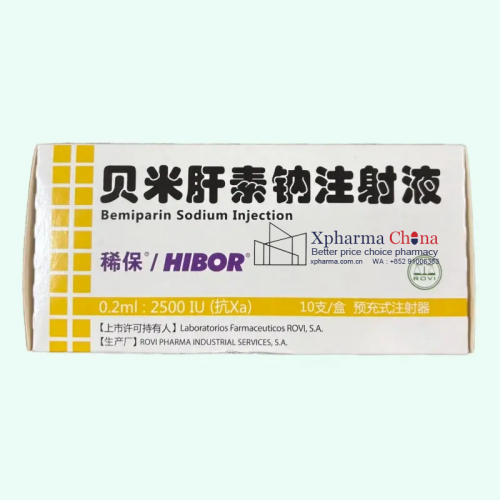
Hibor Bemiparin Sodium Injection
Brand Name: 稀保 ®(Hibor®)
Generic Name: Bemiparin Sodium
Strength: 2500 IU anti-Xa per 0.2 mL pre-filled syringe, 10 syringes per box
Manufacturer: ROVI PHARMA INDUSTRIAL SERVICES, S.A.
Marketing Authorization Holder: Laboratorios Farmacéuticos ROVI, S.A.
Approval Date in China: July 18, 2014
Registration Number: 国药准字HJ20140018
Storage: Store in original packaging below 30°C, protect from light. Do not freeze. Keep out of reach of children. Refer to the full package insert for detailed storage specifications.
Price&Cost:Contact Us now for the best price of Bemiparin Sodium(Hibor)
Only logged in customers who have purchased this product may leave a review.


Reviews
There are no reviews yet.