1. Indications and Usage
Monotherapy: Indicated as an adjunct to diet and exercise to improve glycemic control in adults with type 2 diabetes mellitus.
Combination Therapy: Used in combination with metformin, a sulfonylurea, or insulin when the combination is appropriate for the patient.
2. Dosage and Administration
Starting Dose: The recommended starting dose is 15 mg or 30 mg once daily, taken without regard to meals.
Titration: The dose can be increased to a maximum of 45 mg once daily based on glycemic response. If the patient experiences an inadequate response after 8 to 12 weeks, the dose may be escalated.
Insulin Combination: When used in combination with insulin, the initial insulin dose should often be reduced to minimize the risk of hypoglycemia.
3. Mechanism of Action
PPAR-γ Activation: Pioglitazone is a thiazolidinedione that acts as a ligand for peroxisome proliferator-activated receptor-gamma (PPAR-γ).
Insulin Sensitization: Activation of PPAR-γ regulates the transcription of insulin-responsive genes, leading to increased peripheral glucose uptake, decreased hepatic glucose output, and improved adipokine secretion.
4. Safety and Warnings
Heart Failure: Pioglitazone may cause fluid retention, which can exacerbate or lead to new-onset congestive heart failure. It is contraindicated in patients with New York Heart Association (NYHA) Class III or IV heart failure.
Hepatotoxicity: Although rare, liver enzyme elevations have been reported. Baseline liver function tests should be performed, and symptoms of hepatic dysfunction should be monitored.
Fractures: Increases in the incidence of bone fractures, particularly in women, have been observed.
Macular Edema: Cases of diabetic macular edema with visual impairment have been reported.
5. Adverse Reactions and Clinical Research
Common Adverse Reactions: Upper respiratory tract infection, pharyngolaryngitis, headache, myalgia, and back pain.
Fluid Retention: Edema and weight gain are common adverse reactions associated with thiazolidinediones.
Hypoglycemia: Occurs frequently when used in combination with insulin or sulfonylureas.
Other Adverse Effects: Anemia, sinusitis, and arthralgia have been reported.
6. Drug Interactions
CYP2C8 Inhibitors: Concomitant use with gemfibrozil (a strong CYP2C8 inhibitor) increases pioglitazone exposure. The dose should be limited to 15 mg daily.
CYP2C8 Inducers: Rifampin (a strong inducer) decreases pioglitazone exposure, potentially reducing efficacy.
Insulin and Sulfonylureas: Concurrent use may increase the risk of hypoglycemia.
Oral Contraceptives: Pioglitazone may reduce the efficacy of hormonal contraceptives by increasing the clearance of ethinyl estradiol and levonorgestrel.
7. Pharmaceutical Information
Active Ingredient: Pioglitazone Hydrochloride.
Strengths: Typically available as 15 mg, 30 mg, and 45 mg capsules.
Appearance: The capsule contains powder, typically varying in color depending on the strength (e.g., white to off-white, pink, or yellow).
Storage: Store at controlled room temperature (20°C to 25°C) in a dry place, protected from light and moisture.
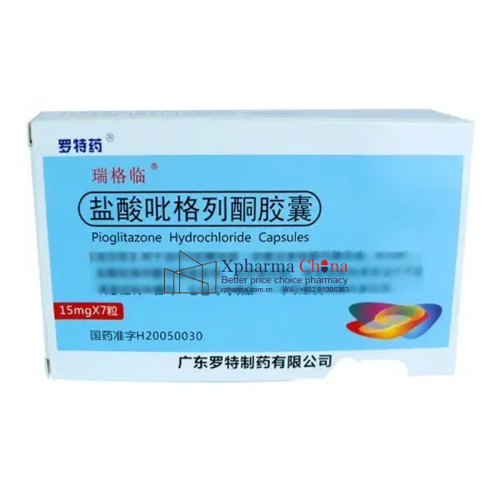
Ruigelin Pioglitazone Hydrochloride Capsules
Brand Name: 瑞格临®(Ruigelin®)
Generic Name: Pioglitazone Hydrochloride
Strength: 15 mg per capsule, 7 capsules per box
Manufacturer: Guangdong Luote Pharmaceutical Co., Ltd.
Marketing Authorization Holder: Guangdong Luote Pharmaceutical Co., Ltd.
Approval Date in China: 2005‑03‑21
Registration Number: 国药准字 H20050030
Storage: Store in a sealed, dry place, protected from light.
Price&Cost:Contact Us now for the best price of Pioglitazone Hydrochloride(Ruigelin)
Only logged in customers who have purchased this product may leave a review.

Reviews
There are no reviews yet.