- Indications and Usage Hereditary Transthyretin-mediated Amyloidosis (hATTR): Indicated for the treatment of adult and pediatric patients 1 year of age and older with hereditary transthyretin-mediated amyloidosis (hATTR).
- Dosage and Administration Recommended Dosage: For the first year of treatment, the recommended dosage is 20 mg taken orally once daily. For the second year and beyond, the recommended dosage is reduced to 10 mg taken once daily. Administration: The capsules should be swallowed whole with water. They can be taken with or without food. Dose Management: The dosage reduction from 20 mg to 10 mg is intended to minimize gastrointestinal side effects and reduce the risk of developing neutralizing antibodies against the drug after long-term use.
- Mechanism of Action Stabilization Mechanism: Tafamidis is a selective transthyretin (TTR) kinetic inhibitor. It functions by binding to the thyroxine-binding sites of the TTR tetramer and stabilizing its structure. Pathogenetic Blockade: By preventing the dissociation of the TTR tetramer into monomers, tafamidis inhibits the formation of amyloid fibrils, thereby slowing the progression of cardiac and neurological manifestations of the disease.
- Safety and Warnings Gastrointestinal Disorders: The efficacy of tafamidis may be reduced due to the formation of neutralizing antibodies over time, often necessitating the dosage tapering protocol. Hypersensitivity: Severe hypersensitivity reactions have been reported, though they are rare. Pregnancy and Breastfeeding:
- Adverse Reactions and Clinical Research Cardiac Safety: The CAPTAIN-AIM trial demonstrated significant structural and functional cardiac benefits, as the primary efficacy endpoint was established based on cardiac outcomes. Neurological Safety: The ATTR-ACT and NAPHR tracer-512-096 (NAPHR) trials showed a reduction in neuropathy, particularly in patients with lower baseline neuropathy scores. Clinical Research Results: Clinical studies have consistently shown that tafamidis delays disease progression in both cardiac and neurological domains across various hATTR variants.
- Drug Interactions CYP Interactions: Tafamidis is metabolized via UGT1A1 and UGT1A3. It is not a substrate of CYP450 enzymes, making interactions with CYP inhibitors or inducers unlikely. P-gp Interactions: Tafamidis is not a substrate, inhibitor, or inducer of P-glycoprotein (P-gp). Protein Binding: Tafamidis is highly bound to plasma proteins, primarily albumin. However, the clinical significance of displacement interactions is low given its pharmacokinetic properties.
- Pharmaceutical Information Active Ingredient: Tafamidis (as meglumine salt). Dosage Forms: 20 mg and 10 mg soft capsules. Storage: Store at 20°C to 25°C (68°F to 77°F) in the original package to protect from moisture and light.
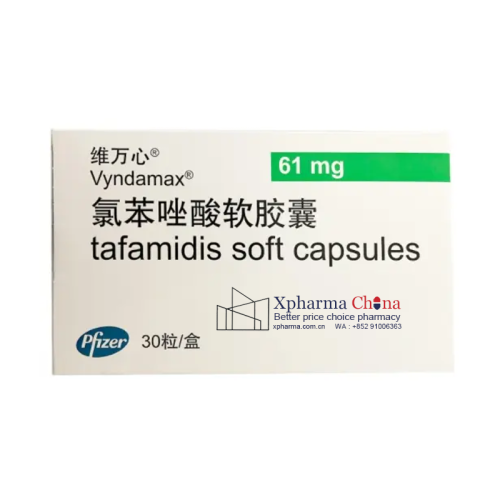
Weiwanxin Tafamidis Soft Capsules
Brand Name: 维万心 ®(Weiwanxin®)
Generic Name: Tafamidis
Strength: 61 mg per soft capsule, 30 capsules per box
Manufacturer: Catalent Pharma Solutions, LLC
Marketing Authorization Holder: Pfizer Europe MA EEIG
Approval Date in China: October 09, 2020
Registration Number: 国药准字HJ20200041
Storage: Store tightly sealed at controlled room temperature between 15°C and 30°C, protected from light and moisture. Refer to the full package insert for detailed storage specifications.
Price&Cost:Contact Us now for the best price of Tafamidis(Weiwanxin)
Only logged in customers who have purchased this product may leave a review.
Reviews
There are no reviews yet.