1. Indications and Usage
Hyperuricemia in Gout: Long-term management of hyperuricemia in patients with gout.
Not for Asymptomatic: Not recommended for the treatment of asymptomatic hyperuricemia.
2. Dosage and Administration
Starting Dose: The recommended starting dose is 20 mg once daily to avoid precipitating acute gouty arthritis due to rapid lowering of serum uric acid.
Maintenance and Titration: The dose can be gradually increased every 4 weeks based on serum uric acid levels, up to a maximum of 80 mg once daily.
Administration: Administer without regard to food or antacids.
Special Populations: No dose adjustment is needed for mild to moderate hepatic or renal impairment. Use with caution in severe hepatic (Child-Pugh C) or severe renal impairment (Clcr <30 mL/min) due to lack of sufficient safety data.
3. Mechanism of Action
Xanthine Oxidase Inhibition: Febuxostat selectively inhibits xanthine oxidase, the enzyme responsible for converting hypoxanthine to xanthine and xanthine to uric acid.
Uric Acid Reduction: By blocking this pathway, it effectively lowers serum and urinary uric acid levels without affecting other purine or pyrimidine synthesis pathways.
4. Safety and Warnings
Cardiovascular Risk: Febuxostat may increase the risk of cardiovascular death, myocardial infarction, and stroke. It should be used with caution in patients with a history of cardiovascular disease.
Hepatotoxicity: Serious liver injury, including liver failure and jaundice, has been reported. Liver function tests should be monitored, particularly at the initiation of therapy.
Acute Gout Flares: Rapid lowering of uric acid levels during the initial treatment phase can precipitate acute gout attacks. Prophylaxis with colchicine or NSAIDs is often recommended for the first 6 months.
Severe Skin Reactions: Severe cutaneous adverse reactions, such as Stevens-Johnson syndrome, have been reported.
5. Adverse Reactions and Clinical Research
Common Adverse Reactions: Liver function abnormalities, nausea, arthralgia, and rash.
Clinical Research: Clinical trials have demonstrated that Febuxostat significantly lowers serum uric acid levels and reduces the frequency of acute gout flares compared to placebo or other hypouricemic agents.
6. Drug Interactions
Azathioprine and Mercaptopurine: Contraindicated. Inhibition of xanthine oxidase by Febuxostat increases the plasma concentrations of these drugs, leading to enhanced bone marrow suppression.
Theophylline: Use with caution. Febuxostat alters the metabolism of theophylline (a substrate of xanthine oxidase), potentially leading to drug accumulation.
Other Substrates: Caution is advised when co-administered with other xanthine oxidase substrates such as cytarabine and didanosine.
7. Pharmaceutical Information
Active Ingredient: Febuxostat.
Appearance: White to off-white film-coated tablets.
Storage: Store at controlled room temperature. Protect from moisture.
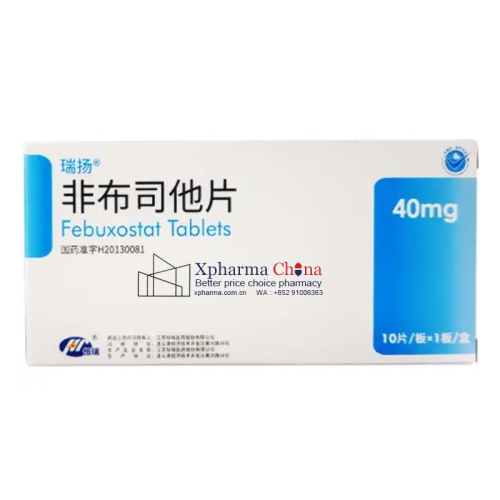
Ruiyang Febuxostat Tablets
Brand Name: 瑞扬®(Ruiyang®)
Generic Name: Febuxostat
Strength: 40 mg per tablet, 1 blister × 10 tablets per box
Manufacturer: Chengdu Shengdi Pharmaceutical Co., Ltd. (Commissioned by Jiangsu Hengrui Medicine Co., Ltd.)
Marketing Authorization Holder: Jiangsu Hengrui Medicine Co., Ltd.
Approval Date in China: 2013
Registration Number: 国药准字H20130081
Storage: Seal tightly, protect from light, store at temperature not exceeding 25°C; keep out of reach of children, follow full storage instructions in the package insert
Price&Cost:Contact Us now for the best price of Febuxostat(Ruiyang)
Only logged in customers who have purchased this product may leave a review.

Reviews
There are no reviews yet.